

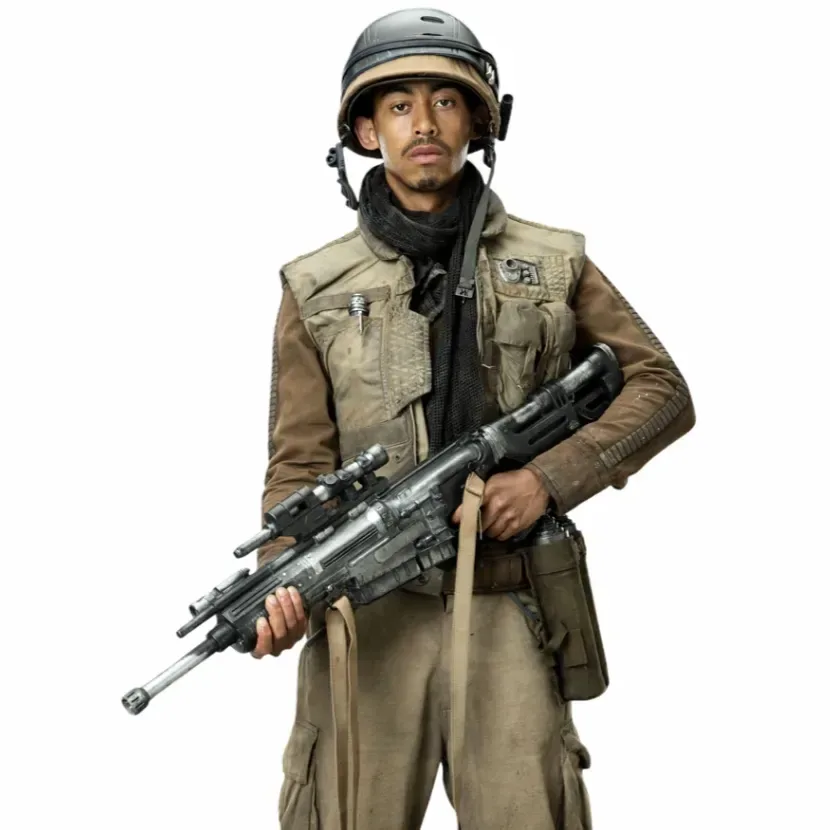
Jordan Stephens has said he chose not to return to the Star Wars universe for Andor after being told he would need to cut off his dreadlocks for the production. Stephens, who appeared in Rogue One: A Star Wars Story as Rebel Alliance soldier Corporal Tonc, said the requested change was framed as necessary for the character to look believable during military-training scenes.
The actor and musician, also known as one half of UK rap duo Rizzle Kicks, said the proposed return would have been a brief commitment. But it involved cutting locks he had been growing for seven years, a sacrifice he was not prepared to make for a single day of filming and what he described as very little money.
Stephens discussed the experience in an interview with Zeteo. His central objection was not simply that he was asked to alter his appearance. He questioned the reasoning that dreadlocks would undermine realism in a franchise built around alien worlds, fantastical creatures, spaceships, and lightsabers.
A helmet did not settle the issue
Corporal Tonc was one of the Rebel fighters seen in Rogue One, the 2016 film set immediately before the events of the original Star Wars. Although Tonc dies during the movie, Stephens said he and other performers were invited to return for the later prequel series Andor, which expanded the era's political conflict and Rebel operations.
For useful background on this topic, read Official Sonic Discord Opens to Immediate Moderation Challenges.
Stephens explained that Tonc wore a helmet throughout his prior screen appearance. Because of that, he initially believed his hairstyle should not pose a problem if the costume returned as well. His recollection is that production plans instead included scenes in which the army would be training, requiring a more conventional military look without the helmet.
Stephens said he argued that a setting featuring an intergalactic war, giant slugs, and swords made of light should not treat a soldier's dreadlocks as the element that breaks audience immersion.
He said the explanation offered to him was that the hair would not be "realistic" within the intended army presentation. For Stephens, that logic was too difficult to accept. He ultimately declined to participate rather than remove hair he had spent years growing.
The disagreement also speaks to a recurring tension in large fictional productions: the difference between internal visual rules and assumptions imported from real-world institutions. A production may seek uniformity in a military unit's costumes, grooming, and silhouette. Yet Star Wars has never been a setting defined by strict realism in the conventional sense. Its worlds have always featured a wide range of species, clothing traditions, hairstyles, cybernetic enhancements, and individualized character designs.
Why the decision matters beyond one small role
Stephens' part in Rogue One was not among the film's most prominent roles, but the circumstances are notable because Andor made its reputation by giving texture to characters and institutions operating at the edges of the saga. The series revisited the years before Rogue One and spent considerable time on the ordinary people, workers, prisoners, soldiers, intelligence officers, and rebels caught up in the Empire's reach.
That focus made room for familiar faces and smaller supporting players to gain additional context. Stephens said Tonc's potential return was part of that broader effort. His decision meant the character was not included in the series, but it also raises questions about whose appearances are considered natural or acceptable when fictional universes aim to portray diverse populations.
Hair has long carried cultural, personal, and professional significance, particularly for Black performers. Requests involving dreadlocks can therefore extend beyond an ordinary costume adjustment. Stephens' account makes clear that he viewed the request as disproportionate, especially considering the short filming commitment, the length of time he had grown his hair, and the fantastical setting in which the role existed.
His point is strengthened by Star Wars' own history. The franchise has not established a rule that characters cannot have dreadlocks. Jedi Master Quinlan Vos, for example, is depicted with dreadlocks in the animated Star Wars: The Clone Wars. Across films, animation, games, novels, and comics, Star Wars has repeatedly used distinct hair, clothing, tattoos, and cultural markers to help individual characters stand out in a galaxy meant to encompass countless peoples and planets.
Andor's grounded tone does not mean ordinary realism
Andor is often described as one of the more grounded live-action Star Wars stories. Its approach emphasizes surveillance, political repression, labor, espionage, and the difficult compromises behind organized rebellion. It generally uses a restrained visual style compared with stories centered on Jedi, Force powers, and galaxy-spanning mystical threats.
Still, grounded storytelling is not the same as demanding narrow real-world standards of appearance. The series takes place in the same galaxy as aliens, droids, hyperspace travel, and the Death Star. Its stronger emphasis on believable political stakes may explain why production wanted military training scenes to communicate discipline and order, but Stephens' experience shows how such instincts can lead to arbitrary boundaries.
Even in real military organizations, grooming policies are not fixed across every time, place, or culture. In a fictional rebellion assembled from countless worlds, it is difficult to argue that one hairstyle would inherently read as implausible. Stephens' frustration appears to stem from that contradiction: a story can ask audiences to accept enormous fictional concepts, then decide that dreadlocks are where believability ends.
Costume design is, of course, a collaborative and practical process. Productions consider continuity, period or worldbuilding details, stunt requirements, helmets, wigs, makeup, lighting, and the visual cohesion of a group. None of that erases the personal stakes of a request for an actor to make a lasting change to their own hair. In this case, Stephens said the trade-off did not make sense.
A missed return to a widely praised Star Wars story
The outcome was that Stephens did not reprise Corporal Tonc in Andor. That meant missing a chance to appear in a Star Wars series that has been broadly praised by viewers for its mature dramatic focus and detailed portrayal of rebellion under imperial rule.
For fans who recognize Tonc from Rogue One, the story also adds an unexpected footnote to the continuity between the film and the television series. The expansion of the Rogue One period brought back ideas, locations, and characters associated with the Rebel Alliance, but not every possible connection made it on screen. In this instance, it was not a scheduling issue, a narrative rewrite, or an ordinary casting decision that kept a returning character away. It was a disagreement over hair and the meaning of realism in a galaxy far, far away.
Stephens' comments are unlikely to settle the broader debate over what visual standards fictional military units should follow. They do, however, highlight why those decisions deserve scrutiny. "Authenticity" can be a useful creative goal, but it becomes far less convincing when it is applied selectively, particularly in a franchise whose identity rests on imagination and variety.
For Stephens, the matter came down to principle. He was not willing to cut seven years of hair for a small return appearance based on an explanation he found illogical. And in a fictional galaxy populated by beings of every imaginable shape and species, his question remains a straightforward one: why should dreadlocks be treated as too unrealistic?
Community
Discussion
Start the conversation.
No comments have been posted yet.