

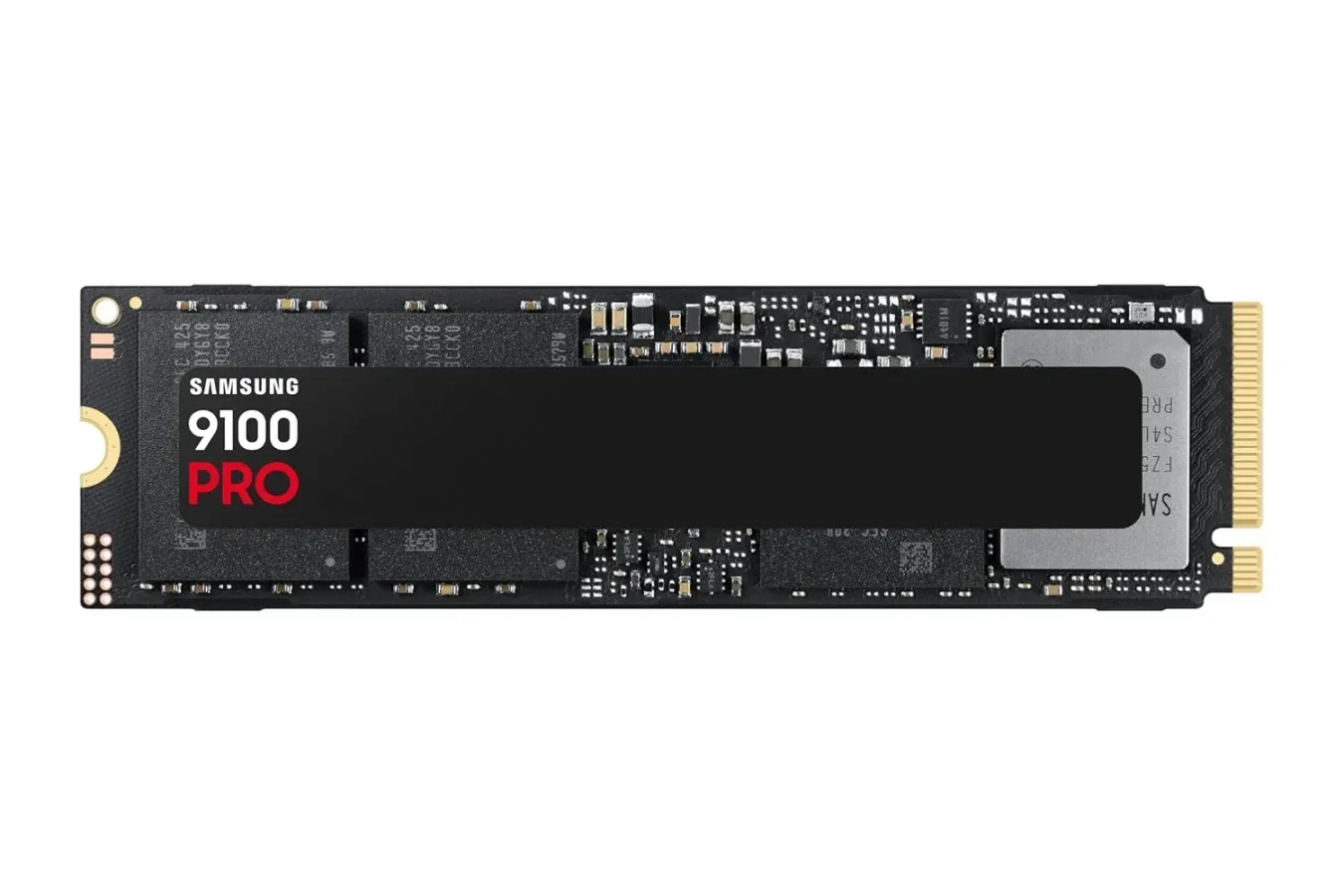
High-speed storage is becoming one of the more meaningful PC upgrades for players building a new machine, expanding a game library, or trying to make a workstation feel less constrained by huge files. Samsung's 9100 PRO 2TB is positioned at the premium end of that market, using the PCIe 5.0 interface and NVMe 2.0 to pursue transfer speeds well beyond those offered by older PCIe 4.0 drives. During Prime Big Deal Days, the 2TB model is listed at $350, reduced from a stated regular price of $680.
That is a $330 reduction, or 49% off. The offer applies to the standard M.2 2280 internal SSD, a common physical format for modern desktop motherboards and many upgradeable laptops. It is important, however, to separate the drive's maximum rated performance from what every PC can deliver. The 9100 PRO can be installed in systems with an appropriate M.2 slot, but users need a PCIe 5.0-capable platform to access its top-tier bandwidth.
A Gen 5 SSD built for demanding PC workloads
The Samsung 9100 PRO 2TB is a PCIe 5.0 x4 NVMe drive with sequential read speeds rated at up to 14,700 MB/s and sequential writes rated at up to 13,400 MB/s. Those figures make clear what kind of hardware this SSD is aimed at: PCs that regularly move large files, load expansive games, edit high-resolution media, or handle data-heavy local applications.
For gaming, storage speed is not a universal cure for low frame rates. A faster SSD will not replace a stronger graphics card or processor, and game engines differ widely in how much they benefit from rapid storage. Still, a capable NVMe drive can improve the daily experience around a game library. That includes installing large titles, copying files, applying patches, loading saved data, and reducing wait times in games designed to stream assets aggressively.
For useful background on this topic, read Warhammer Survivors Launches November 10 With New PC and Xbox Demo Available Now.
The capacity matters as much as the interface. Modern PC games can occupy well over 100GB each, particularly when high-resolution texture packs, expansions, and frequent updates are included. A 2TB drive gives users considerably more flexibility than a 1TB model when it is expected to hold an operating system, core applications, active projects, and a rotating selection of large games at the same time.
What the headline speed ratings mean
Sequential performance is generally most relevant when data is read or written in long, continuous blocks. Copying a large video file, moving a substantial game installation, opening a sizable project archive, or transferring footage can be examples of workloads where high sequential throughput is useful. The 9100 PRO's advertised 14,700 MB/s read rating and 13,400 MB/s write rating place it in the newest generation of consumer SSD performance.
Samsung also rates the 2TB model at up to 1,850K random read IOPS and 2,600K random write IOPS. Random performance describes a different kind of activity: accessing many small pieces of information in different locations rather than processing one large uninterrupted file. This is relevant to routine operating system behavior, application launches, multitasking, caches, and software that constantly reads and writes smaller data blocks.
In practical use, real-world results depend on more than the SSD's label. The motherboard, CPU platform, cooling arrangement, available PCIe lanes, firmware, operating system, file type, and workload can all affect observed speeds. A Gen 4 system may still use the drive where compatibility allows, but it will not provide the full Gen 5 transfer ceiling. Buyers looking specifically for the highest possible performance should verify that their motherboard has a PCIe 5.0 M.2 slot and consult its documentation for lane-sharing considerations.
Samsung's controller, NAND, and cache configuration
The 9100 PRO uses Samsung's in-house Presto controller, built on a 5-nanometer process, alongside eighth-generation V-NAND TLC flash memory. TLC, or triple-level cell NAND, is widely used in higher-capacity consumer SSDs because it balances density, performance, and endurance. Samsung also includes a 2GB LPDDR4X cache on the 2TB model to help maintain responsive behavior under heavier workloads.
For players, the technical breakdown is less important than the intended outcome: fast access to the data stored on the drive. For creators and power users, though, these components provide useful context. Editing applications, image libraries, virtual machines, software development tools, and local AI workflows can all create situations where storage is repeatedly asked to retrieve or save substantial quantities of data.
Samsung identifies the drive as an option for local AI applications and models as well. Those workloads can involve large files and repeated loading or saving activity, though the full experience will naturally depend on the rest of the PC, including system memory and graphics hardware where applicable. The SSD can help reduce storage-related waiting, but it is only one part of a machine built for that purpose.
Endurance, encryption, and long-session cooling
The 2TB 9100 PRO carries an endurance rating of 1,200 terabytes written, often shortened to 1,200 TBW. That rating is an estimate of the amount of data the drive can be written with over its supported service life. It is particularly relevant for users who frequently export video, work with raw media, maintain large project files, or otherwise write data at a high volume.
Samsung backs the drive with a five-year limited warranty. As with any storage purchase, prospective owners should review the warranty terms and conditions, including coverage limits and the relationship between the warranty period and the endurance rating. Regular backups also remain essential. A fast internal SSD is valuable, but it is not a substitute for maintaining copies of irreplaceable save files, work projects, photos, or other personal data elsewhere.
The drive also includes AES 256-bit hardware-based encryption for data protection. That capability can matter to users storing sensitive documents or professional assets, although encryption setup and operating system support should be considered before relying on it as part of a broader security plan.
Thermals are another major consideration with PCIe 5.0 storage. Pushing this much bandwidth can generate heat, especially during sustained transfers. The 9100 PRO includes power and thermal management features intended to keep performance stable during longer workloads and extended gaming sessions. Even so, PC builders should check whether their motherboard provides an M.2 heatsink and make sure the drive has suitable airflow. In a tightly packed system, installation and cooling choices can influence sustained behavior more than brief benchmark runs suggest.
Who should consider the 2TB Samsung 9100 PRO?
At its discounted $350 price, the 9100 PRO 2TB is most compelling for users who already own, or are actively building, a PCIe 5.0-equipped PC. That includes enthusiasts planning a top-end gaming system, video editors working with large footage files, and creators or developers who want rapid access to large local projects.
It can also make sense for someone who wants a high-capacity primary drive rather than splitting their software and game collection among multiple smaller disks. A single 2TB SSD can simplify storage management while leaving room for an operating system, applications, a substantial library, and active creative files. Users upgrading from a SATA SSD or older hard drive should see a dramatic increase in general responsiveness, though moving from a good Gen 4 NVMe drive to Gen 5 will produce a more workload-dependent difference.
For budget-focused gaming builds, the calculation is less straightforward. A lower-cost PCIe 4.0 SSD can still provide excellent game loading performance and may free up money for other components. The 9100 PRO is not merely about getting an SSD into a PC; it is about buying into a premium performance tier and having the platform capable of taking advantage of it.
Compatibility checks to make before purchasing
- Confirm the M.2 slot: The drive uses the M.2 2280 form factor, so verify that the target system has a compatible M.2 slot.
- Check PCIe generation support: PCIe 5.0 x4 support is needed to pursue the drive's stated peak speeds.
- Review motherboard lane allocation: Some platforms share lanes between M.2 slots and other components, which can affect configuration options.
- Plan for cooling: Use a motherboard M.2 heatsink where available and ensure the installation has adequate airflow.
- Consider the workload: Gen 5 bandwidth is most valuable for sustained large transfers and demanding professional tasks, rather than every everyday activity.
Samsung's Magician software is included as part of the broader drive ecosystem. It can be used to monitor SSD health, check for firmware updates, and access performance optimization options. Firmware maintenance can be worthwhile for any modern storage device, especially for users who expect it to serve as a primary drive over several years.
The Prime Big Deal Days listing puts the Samsung 9100 PRO 2TB at a much lower price than its stated $680 regular cost. For a compatible PCIe 5.0 PC, the combination of 2TB capacity, very high rated sequential throughput, strong random I/O figures, 1,200 TBW endurance, encryption support, and a five-year limited warranty makes it a notable high-end storage option. Buyers should still confirm the final price at checkout and make sure their system can use the hardware effectively before treating the discount as an automatic upgrade decision.
Community
Discussion
Start the conversation.
No comments have been posted yet.