

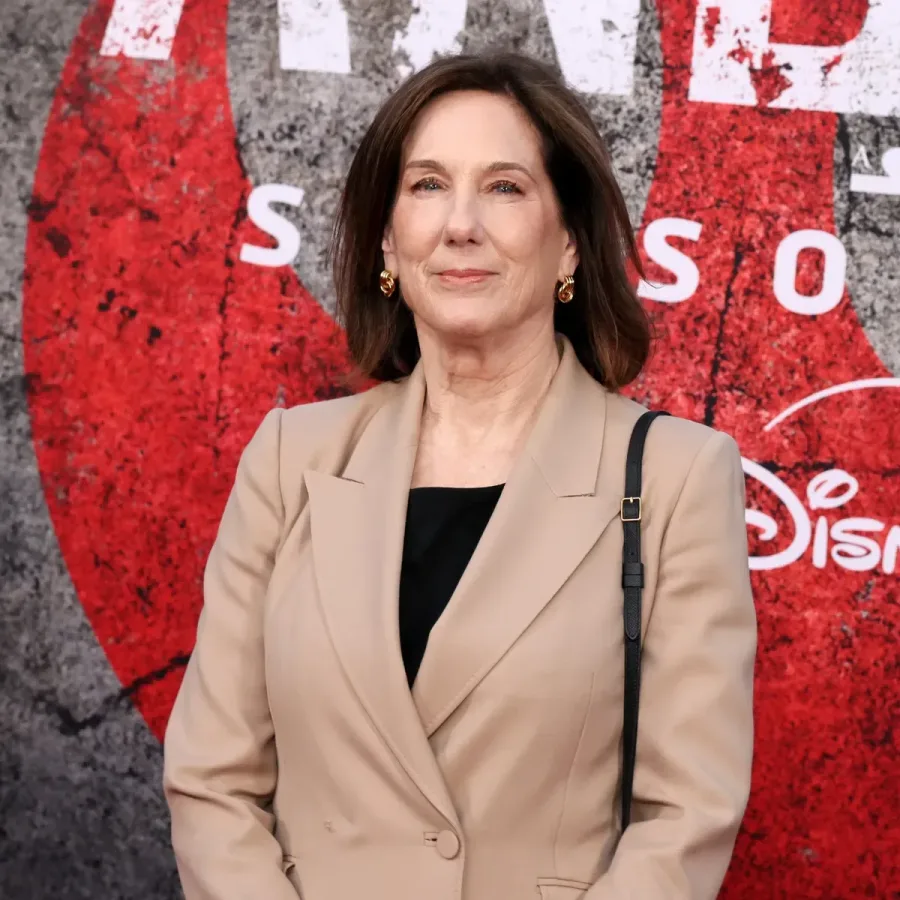
Kathleen Kennedy has reflected on her departure from Lucasfilm, saying she feels "a bit of relief" after a long tenure overseeing Star Wars. Speaking at the Bloomberg Screentime event in Los Angeles, Kennedy acknowledged the immense pressure attached to leading one of entertainment's most enduring and intensely scrutinized franchises.
Her comments arrive after 14 years in charge of Lucasfilm, a period that saw the company move through a Disney acquisition, a new theatrical sequel trilogy, the rapid expansion of Disney+ programming, and an unusually large collection of announced, delayed, reshaped, and abandoned projects. Kennedy took the helm of Lucasfilm in 2002 from Star Wars creator George Lucas, inheriting a creative institution with a fan community that spans generations.
"I suppose there's a bit of relief," Kennedy said of the decision to step down. "These jobs are not easy and stepping into something like that that George had created was an incredible challenge."
That assessment captures the central tension of the Kennedy era. Star Wars remains a massive commercial and cultural force, but it is also a property where every creative choice is examined in exceptional detail. The franchise's modern history under Kennedy included major successes across film and streaming, alongside sharp fan disagreements, significant production changes, and a development slate that often shifted before reaching screens.
For useful background on this topic, read GTA 6 Receives Mature ESRB Rating as Launch Draws Near.
A tenure defined by expansion and pressure
Lucasfilm's transition into the Disney era fundamentally changed the scale and pace of Star Wars. The sequel trilogy brought the series back to cinemas with The Force Awakens, followed by The Last Jedi and The Rise of Skywalker. While the three films attracted substantial debate and the final chapter in particular met a fierce backlash, the trilogy generated billions of dollars worldwide.
Beyond the movies, the franchise became a major part of Disney's streaming plans. The early seasons of The Mandalorian emerged as a defining success for Disney+, introducing Grogu to a global audience and showing that the galaxy far, far away could sustain serialized live-action television. Andor, meanwhile, earned considerable critical praise for its more grounded political drama and its focused exploration of rebellion under the Empire.
Those successes did not make the wider task straightforward. Kennedy said that balancing the demands of longtime fans with the need to make something fresh has been the hardest part of the job.
"Certainly something that's been around now for 50 years. You've got people where this means a lot to them," Kennedy said. "But at the same time, the challenge is to try to create something new, something original. So finding that balance is really the toughest thing."
That balance is especially difficult for a franchise built on nostalgia while also depending on forward momentum. Audiences want recognizable worlds, characters, music, ships, and mythology. Yet repeating familiar material too closely can lead to complaints that the series is standing still. Pushing into new territory, on the other hand, can bring resistance from viewers with deeply held ideas about what Star Wars should be.
For Kennedy, that challenge played out across every format. The theatrical releases had to meet blockbuster expectations. Streaming shows needed to establish distinct identities while still fitting into the franchise's sprawling continuity. Every rumored or announced project invited immediate interest and, frequently, immediate judgment.
Films that changed course--and projects that never arrived
Some of the most visible turbulence of Kennedy's tenure occurred behind the scenes of the films themselves. Solo: A Star Wars Story struggled commercially and was notably complicated during production. Directors Phil Lord and Chris Miller left the project partway through filming, with Ron Howard taking over. The film's production history became one of the clearest examples of Lucasfilm's willingness to make dramatic creative changes when it believed a project needed a different direction.
Rogue One: A Star Wars Story, despite ultimately becoming a hit, also went through extensive work during its final stages. Gareth Edwards was reportedly replaced for reshoots. Development on the final sequel-trilogy installment changed as well, with Colin Trevorrow departing Episode IX before the film became The Rise of Skywalker.
Then there is the considerable list of concepts that were discussed, announced, or known to be in development but did not become finished releases. These include The Hunt for Ben Solo, a trilogy from Game of Thrones showrunners D.B. Weiss and David Benioff, a separate trilogy planned with The Last Jedi director Rian Johnson, and a Knights of the Old Republic concept that may have launched another trilogy. For gaming audiences, the latter remains particularly notable because the Old Republic era has long been viewed as one of the richest corners of the wider Star Wars universe.
Other talent linked to possible Star Wars work over the years included Marvel Studios head Kevin Feige, Luke Cage writer Matt Owens, filmmaker David Fincher, and comedian Simon Farnaby. The scale of that list illustrates both Lucasfilm's ambition and the difficulty of getting large-scale franchise ideas from early development through to production.
Kennedy framed that reality as part of the broader movie business rather than an issue unique to Star Wars. Not every pitch becomes a completed film, and not every completed film lands in exactly the same way with audiences.
"I mean, I don't think you can do anything in terms of the movie business where every single thing is going to be a perfect hit," Kennedy said. "I think you learn things, I always like learning things from the movies that we do, the post-mortems we do on what worked, what didn't. But I'm always proud of the work that's been done."
What remains on the Star Wars slate
Kennedy's exit does not resolve the uncertainty surrounding the current feature-film lineup. Several projects developed during her time remain associated with Lucasfilm, although it is unclear which will ultimately move forward. Simon Kinberg appears to have been given the opportunity to make Episodes 10 through 12, a development that could substantially define the franchise's theatrical direction.
Other ideas still connected to the slate include Sharmeen Obaid-Chinoy's film continuing Rey's story, Dave Filoni's planned feature intended to conclude the interconnected "Mandoverse" storyline, and James Mangold's Dawn of the Jedi project. Taika Waititi's long-discussed Star Wars movie also remains in the conversation, as does Patty Jenkins' long-gestating Rogue Squadron. A project involving Donald Glover's return as Lando Calrissian is likewise among the concepts that have yet to receive a definitive release path.
Each project represents a different answer to the question Kennedy identified: how does Star Wars continue evolving? A Rey continuation would build directly from the sequel era. Filoni's film could capitalize on a television-led narrative that has attracted a committed audience. Mangold's project has the potential to travel far deeper into the franchise's fictional past, while Rogue Squadron could emphasize the aerial action that has always been central to the series' identity.
Still, the franchise's recent history suggests that fans should treat any long-term development slate with some caution until cameras are rolling and a final plan is in place. Lucasfilm has repeatedly shown that concepts can be reworked, delayed, or replaced as creative priorities change.
The next chapter begins soon
Despite the questions around the long-range film strategy, Star Wars has clear near-term plans. Ryan Gosling's Star Wars: Starfighter is set to continue the franchise next year, alongside Ahsoka Season 2. Those projects will offer an early indication of how Lucasfilm's next phase approaches the mixture of familiar characters, newer stories, theatrical spectacle, and streaming continuity.
Kennedy leaves behind a complicated legacy because the job itself was complicated. Her tenure produced some of the franchise's biggest modern commercial moments and some of its best-regarded television, while also becoming synonymous with the difficulties of managing a vast franchise in an era of instant reaction and continuously escalating audience expectations.
Her remarks do not attempt to present the period as flawless. Instead, they acknowledge the burden of the role, the inevitability of missteps, and the importance of learning from projects that succeeded as well as those that struggled. For a series approaching half a century of storytelling, that may be the defining challenge for whoever shapes its future: honoring what audiences already love without allowing the galaxy to stop moving forward.
Community
Discussion
Start the conversation.
No comments have been posted yet.