

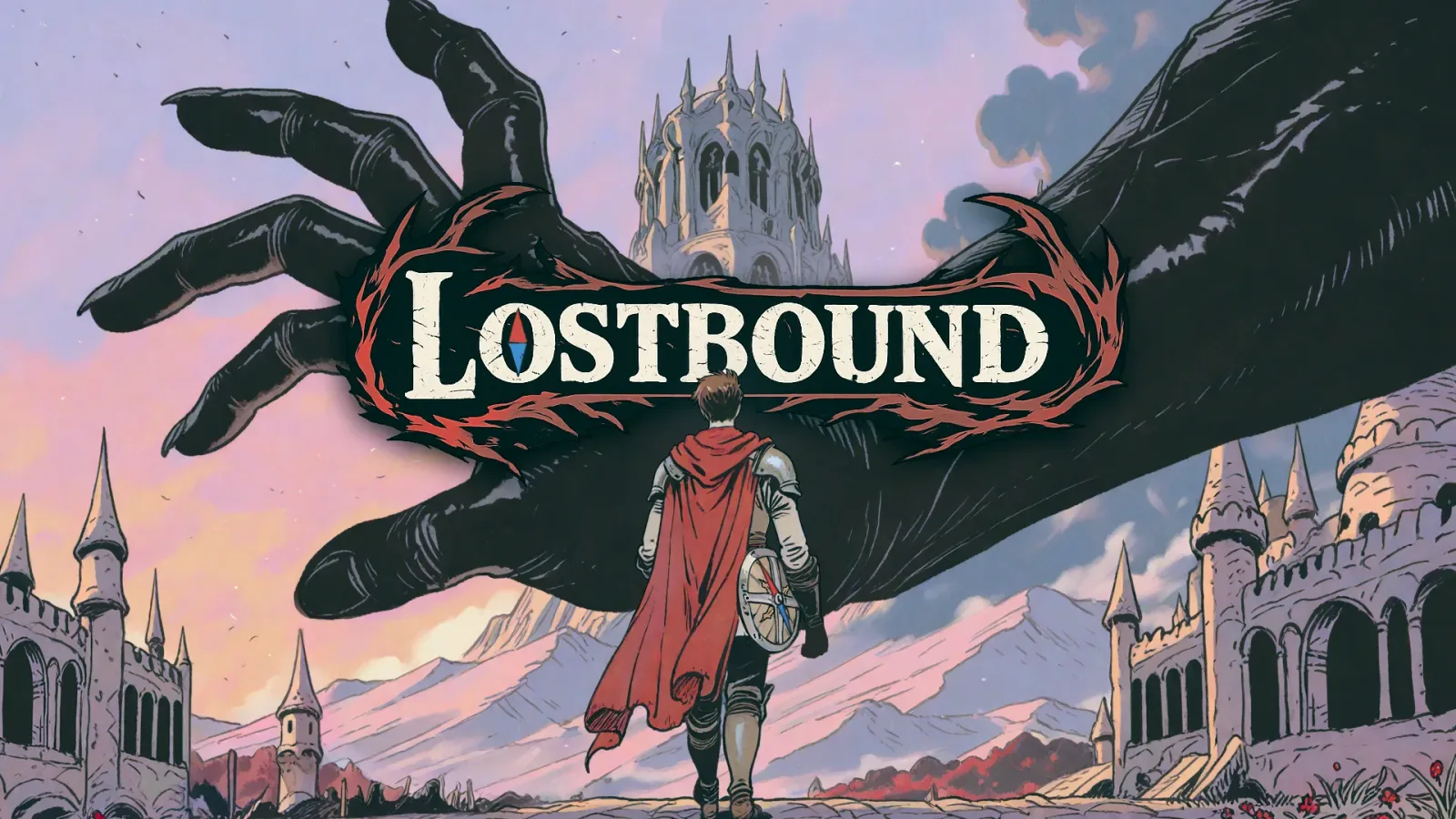
Lostbound, the dark roguelite action RPG from developer Tenkarider and publisher Tambù Digital, is scheduled to launch for PC through Steam on October 6, 2026. The game's central idea is not merely surviving hostile dungeons or assembling a powerful build. Players will also need to escape a world that progressively disappears behind them.
That pressure comes from an ominous presence called The Hand. As players explore Lostbound's nonlinear environments, The Hand remains in pursuit, destroying routes that have already been travelled. The result is a structure built around momentum, adaptation, and difficult calls: continue into the unknown in search of something valuable, or turn back before an escape route is gone for good.
A free demo is already available, giving PC players an opportunity to try the game's exploration, dungeon-delving, and the ever-present threat created by The Hand before the full Steam release arrives.
A roguelite where the map is part of the danger
Roguelites frequently create tension through limited health, dangerous enemies, randomized rewards, and the possibility of losing a run. Lostbound adds another major concern to that familiar formula: the physical reliability of the world itself. Previously explored paths are not necessarily safe passages that can be used indefinitely. The Hand's pursuit means the ground covered earlier can be erased from the player's options.
For useful background on this topic, read Lawn Mowing Simulator 2 Launches on PC, PS5 and Xbox Series X|S.
That distinction gives exploration a different weight. In many action RPGs, backtracking is a useful tool for recovering resources, checking alternate routes, or returning to a known safe area. Lostbound instead asks players to treat time and movement as resources. A promising side route may contain an Artifact, a secret, or a reward, but it may also leave less room to retreat if the journey becomes too dangerous.
The announced design places particular emphasis on making choices under pressure. The Hand is not described simply as an enemy waiting at the end of a dungeon. It is a persistent force that reshapes the player's relationship with the world as a run unfolds. Rather than clearing an area and assuming it will remain accessible, players must decide how much risk they can accept before the world closes in.
Nightfall is another component of this escalating survival loop. Players will need to manage both time and resources as night approaches and The Hand draws closer. This establishes a rhythm in which an expedition is not only about combat ability. The question of whether there is enough time to search further, fight through another challenge, or safely change direction can be as meaningful as choosing which enemy to engage first.
Nonlinear exploration with retro-inspired foundations
Lostbound combines roguelite progression with retro-inspired nonlinear exploration. The game's world is designed around the appeal of uncovering routes, descending into dangerous locations, and looking for secrets rather than simply following a fixed corridor from one objective to the next.
Nonlinear structure is especially significant in a game where routes can be lost. It suggests that navigation will be a key part of every run, with the player weighing the value of multiple possible directions while facing a threat that limits how long any choice can be postponed. The overall setup turns the map into a strategic puzzle, not just a backdrop for combat.
The darker tone also extends to the game's dungeons. These areas are said to contain enemies, traps, secrets, and rewards, presenting concentrated risks for players who choose to delve deeper. Dungeons can offer valuable opportunities, but Lostbound's wider pursuit mechanic means a reward is never entirely separate from the cost of obtaining it. Time spent investigating a hostile chamber may change the conditions of the route back out.
This approach could make knowledge gained during unsuccessful runs particularly valuable. Learning where dangers tend to emerge, recognizing when a route is becoming too costly, and understanding how much can reasonably be explored before The Hand catches up are all positioned as parts of the intended experience. The game emphasizes learning and adapting across runs, placing player judgment at the center of its progression loop.
Artifacts create room for changing builds
Build experimentation will come through Artifacts, which are placed randomly across the game's world. These items modify a player's build and are intended to make individual attempts feel different from one another. Instead of relying on the exact same path and character setup every time, players will need to account for the Artifacts they discover during a given run.
Random placement is an important fit for Lostbound's broader risk-and-reward design. An Artifact may be located in a spot that is easy to reach, but it may also sit beyond traps, enemies, or a route that is becoming increasingly difficult to abandon. Since the game's environments crumble behind the player, finding an appealing item is only one half of the decision. Players must also consider what they are willing to give up, and whether the potential build change is worth the time required to claim it.
The announcement does not detail individual Artifact effects, combat classes, or specific weapon options. What it does establish is that artifacts are a major source of run-to-run variety. Their placement and their effect on builds are meant to encourage players to adjust rather than pursue a single guaranteed strategy.
That philosophy carries through to the game's roguelite progression more broadly. Lostbound is built around repeated attempts in which experience matters. Players are expected to become more capable not simply because they have seen more content, but because they have learned how to read the world's dangers, prioritize objectives, and respond when an intended plan becomes impossible.
Retreat can be as important as pressing onward
The most distinctive element of Lostbound's premise is the way it frames retreat. In many games, pulling back is a momentary response to low health or an overwhelming encounter. Here, retreating early may be a wider strategic decision made in response to dwindling time, dwindling resources, approaching night, or the knowledge that The Hand is removing the possibility of returning along a familiar path.
Conversely, choosing to push onward is not automatically reckless. There may be secrets to uncover, dungeon rewards to secure, and Artifacts that can fundamentally change a run. The tension comes from uncertainty. Players will not simply be deciding whether an enemy can be defeated; they will be deciding whether a destination can be reached and left behind before the world itself turns against them.
Lostbound's world does not merely contain danger. Its collapsing routes are designed to make every detour, advance, and escape route part of the challenge.
This combination of action RPG combat, dungeon hazards, randomized build elements, and persistent environmental pressure gives Lostbound a clear identity within the roguelite space. The game is not presented as an endurance test based only on surviving fights. It is also a contest against an advancing force that changes what survival means from moment to moment.
Demo available ahead of the full game
Players interested in seeing how these systems work in practice can already access the free Lostbound demo. It offers a preview of the game's setting, its exploratory structure, its dungeons, and the pressure created by The Hand. For a game built around timing and decision-making, hands-on play should be the clearest way to understand how quickly a worthwhile detour can become a dangerous commitment.
The demo also arrives well ahead of launch, leaving prospective players time to become familiar with the game's basic loop before the full version is released. Tenkarider and Tambù Digital have confirmed only the PC Steam version in the current announcement, with no additional platforms detailed.
Lostbound launches on PC via Steam on October 6, 2026. Until then, its available demo offers an early look at a roguelite adventure where every expedition must balance curiosity against urgency--and where the paths left behind may not remain there for long.
Community
Discussion
Start the conversation.
No comments have been posted yet.