

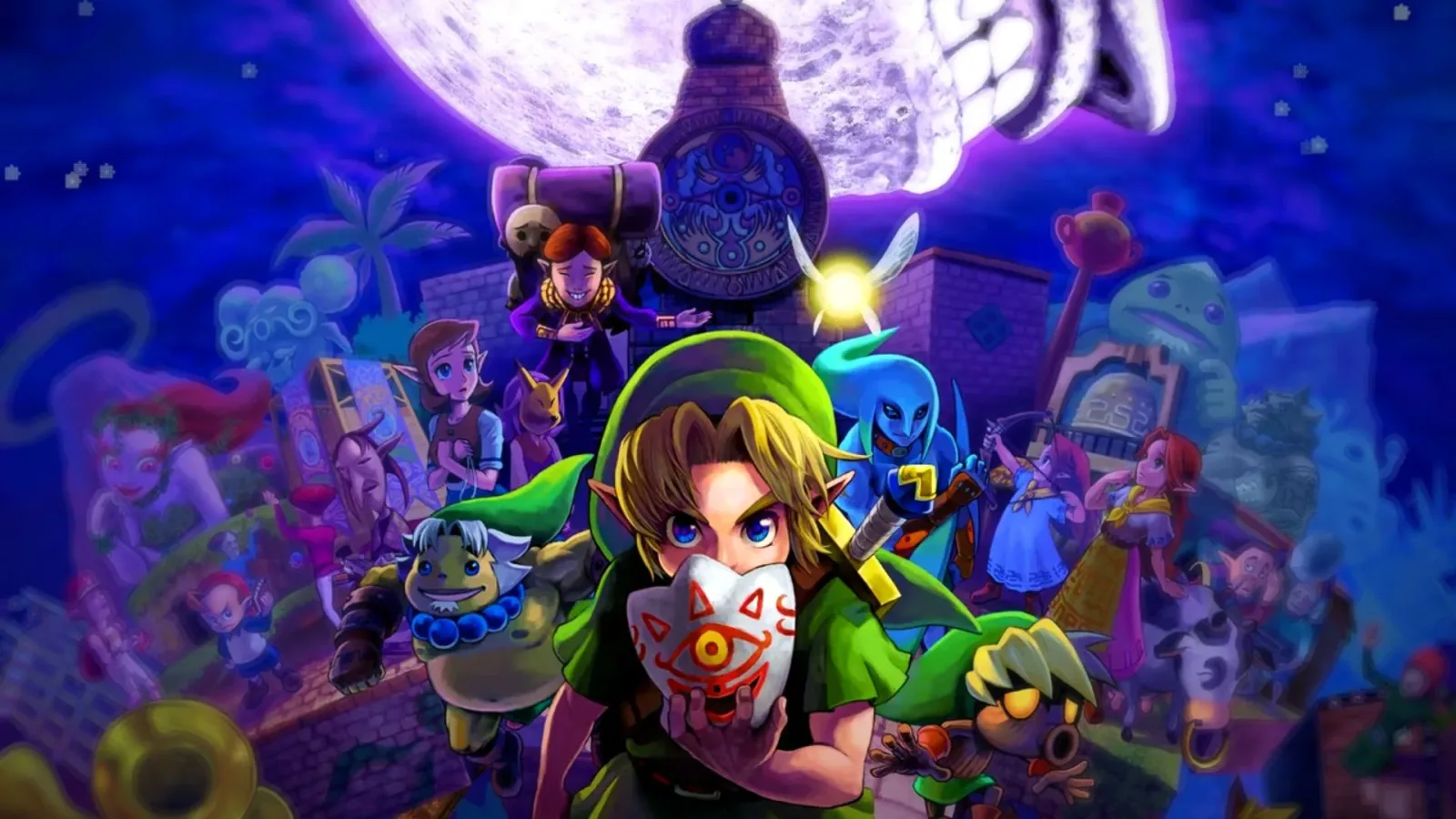
Fans hoping that The Legend of Zelda: Majora's Mask would swiftly follow Ocarina of Time back into the spotlight may need to reset their expectations. NateTheHate, a leaker who previously shared accurate Nintendo information including details connected to the recent Ocarina of Time remake, has said they have heard nothing that indicates a Majora's Mask remake is currently an active project.
The comment is not a formal denial from Nintendo, and it does not rule out a remake at some point in the future. But for a community that had begun to view Majora's Mask as the obvious next candidate, it is an important cooling-off moment. There is presently no announced Majora's Mask remake, no confirmed release window, and no indication that Nintendo intends to unveil one in the immediate future.
That absence is especially notable because Majora's Mask has long been seen as the natural companion piece to Ocarina of Time. The Nintendo 64 original was built as a direct sequel and famously reused technology, assets, and much of its foundation while taking the series in a radically stranger direction. A modern remake could theoretically benefit from a similar starting point after Ocarina of Time's renewed success. Yet the apparent lack of information around an active project suggests that assumption should not be treated as evidence.
Embedded X/Twitter post
A familiar hope meets an uncertain reality
When asked about the status of a Majora's Mask remake on social media, NateTheHate's response was narrow but direct: they had heard nothing to suggest such a project is currently active. The wording matters. Leakers generally have incomplete visibility into internal plans, particularly early work that may be tightly held, cancelled, or years away from public announcement. "Heard nothing" is not the same as "it will never happen."
For useful background on this topic, read Analogue 3D Firmware 1.6.0 Adds Wi-Fi and Automatic 3DOS Updates.
Still, it pushes back against the idea that a reveal is imminent. In the months following Ocarina of Time's remake, some fans had expected Nintendo to take a route comparable to publishers that have revisited connected classics in quick succession. Majora's Mask seemed particularly plausible because of its relationship with Ocarina of Time, its enduring reputation, and its ability to offer a markedly different adventure without leaving the same broad era of Zelda history.
The series' history makes that enthusiasm understandable. Majora's Mask first arrived as a follow-up to Ocarina of Time, but it was never simply more of the same. Link's journey takes him to Termina, a parallel world facing catastrophe as the moon looms overhead. Rather than following a conventional linear quest structure, the game revolves around a repeating three-day cycle. Players use the Ocarina of Time to return to the first day, retaining key progress while learning how people, places, and events change across a tightly scheduled world.
That structure has made Majora's Mask one of the most celebrated and debated Zelda games. Its tone is uneasy, intimate, and often melancholy. Its masks change Link's abilities and identity, while the central clock gives nearly every decision a sense of urgency. For some players, that pressure is exactly what makes the game memorable. For others, it is a barrier that makes an already unconventional Zelda adventure feel intimidating.
Why a remake still makes sense on paper
Even without evidence of an active project, a new Majora's Mask remake remains easy to imagine. Nintendo has already demonstrated that it is willing to revisit the game: The Legend of Zelda: Majora's Mask 3D released for Nintendo 3DS in 2015, following Ocarina of Time 3D in 2011. That earlier pairing established a clear precedent for updating both Nintendo 64 titles for a newer audience.
Majora's Mask 3D also showed how difficult the remake conversation can be. The 3DS version added visual improvements, touchscreen features, gyroscope aiming, and adjustments intended to make the time cycle and save system more approachable. At the same time, some long-time fans objected to changes affecting boss fights, movement options, and parts of the game's economy and progression. The debate revealed that even when the core story and world remain intact, seemingly practical quality-of-life changes can alter the feel of a game designed around planning, repetition, and limited time.
A future remake would face similar choices. Modern hardware could transform Termina with more expressive character animation, richer lighting, seamless environments, and a more detailed Clock Town. Better interface design could make NPC schedules, notebook clues, and cycle planning easier to understand. Accessibility features could help newcomers engage with an experience that asks them to fail, reset, and try again.
But those improvements would need to respect the defining tension at the heart of Majora's Mask. The moon is not merely an image in the sky; it is the game's constant threat. The three-day cycle is not just a gimmick; it is the structure that connects the world's many small tragedies, routines, and secrets. Removing or substantially weakening the time limit could make the game more immediately comfortable, but it could also undermine why Termina feels so distinct from Hyrule.
The timer is central to Majora's Mask's identity
Discussion around a possible remake has again raised the familiar question of whether Nintendo should soften the clock. There is a reasonable argument for giving players more options, clearer guidance, or settings that reduce frustration. Majora's Mask can be demanding, particularly for those encountering it without prior knowledge. Important events happen at particular times, side quests can require careful preparation, and dungeon progress may be interrupted by the need to reset the cycle.
Yet a full removal of the timer would be a much larger creative decision than a standard accessibility tweak. The deadline shapes the game's emotional language. It turns ordinary conversations into meaningful observations because players can see how individuals respond as disaster approaches. It gives each region a rhythm. It makes the act of returning to the first day emotionally complicated: Link restores possibility, but also leaves behind moments he has witnessed and relationships that will have to be rebuilt.
The strongest version of a remake would likely look for ways to make that design legible rather than erase it. Better event tracking, more transparent hints, flexible control options, and thoughtful saving systems could lower unnecessary friction. None of those ideas require turning Majora's Mask into a conventional open-ended adventure with no pressure. The game's unusual structure is a major part of why it still inspires such passionate reactions.
Nintendo's Zelda cadence leaves room for many possibilities
Although the current rumor picture offers little encouragement for an imminent Majora's Mask announcement, Zelda has remained a consistently active Nintendo franchise. Since 2013, the series has appeared in some form almost every year through new games, remasters, remakes, expansions, and Hyrule Warriors releases. The exception was 2022, when there was no new Zelda game, remake or remaster, or Hyrule Warriors entry.
That pattern does not guarantee that every beloved title will receive another remake, but it does show Nintendo's willingness to keep Zelda present between its largest original releases. Remakes are one way to do that. They can introduce landmark games to players who missed older hardware, preserve important works in a form suited to current systems, and provide a different kind of release alongside the enormous development cycles of all-new adventures.
At the same time, Nintendo's approach has never been entirely predictable. The company may choose to revisit a different Zelda era, focus on a new original project, expand another spin-off, or simply wait until it has a stronger reason to return to Termina. Development priorities can change, and even well-informed reports should be understood as snapshots rather than final roadmaps.
What fans should take from the report
For now, the practical takeaway is simple: do not expect a Majora's Mask remake announcement solely because Ocarina of Time has received one. The connection between the two games makes a follow-up appealing, but it is not confirmation of Nintendo's plans. NateTheHate's statement indicates an absence of information pointing to an active Majora's Mask project, not a permanent closing of the door.
That leaves fans in a familiar position. Majora's Mask remains an obvious candidate for revisiting, but also a uniquely challenging one. Any new version would need to balance modern presentation and accessibility against the severe, strange, time-bound design that made the original unforgettable. Until Nintendo says otherwise, the moon over Termina is staying where it is: iconic, ominous, and not yet part of an announced return.
Community
Discussion
Start the conversation.
No comments have been posted yet.