

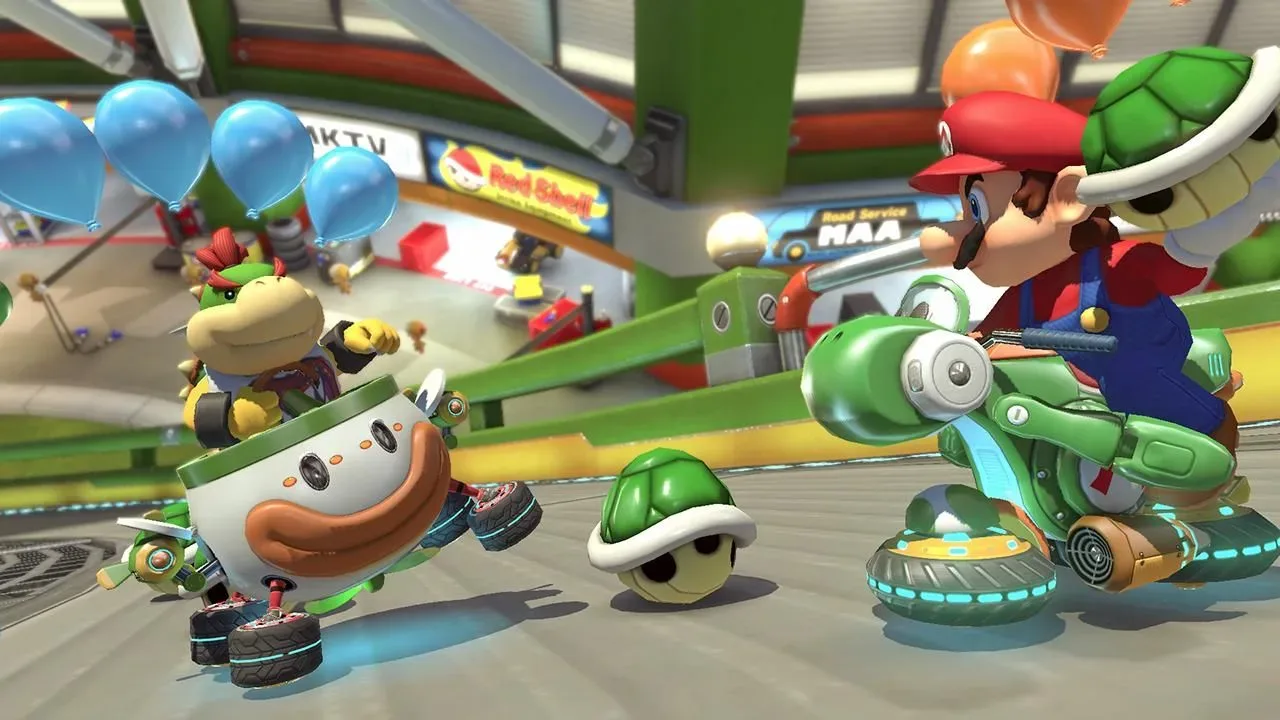
Mario Kart 8 Deluxe has spent years as one of Nintendo’s most stable competitive games. Its tracks, driving physics, shortcuts, vehicle combinations and time-trial leaderboards have all been examined in extraordinary detail by a community that measures success in fractions of a second. That foundation has now shifted in a major way.
A surprise update for Mario Kart 8 Deluxe on Nintendo Switch 2 has increased the base speed of every racer, regardless of their chosen character or kart setup. As reported by GamesRadar+, Nintendo’s patch notes describe the change as a speed increase equivalent to having collected one coin under the game’s prior behavior. For casual players, that might sound like a modest adjustment. For high-level time-trial competitors, it means the assumptions behind a vast number of existing world records have changed at once.
The update is part of version 4.0, a notably substantial patch that also adds clearer visuals, improved loading times, multiplayer support for five to eight players, and GameChat functionality. Yet it is the universal speed adjustment that has immediately captured the attention of the Mario Kart speedrunning community. A game in which racers have spent years refining routes around previously fixed performance limits now has a different baseline pace.
In short, Mario Kart 8 Deluxe’s old records were achieved in a different version of the game. The leaderboard chase is beginning again.
What the one-coin speed increase means
Coins are a central part of Mario Kart 8 Deluxe’s racing system. Players can collect up to 10 coins during a race, and each coin provides an incremental boost to their top speed until that cap is reached. Coins also become an important consideration in time trials, where the fastest possible run is not simply about taking each corner well. Drivers must collect coins efficiently without compromising their racing line, boosts or shortcut execution.
According to the patch-note description highlighted by GamesRadar+, version 4.0 increases a racer’s starting pace to the equivalent of what one coin delivered before the update. The key point is that this is not a balance change aimed at a single character, a particular vehicle part, or one narrowly defined style of play. It is an across-the-board adjustment.
Every driver starts faster. Every kart configuration benefits from that higher initial speed. Every course has therefore become a fresh optimization problem, even if its layout has not changed.
That does not necessarily mean every record will fall in identical fashion or by an identical margin. Mario Kart time trials are influenced by corner geometry, boost panels, anti-gravity sections, itemless route planning, coin placement, drift timing and the degree to which a track rewards raw top speed. On some courses, a baseline increase may produce more substantial gains than on others. But the change is broad enough that the old collection of best times is no longer directly comparable to performances set under version 4.0.
The reaction from competitive players and observers has reflected that reality. One social-media post shared in the aftermath of the update summarized the feeling bluntly: “RIP every MK8D World Record in the last 5 years.” Other posts expressed disbelief at the size and competitive significance of the change. The tone may be humorous, but the underlying point is serious: long-standing records are now exposed to a completely new speed ceiling.
A major update beyond the headline feature
The speed change arrives as part of Nintendo’s effort to enhance Mario Kart 8 Deluxe for Switch 2. The version 4.0 patch includes clearer visuals and faster load times, along with support for five-to-eight-player multiplayer and GameChat. Those additions give the long-running racer a more modern set of system features and bring it closer to Nintendo’s newer Switch 2 ecosystem.
It is a particularly notable move because Mario Kart World served as Switch 2’s major launch title. Nintendo is therefore supporting both the new entry and the older Mario Kart 8 Deluxe with Switch 2-related improvements, rather than treating the previous game solely as a legacy release.
For regular players, improved image clarity and shorter waits between races may be the most immediately visible benefits. Expanded multiplayer support could also matter enormously for households and local gatherings that still rely on Mario Kart 8 Deluxe as an all-purpose party game. GameChat support, meanwhile, gives players another way to coordinate and socialize while racing.
However, the speed increase is different from those quality-of-life and feature upgrades because it affects the game’s fundamental competitive environment. Visuals and loading improvements can enhance the experience without changing the conditions under which a fast lap is set. A universal performance adjustment does change those conditions.
That distinction is why the patch has prompted such an immediate response from record-focused players. The community will need to establish what version 4.0’s optimal strategies look like track by track, and it may take time before the fastest routes, vehicle choices and precise driving techniques are fully understood.
Why tiny changes are huge in time trials
At first glance, “one coin faster” can sound like an almost trivial number. Mario Kart races are full of dramatic elements: mushroom boosts, red shells, blue shells, gliders, ramps and sudden recoveries from chaos. But time trials remove much of that noise. When items and unpredictable rivals are taken out of the equation, every component of the driving model becomes more visible.
At the highest level, a record lap can be determined by a slightly tighter drift, an extra mini-turbo maintained through a bend, a better landing angle after a jump, or a coin collected without adding even the smallest detour. Racers routinely repeat tracks for countless attempts in pursuit of a marginal improvement. A permanent increase to baseline speed does not just offer a tiny shortcut to a faster clock; it changes how quickly competitors reach key parts of every lap and how their momentum carries through them.
That can affect the timing of drifts and boost releases. It can change approaches to jumps and corners. It can require runners to reconsider where a safer line is no longer fast enough, or where a formerly difficult technique becomes more valuable because the entry speed is higher. The fastest old run on a course may still demonstrate exceptional skill, but its time was established under parameters that no longer apply.
This is why the update can be viewed as both disruptive and exciting. Record holders may see achievements built over years displaced rapidly, but they also have a chance to prove themselves in the new ruleset. The same is true for players who were narrowly behind the very best times before version 4.0. A changed competitive landscape can reward racers who adapt quickest.
Old records, new categories, and the next leaderboard scramble
Competitive communities often preserve records by game version when an update meaningfully alters performance, and Mario Kart 8 Deluxe’s long history gives its players plenty of reason to care about that context. The records created before this patch remain evidence of what was possible under the older physics and speed values. They are not erased as accomplishments simply because new times can now be achieved under faster conditions.
But for the active race to set the quickest times on the current version of the game, the practical result is straightforward: version 4.0 records are the new target. Existing best laps are likely to be overtaken as racers test the updated pace and learn how it interacts with each circuit.
There will also be an early period of uncertainty. The patch-note wording establishes the broad intent of the baseline increase, but elite players will want to understand its exact implications in real gameplay. They will compare lap splits, identify which tracks show the largest differences, test whether old vehicle preferences remain optimal, and look for new ways to convert the extra speed into time savings.
That process is a familiar part of competitive racing games. A patch creates the starting point, but the community’s experimentation reveals the full meta. In Mario Kart, where tracks contain a dense mix of terrain, boost mechanics and technical turns, the results may be far more complicated than simply driving every course a little quicker.
Mario Kart 8 Deluxe enters its post-4.0 era
Nintendo’s update demonstrates that Mario Kart 8 Deluxe is still capable of surprising its dedicated audience. Long after its original release, and despite the arrival of Mario Kart World as a major Switch 2 game, the older title has received an update with consequences that reach far beyond presentation and platform features.
The Switch 2 enhancements make Mario Kart 8 Deluxe more convenient and more capable for current players. But the base-speed increase has given its competitive scene a fresh reason to return to every track, chase every split, and question every route that once seemed solved.
For anyone unconcerned with leaderboards, the update may simply make racing feel a little more energetic. For the time-trial specialists whose names sit at the top of global rankings, it is a line between eras. Mario Kart 8 Deluxe now has a post-4.0 world, and keeping up will mean setting fast times all over again.
Community
Discussion
Start the conversation.
No comments have been posted yet.