

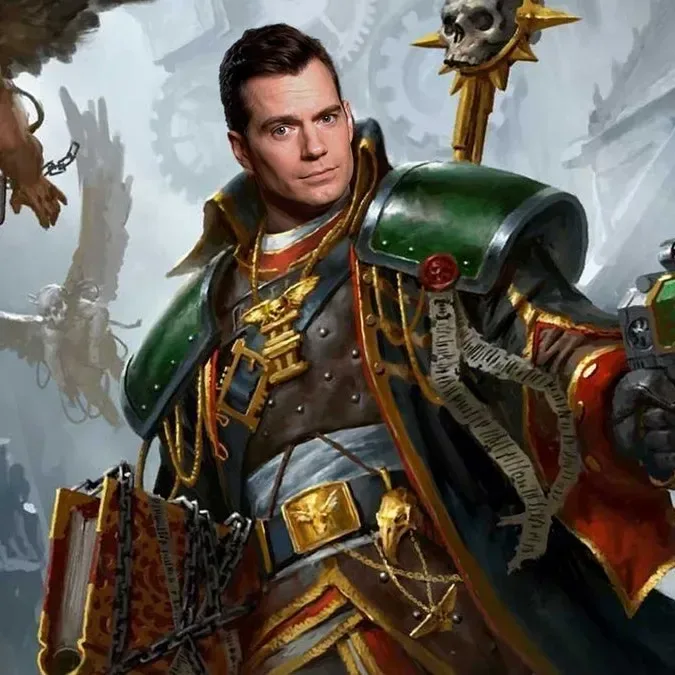
Bringing Warhammer 40,000 to television may be one of the most daunting adaptation jobs in modern genre entertainment. Mike Flanagan, the writer, director, and showrunner now developing an Amazon series set in Games Workshop's vast far-future universe, has described the undertaking as "brutally difficult." It is an assessment that will sound familiar to anyone who has ever tried to explain the 41st millennium to a curious newcomer.
Flanagan is attached to the project as part of a multi-year agreement to create and produce original programming for Amazon. His first series under that arrangement was an adaptation of Stephen King's Carrie, which has reached Prime Video. The Warhammer 40,000 production is expected to form part of the larger screen universe associated with Henry Cavill, who is set to star in the show.
There remains much that has not been publicly established about the series, including its story, characters, setting within the Imperium, and production timetable. But Flanagan's comments offer a useful look at the central creative issue facing everyone involved: Warhammer 40,000 is not simply a single narrative awaiting adaptation. It is a sprawling setting built across decades of tabletop gaming, fiction, art, video games, rulebooks, codices, and countless overlapping stories.
Finding the first step into the 41st millennium
In a recent appearance on The Process Unlocked, Flanagan compared the work to an especially difficult ascent, saying he feels as though he is tackling his "adaptation Everest." He explained that the hardest question is not necessarily how to portray the franchise's distinctive armies, technology, gothic architecture, or famously bleak tone. The real question is where the story should begin.
For useful background on this topic, read Resident Evil Veronica Remake: Release Window, Platforms, Story and Gameplay Details.
That is a major distinction. Many large fantasy and science-fiction properties have a recognizable opening chapter: a first book, a first quest, a defining protagonist, or a relatively contained event that naturally introduces the audience to its world. Warhammer 40,000 does not have that same obvious gateway. It has broad eras of history, multiple galactic factions, contradictory accounts, and stories that leap between very different scales of conflict.
One tale might follow an ordinary Imperial citizen struggling through bureaucracy, superstition, and war. Another could center on an Inquisitor pursuing a heretical conspiracy. The next may be a huge military campaign involving Space Marines, Chaos forces, alien empires, ancient machines, and worlds consumed by war. Each approach is recognizably Warhammer 40,000, but each creates a very different television series.
Flanagan noted the sheer difference in scale between the franchise and another of his long-anticipated projects, an adaptation of Stephen King's The Dark Tower. The Dark Tower saga contains eight books, while Warhammer 40,000 has roughly 700 novels to draw from. Those books are not brief supplemental texts, either. They are full-length works covering a remarkable range of characters, regions, organizations, and points in the setting's enormous timeline.
Why The Dark Tower offers a clearer blueprint
Flanagan sees a comparatively simple way to approach The Dark Tower: adapt King's books in their existing order. In his view, King already designed a highly effective introduction to a universe that later grows stranger and larger. The opening starts with a limited number of key elements--a pursuer, a target, and a sparse landscape--before gradually revealing the larger reality around them.
That incremental structure matters. Audiences are not initially asked to memorize a history book or understand every supernatural rule, distant faction, and cosmic threat. They are first given a character dynamic and a clear objective. Once that emotional and narrative foundation is in place, the world can expand one piece at a time.
Flanagan said his own Dark Tower plan is notably faithful to the books, with alterations made where television's format requires them. The underlying path is already there, which dramatically reduces the adaptation burden. As he put it, much of the work has effectively been handled by King's construction of the original story; the principal difficulty is getting the project approved.
Warhammer 40,000 presents the inverse challenge. There is no one universally accepted first chapter. The setting has a history stretching over millennia, while its central present-day era is intentionally huge, unstable, and shaped by competing viewpoints. A viewer could theoretically enter through the perspective of the Imperium of Man, the forces of Chaos, the Aeldari, Orks, Necrons, Tyranids, T'au, or many other corners of the galaxy. Even within the Imperium, the experience of a Space Marine is radically different from that of an Inquisitor, Guardsman, Rogue Trader, hive-world worker, tech-priest, or noble.
A universe defined by scale, conflict, and uncertainty
Warhammer 40,000's vastness is part of its appeal. The franchise is set in a future where humanity's galaxy-spanning empire survives through cruelty, faith, fear, sacrifice, and endless warfare. Its iconic phrase, the "grim darkness of the far future," signals that this is not a clean heroic space opera. It is a world of enormous cathedrals built into starships, ancient institutions that barely understand the technology they preserve, and civilizations fighting wars that can last for generations.
That atmosphere has given Warhammer 40,000 a unique identity, but it also makes adaptation choices unusually consequential. A series that begins with bolter fire, towering Space Marines, and a galaxy-wide crusade could communicate the spectacle immediately, yet it risks overwhelming viewers with terminology and scale. A smaller story about a human investigator, soldier, or survivor may provide a more relatable route into the setting, but it would need to retain enough of Warhammer's strangeness and menace to feel representative.
The franchise's lore also resists clean simplification. The official fiction has accumulated over decades, and many stories are filtered through incomplete records, ideology, propaganda, superstition, and the biases of the people telling them. That ambiguity is not merely a complication for dedicated fans attempting to reconcile every detail. It is part of the setting's texture. The truth about legendary figures, historic disasters, religious beliefs, and even the Emperor of Mankind is often elusive.
For television, that can be a strength as well as a problem. Flanagan does not necessarily need to explain every historical dispute or provide a definitive answer to every mystery. A well-chosen perspective could let the audience learn about the universe naturally, while preserving the sense that the galaxy is older, stranger, and far larger than any one character can comprehend.
The Eisenhorn question
One frequently suggested entry point is Dan Abnett's Eisenhorn series. The novels follow Gregor Eisenhorn, an Imperial Inquisitor whose investigations lead through conspiracies, occult horrors, political corruption, alien encounters, and escalating threats to the Imperium. The stories are often recommended to readers who want an accessible way into Warhammer 40,000 fiction because they are comparatively grounded and focused around a central protagonist.
That does not mean Eisenhorn's world is small. The trilogy and its wider connected material eventually travel into some of the setting's darker and more complex territory. But the investigative framework offers a practical dramatic engine. A mystery can introduce a new location, institution, or danger only when the narrative needs it. The audience learns alongside the investigator instead of being asked to absorb the whole galaxy before the plot begins.
An Eisenhorn adaptation could also make it easier to manage the franchise's most expensive elements. Space Marines remain an essential part of the Warhammer 40,000 identity, but their rare appearances in the Eisenhorn books can preserve their impact. Rather than requiring giant genetically engineered warriors to dominate every episode, a series could treat their arrival as an extraordinary and frightening event. The human-scale cast, meanwhile, would provide the emotional point of view.
There has been fan speculation that Cavill could play Eisenhorn, particularly because of the character's suitability as a lead in a tightly focused adaptation. However, no confirmed casting role or story choice has been announced. Any assumption that the series will adapt Eisenhorn specifically remains just that: speculation. The project could take inspiration from a known Black Library storyline, combine elements from multiple corners of the setting, or create a new narrative designed for television.
Henry Cavill's Warhammer ambitions meet Flanagan's adaptation experience
Cavill's involvement has generated considerable anticipation among Warhammer fans. The actor has long been associated with gaming and genre fandom, and his attachment gives the screen universe a prominent face as it moves forward. Yet the eventual success of the project will depend on much more than casting. It will require a creative approach that respects established fans without turning the first season into a glossary of names, dates, chapters, legions, crusades, and obscure historical events.
Flanagan's previous work suggests why he may be an intriguing fit for that balancing act. His horror series have often emphasized character, grief, faith, family, trauma, and intimate emotional stakes even when their worlds include ghosts or elaborate supernatural mythology. Warhammer 40,000 has no shortage of horror: daemonic corruption, body horror, persecution, cosmic dread, and the terror of living under a totalitarian regime are all fundamental parts of the setting. The difficult task will be deciding which of those elements should lead the audience into the larger universe.
A successful adaptation does not need to cover every faction or resolve every lore debate. It needs a compelling first story. That story must establish a human connection, explain only what is necessary, and gradually reveal why the Warhammer 40,000 galaxy has held players and readers for so long. In a setting where entire planets can be lost in a sentence and ancient wars echo across ten thousand years, choosing a single point of view may be the boldest and most important creative decision.
A difficult challenge, but a promising one
Flanagan's candor should be encouraging rather than alarming. Recognizing Warhammer 40,000's complexity is preferable to treating it as a straightforward military science-fiction property with familiar armor and a few borrowed names. The franchise's size is not an obstacle that can be erased; it is the central feature that must be shaped into a story audiences can follow.
For now, viewers will have to wait for concrete details about the Amazon series. There is no confirmed release date, no announced setting, and no official word on which character Cavill will play. What is clear is that the team faces an adaptation problem unlike the relatively linear path offered by a conventional book series.
Warhammer 40,000 has hundreds of possible beginnings. Flanagan's job is to find the one that makes viewers want to take the next step into the darkness.
Community
Discussion
Start the conversation.
No comments have been posted yet.