

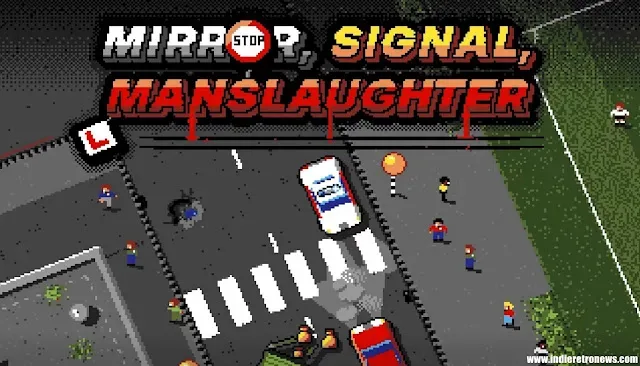
Mirror Signal Manslaughter is a newly unveiled game for the Commodore Amiga from chiptune musician and developer LukHash. Built as an affectionate tribute to the unmistakable character of Sensible Software, the project takes a crime-and-driving premise familiar to fans of the earliest Grand Theft Auto games and filters it through a colourful, deliberately cheeky 16-bit sensibility.
The idea has an especially interesting historical hook. Mirror Signal Manslaughter revives the spirit of an abandoned concept said to have been envisioned by the Sensible Software team in 1991, years before Rockstar's Grand Theft Auto series reached stores. Rather than presenting itself as a recovered commercial game from that era, LukHash's project appears to be a modern homage: an attempt to explore the kind of playful, unruly Amiga game that might have emerged had that old concept been carried through to completion.
An Amiga "what if?" brought back to life
There is no shortage of retro-inspired games that borrow visual cues from the hardware of the 1980s and 1990s. Mirror Signal Manslaughter stands apart because its inspiration is not just a broad pixel-art aesthetic or a familiar genre. Its central appeal is tied to a specific alternate-history question: what if one of Britain's most distinctive Amiga-era studios had made its own top-down automotive crime game before the genre became inseparable from Grand Theft Auto?
Sensible Software occupies a particularly treasured place in the Amiga library. The studio became known for games with immediate controls, expressive animation, crisp presentation, and a sense of humour that could be mischievous without becoming needlessly complicated. Its work often made a strong impression with relatively simple premises, whether the player was running and gunning, scoring goals, commanding tiny soldiers, or navigating a world filled with cartoon exaggeration.
For useful background on this topic, read Wizard of Wor Returns on Amiga With a New AGA Edition.
That identity is important to the pitch behind Mirror Signal Manslaughter. The game is not merely described as "GTA-like" because of cars and criminal chaos. Its stated purpose is to combine that sort of top-down, open-ended driving concept with a distinctly Sensible-inspired personality. The result is intended as a tongue-in-cheek tribute to an important developer from the Amiga's 16-bit heyday.
A concept older than Grand Theft Auto
The 1991 connection gives the project more than a convenient nostalgia label. Grand Theft Auto did not arrive until later in the decade, and its original overhead viewpoint, urban mayhem, vehicle theft, and mission-based criminal structure became enormously influential. Looking back from the modern era, it is easy to assume that this combination of ideas only belonged to Rockstar's series. The abandoned Sensible Software concept suggests that the broad ingredients of a free-roaming, vehicle-focused city game were already compelling to designers working in the early 1990s.
Of course, a shared premise does not mean two games would have played alike. Sensible Software's best-known titles had a particular rhythm and attitude. They were often accessible at first glance, but they also rewarded practice, quick reactions, and a willingness to embrace their eccentricities. A Sensible-flavoured take on a crime-driving game could reasonably be expected to feel very different from the later Grand Theft Auto formula, even if both were built around overhead action and motor vehicles.
For another perspective on this story, read Mirror Signal Manslaughter revives a lost Amiga game idea.
Mirror Signal Manslaughter leans into that possibility. Its title alone has the sort of knowingly absurd, very British energy that suits the inspiration. It evokes traffic etiquette and violent escalation in the same breath, a contrast that reflects the irreverence many players associate with the era's Amiga games. The project's identity is therefore rooted as much in comedy and imagined history as it is in any single mechanic.
Why Sensible Software remains such a fitting influence
For retro players, the mention of Sensible Software immediately conjures a specific design language. The studio's games were rarely sterile recreations of real-world activities. Instead, they bent reality into something lively and readable: tiny characters had attitude, environments were full of visual shorthand, and action tended to arrive quickly. Even when a game offered depth, its basic interaction was usually easy to understand.
That makes the studio a natural point of reference for a compact Amiga project. The Commodore Amiga remains beloved not only for technically ambitious showcases, but also for games that used its visual and audio strengths to create bold personalities. The machine's library was packed with colourful sprites, memorable soundtracks, unusual British humour, and experiments that did not always fit neatly into a single genre.
LukHash is well positioned to approach that environment from a music-minded perspective. Known as a chiptune musician as well as a developer, he is working in a space where sound, mood, and hardware-era texture are likely to matter as much as the broad game concept. The available announcement does not lay out a detailed feature list, campaign structure, control scheme, or technical specifications, so players should be cautious about assuming exactly how Mirror Signal Manslaughter will play. Still, the project's stated inspiration gives it a clear creative direction.
Not simply a Grand Theft Auto imitation
Describing a game through Grand Theft Auto is useful shorthand, but it can also obscure what makes smaller retro projects interesting. Grand Theft Auto became a vast cultural and commercial force, evolving from its 2D roots into enormous 3D worlds with cinematic storytelling, licensed music, online modes, and massive production values. Mirror Signal Manslaughter is framed around a much narrower and more playful goal.
Its value lies in reimagining an unrealised early-1990s idea through the limitations and charms of the Amiga. That means the comparison is best understood as a conceptual one: a top-down crime-and-driving setup with room for disorder, not a promise of a modern open world compressed onto vintage hardware. The project is looking backward to a point before the genre's conventions were fixed, when an idea involving vehicles, city streets, and anarchic player freedom could have gone in numerous directions.
That approach could appeal to players who enjoy discovering games that feel like artefacts from parallel timelines. Retro development is at its most compelling when it does more than reproduce old graphics. A project such as Mirror Signal Manslaughter can invite players to consider how different creative voices might have handled familiar ideas, and how much genre history depends on the games that were never finished or released.
A tribute that acknowledges its boundaries
It is worth stressing that Mirror Signal Manslaughter is an homage rather than a newly unearthed Sensible Software production. Its connection to the studio comes from the abandoned 1991 concept and from LukHash's stated effort to capture the studio's tone. That distinction matters, but it does not lessen the appeal. Fan-made and independently developed tributes have long been part of the retro scene, especially around systems like the Amiga where passionate communities continue to build new software decades after the hardware's commercial peak.
These releases can offer a different kind of preservation. They do not preserve code or assets in the archival sense; instead, they preserve creative possibilities. An unused pitch, a rumoured prototype, or an abandoned design can become the spark for a new work that speaks to the original era while remaining honest about being a modern creation.
For Amiga enthusiasts, that makes Mirror Signal Manslaughter more than another game wearing a retro coat. It is a playful attempt to fill in a blank spot in the machine's imagined history. The game asks players to picture an alternate 1990s in which a Sensible Software-style spin on vehicular criminal mayhem had reached the Amiga library alongside the studio's better-known work.
What to expect next
Mirror Signal Manslaughter has been unveiled for the Commodore Amiga, with a download referenced alongside its announcement. Beyond that, details remain limited. There is no confirmed information here on wider platform versions, pricing, release scheduling, supported Amiga configurations, or the full scope of its modes and objectives.
For now, the most compelling reason to keep an eye on it is its premise. LukHash is taking a shelved 1991-style idea, combining it with the visual and comedic spirit associated with Sensible Software, and shaping it into a new 16-bit Amiga experience. In a retro scene often driven by familiar franchises and straightforward remakes, that is a refreshingly strange proposition: not the game players remember, but the game they can imagine remembering from a different version of the Amiga era.
Community
Discussion
Start the conversation.
No comments have been posted yet.