

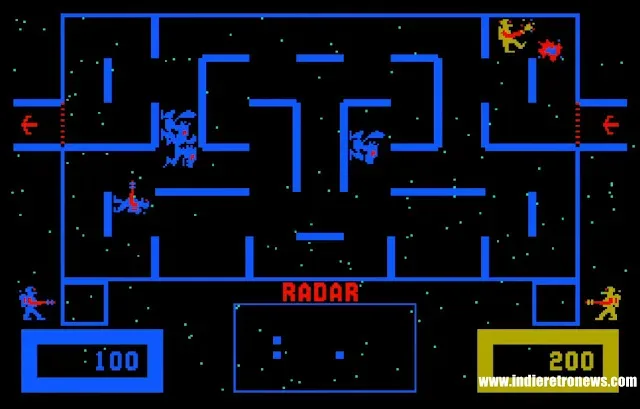
Wizard of Wor, the early-1980s arcade maze shooter known for its tense monster hunts, competitive score chasing, and memorable digitised announcements, has received a dedicated Commodore Amiga AGA edition from dlfrsilver. Called Wizard of Wor AGA, the release is designed specifically around the capabilities and memory layout of AGA-equipped Amiga machines rather than the older baseline Amiga hardware associated with systems such as the Amiga 500.
The project revisits a game that has travelled across a considerable range of vintage formats. Following its arcade debut, Wizard of Wor appeared on Atari 8-bit computers, Atari 2600, Atari 5200, Bally Astrocade, and Commodore 64. That history makes an Amiga version a natural fit for retro enthusiasts, but this particular release is not simply about placing the game on another period machine. Its technical approach focuses heavily on avoiding the interruptions that can come from loading audio during play.
For players with appropriate Amiga hardware, the headline feature is the use of memory to keep the game's audio ready in advance. All 79 digitised speech samples are preloaded into Fast RAM. The graphics, sound effects, and Paula playback buffers remain in Chip RAM. The goal is to let matches continue without unwanted disk activity breaking up the action, an especially important consideration for a fast arcade game where sudden pauses can undermine the rhythm of play.
Why the AGA version needs more than a standard Amiga setup
dlfrsilver explained that the edition began as a request from a friend, while the game's extensive audio also shaped the target hardware. The jingles, sound effects, and voices require around 2MB and cannot all reside in Chip RAM in the intended arrangement. On an Amiga 500-class configuration, the system would need to load audio repeatedly, consuming too much space and resulting in constant loading. The AGA release addresses that limitation by splitting duties across the Amiga's distinct memory types.
For useful background on this topic, read Ocean's 1986 Batman Gets New Commodore 64 and Plus/4 Conversion.
That distinction is central to understanding this version. Chip RAM is memory shared with the Amiga's custom hardware, including the graphics and audio systems. Fast RAM is generally available to the CPU without that same shared-hardware role. By putting the large bank of speech data into Fast RAM while preserving Chip RAM for graphics, effects, and Paula audio playback buffers, Wizard of Wor AGA aims to maintain the audiovisual character of the arcade experience without forcing the machine back to storage during each session.
The result is a version intended for Amiga users who want the vocal callouts and arcade atmosphere present without recurring in-game disk access. Digitised voice was a defining part of many classic arcade experiences, and Wizard of Wor is particularly remembered for its electronic announcements. Keeping those samples immediately available is therefore not merely a technical flourish; it is a meaningful part of recreating the game's identity on the platform.
Hardware requirements and memory guidance
Wizard of Wor AGA is built for an Amiga with the AGA chipset and a standard 14MHz 68020 CPU. Notably, it does not require an accelerator card. That should make the release relevant to owners of suitably configured stock AGA machines, provided they can meet the memory needs.
The game uses 2.75MB of memory in total. Its allocation is listed as 1.16MB of Chip RAM and 1.59MB of Fast RAM. A system with 4MB of Fast RAM is recommended. However, a real-hardware setup with 2MB of Chip RAM and 2MB of Fast RAM should theoretically also be sufficient. As with many retro releases, the exact practical experience can depend on an owner's individual machine configuration, memory expansion, storage setup, and Workbench environment, but the stated target is clear: this is an AGA and 68020-focused production with Fast RAM playing an essential role.
That requirement also establishes an important boundary for prospective players. This is not positioned as an Amiga 500 edition, nor is it designed around the constraints of a purely Chip RAM-based system. The absence of an accelerator requirement is welcome, but the AGA chipset, 68020 processor, and additional Fast RAM remain fundamental to the way this edition handles its complete audio package.
Arcade fundamentals remain at the center
Technical details may define the port's construction, but the game itself remains rooted in a simple and enduring arcade premise. Wizard of Wor sends players into maze-like arenas populated by hostile creatures. Players navigate corridors, fire down lines of sight, try to eliminate enemies before being caught, and compete for survival and points. The game's escalating pressure and its mixture of tactical positioning with sudden danger helped make it a fixture of the era's arcade scene.
The original design is also well suited to short repeat sessions. Its controls are direct, its rules are quickly understood, and its challenge grows from reading the maze, reacting to threats, and learning the behavior of enemies. Those qualities have helped it remain memorable long after its first wave of home conversions. On Amiga, the opportunity to play with a fuller collection of speech samples already loaded into memory adds another layer to that nostalgic appeal.
Classic arcade ports can often involve compromise, especially where sound, memory, color capability, or media limitations are concerned. The AGA edition's design makes a different choice: rather than fitting every asset into the smallest common Amiga specification, it targets hardware able to hold the audio up front. For players with the required machine, that should mean less attention on loading behavior and more attention on the maze.
Controls for starting, settings, and returning to Workbench
The available keyboard instructions preserve an appropriately arcade-like setup. Pressing 5 inserts a coin. Players can then press 1 or 2 to begin play, supporting the game's one- or two-player roots. The use of familiar arcade-style credit and start keys makes getting into a match straightforward for anyone accustomed to vintage computer and emulation conventions.
- 5: Insert a coin.
- 1: Start a game for player one.
- 2: Start a game for player two.
- F1: Open the settings options and save configuration choices.
- Esc: Exit back to Workbench.
The inclusion of an F1 settings screen is useful for players who want to adjust their experience and retain those selections, while Escape provides a quick return to the Amiga desktop environment. These are modest conveniences, but they matter for a retro project intended to be played on an operating system-driven home computer rather than a dedicated arcade cabinet.
A focused release for Amiga preservation and play
Wizard of Wor AGA represents the kind of platform-specific retro work that values both playability and the character of the host machine. It does not attempt to treat every Amiga as identical. Instead, it takes advantage of AGA hardware, a 68020 CPU, Chip RAM, and Fast RAM to solve a specific problem: fitting the game's jingles, effects, and 79 digitised speech samples into a setup that can keep them available during gameplay.
For collectors and active Amiga users, that makes the release notable beyond its choice of game. It demonstrates how memory planning can affect the feel of an arcade conversion, particularly when the source material depends on frequent vocal audio. Players with an AGA-equipped system and sufficient Fast RAM can look forward to a version designed to keep its sounds at hand instead of repeatedly reaching for the disk.
More than four decades after Wizard of Wor first challenged players to survive its monster-filled mazes, the game's immediate action still makes sense on vintage hardware. This AGA edition gives it another home, with technical decisions aimed at preserving the flow of the action and the distinctive soundscape that helped the arcade original stand out.
Community
Discussion
Start the conversation.
No comments have been posted yet.