

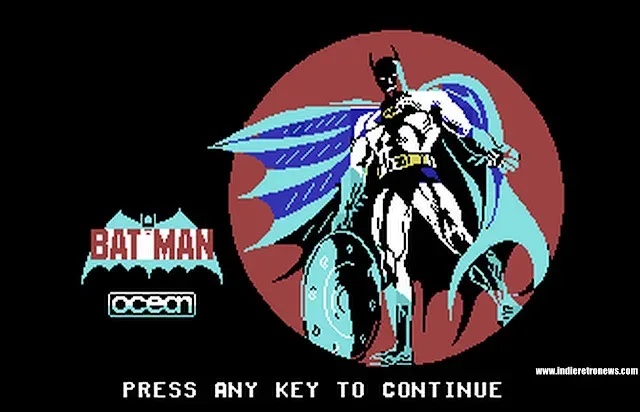
Batman, Ocean Software's 1986 isometric action-adventure, is heading back to the 8-bit era with new conversions for the Commodore 64 and Commodore Plus/4. The project adapts the game's ZX Spectrum version for both Commodore machines, giving retro players two new ways to revisit one of the earliest licensed Batman games.
The Commodore 64 release is credited to Exceed (EXD), while Absence (ACE) is associated with the Commodore Plus/4 version. Coding credits are shared by Chronos and Murphy. The announcement identifies the conversion as Batman +8 PAL/NTSC, indicating support for the two major video standards used by classic home-computer software.
Rather than being a newly designed Batman adventure, this is a conversion of the 1986 ZX Spectrum original. That distinction is important: the goal is to bring the identity and play style of Ocean's early isometric Batman game to hardware that did not receive this specific version at the time.
A return for an early Batman game
Batman's game history is often remembered through later action titles, fighting games, LEGO adaptations, and large-scale open-world releases. But the character's relationship with video games extends much further back. Ocean's 1986 game arrived during an era when licensed releases were frequently ambitious attempts to translate a film, television, comic, or pop-culture property into the design language of contemporary microcomputers.
For useful background on this topic, read 12 Gift Ideas for Video Game RPG Fans, From New Adventures to Clever Collectibles.
The ZX Spectrum edition is especially notable for its isometric presentation. At a time when many home-computer games relied on side-on or top-down screens, isometric design created an illusion of depth and gave developers a way to build spaces that felt more architectural. That perspective could make rooms, corridors, hazards, and routes feel less immediately obvious, asking players to understand the shape of the environment as well as the challenges placed within it.
In the context of a Batman game, that style is a natural fit. Batman has long been associated with navigating secretive, dangerous spaces: hideouts, compounds, rooms full of traps, and locations where observation matters as much as direct confrontation. Even within the technical limits of mid-1980s home hardware, an isometric adventure could suggest that sense of investigation and tense movement through unfamiliar territory.
The new Commodore editions are therefore more than simple curiosities for collectors. They offer an opportunity to examine a piece of licensed-game history on machines whose communities remain highly active decades after their original commercial lifespans. The Commodore 64 and Plus/4 each have dedicated enthusiasts, programmers, preservationists, and demo-scene veterans who continue to create software and revisit the libraries that defined the systems.
Two Commodore machines, one conversion effort
Bringing the game to both the Commodore 64 and Commodore Plus/4 is a meaningful part of the announcement. Although both systems sit within Commodore's 8-bit heritage, they occupy different places in that history and have distinct technical identities.
The Commodore 64 remains one of the best-known home computers ever made, supported by an enormous historical library and a continuing development scene. New games, conversions, utilities, music releases, and hardware projects still arrive for the platform. A previously unavailable adaptation of a recognizable 1980s title is the kind of release that can appeal to players interested in both Batman's gaming past and the C64's extensive catalogue.
The Plus/4 has a smaller but devoted following. Its presence in this release gives the project a broader preservation-minded appeal, particularly because Plus/4 owners have often seen modern hobbyist developers explore the machine's particular strengths and limitations. A native version for that system means it is not merely being treated as an afterthought alongside the more commercially dominant Commodore 64.
The credits list Chronos and Murphy for code, while Absence and Exceed are named as the respective releasing groups. Community projects like this depend on specialized knowledge that differs greatly from modern game production. Developers have to consider original hardware behavior, memory restrictions, display timing, storage formats, and compatibility expectations, all while deciding how faithfully to reproduce the source game.
That work becomes still more relevant when a conversion is intended to operate across PAL and NTSC environments. The project is identified as Batman +8 PAL/NTSC. PAL and NTSC systems historically differ in video timing, and software written around one standard can face presentation or speed differences on the other. Explicitly naming both standards signals attention to a practical issue familiar to retro-computing players and collectors.
Intro music and native TED playback
The release also includes a specific musical credit. The introductory tune is identified as Batman (short) by JCH. For the Plus/4 version, an advanced frequency converter is used to play the music on the machine's native TED hardware, with the converter emulating lower notes.
This detail underlines how much of the character of a retro conversion can lie beyond graphics and controls. Sound on vintage systems is closely tied to the chips and techniques used to produce it. Recreating a piece of music, or making it convincing on a different sound architecture, can require its own technical approach. In this case, the note about lower-note emulation suggests a deliberate effort to accommodate musical ranges that native playback would otherwise handle differently.
For players who enjoy comparing versions of old games, the intro may be one of the most immediately noticeable places to hear the individuality of each machine. The game's central design is rooted in the ZX Spectrum original, but a Commodore conversion inevitably becomes its own artifact through the behavior of the target hardware, the choices of its coders, and the audio methods used for the release.
Why conversions like this matter
Retro releases are sometimes described as nostalgia projects, but that description can miss the creative and archival value of the work. Many well-known games from the 1980s were not released for every relevant platform, even when those platforms were active at the same time. Licensing arrangements, development budgets, deadlines, and the technical demands of individual machines could all determine where a game appeared.
A modern conversion can fill one of those historical gaps. It does not change the original release history, but it allows players to ask a useful question: what might this game have looked and felt like had it reached another major home computer during its era?
That question is especially interesting with Batman because the property has been represented through so many different game formats over the decades. The 1986 title belongs to a period before superhero games settled into the conventions that many players now expect. It reflects an earlier design environment, where recognizable characters were interpreted through the mechanics that developers knew how to build for cassette-based home computers.
Approaching the game now also provides useful historical perspective. Modern Batman games often have the processing power to render large environments, detailed animation, extensive voice work, and cinematic scenes. An 8-bit isometric adventure has a much narrower technical canvas, yet its perspective and structure show how designers could create atmosphere, exploration, and challenge with far more limited resources.
A release for retro Batman and Commodore fans
The Commodore 64 and Plus/4 versions of Batman should be of interest to several overlapping groups: fans of Ocean's 1980s catalogue, Batman game historians, ZX Spectrum enthusiasts curious about an alternate-platform adaptation, and Commodore users looking for new software on original hardware or compatible setups.
The project's announcement is dated November 26, 2026, and its available details focus on the release groups, coding credits, the ZX Spectrum origin, PAL/NTSC identification, and the intro music implementation. No further release specifics are provided here, so players should avoid assuming details about distribution, media format, or additional features until they are formally confirmed.
What is clear is that a notable piece of Batman's early gaming legacy is receiving renewed attention on two classic Commodore platforms. With Chronos and Murphy handling code, Absence and Exceed attached to the respective releases, and JCH's short Batman theme featured in the introduction, this conversion gives a 1986 isometric adventure a fresh place in the ongoing life of 8-bit computing.
Community
Discussion
Start the conversation.
No comments have been posted yet.