

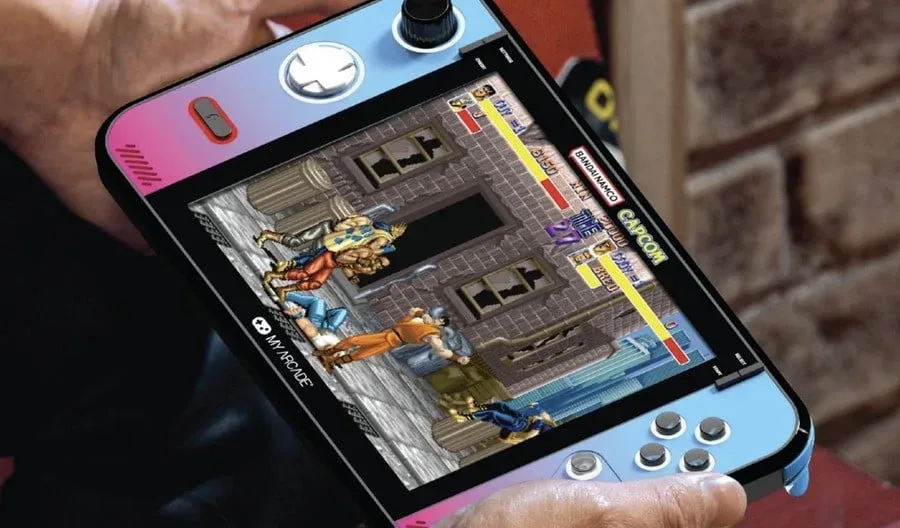
My Arcade's long-awaited Gamestation Retro Go handheld is finally approaching release. The company has confirmed an October launch window for the retro-focused portable, which was first revealed at CES in January 2025. A GameStop product listing gives the hardware a more specific date of October 31 and places its price at $199.
The update resolves a lengthy period of uncertainty around the machine. My Arcade initially positioned the Gamestation Retro family for availability in the third quarter of 2025, but the Retro Go did not arrive during that timeframe. It was subsequently pushed into 2026, and October is now the stated target. As with any retailer listing, the October 31 date is best viewed as the current planned date rather than an absolute guarantee until the product is physically shipping, but it is the clearest schedule attached to the device so far.
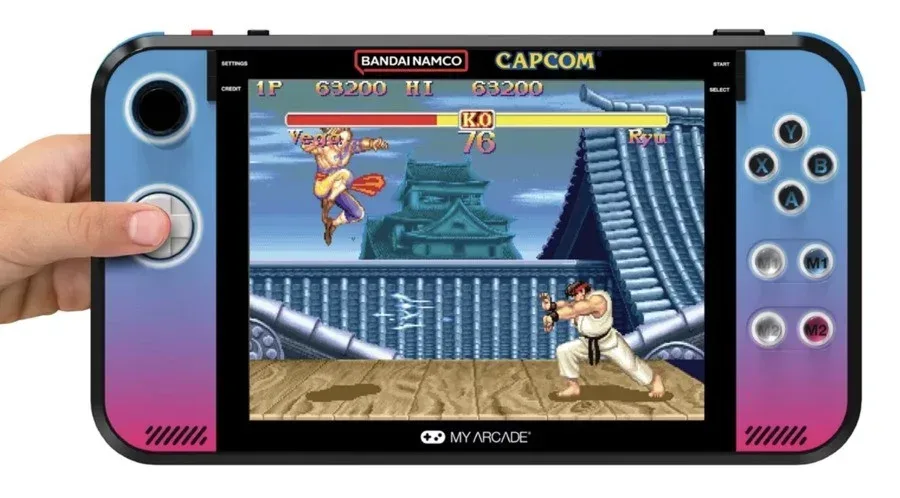
Gamestation Retro Go stands out in a crowded retro-hardware market because it is built around an official collaboration involving games from both Capcom and Bandai Namco. My Arcade says the system will include more than 100 pre-loaded arcade and home-console titles. Among the games named for the lineup are Pac-Man, Galaga, Pole Position, Dig Dug, Street Fighter II, Mega Man, Final Fight, and 1942.
Embedded X/Twitter post
A large portable for an unusually broad licensed library
The Retro Go is a sizable, landscape-oriented handheld with a form factor that resembles a modern hybrid gaming portable. Its centerpiece is an 8-inch high-resolution display, accompanied by an internal rechargeable battery. The original reveal focused on its physical scale as much as its software catalog: this is not intended to be a pocket-sized novelty device, but a larger all-in-one system designed for comfortably playing older games on a modern screen.
For useful background on this topic, read Why The Curse of the Black Pearl Missed Out on a True Game Tie-In.
Its appeal rests heavily on the combination of publishers. Licensed retro products frequently separate game catalogs by rights holder, resulting in multiple devices for fans who want titles from different companies. My Arcade's approach puts recognizable Capcom and Bandai Namco games in one piece of hardware, offering a more varied package across arcade action, shooters, fighters, maze games, platformers, and console-era classics.
That kind of multi-publisher arrangement is not unheard of, but it is far from the norm. Retro-Bit's 2016 Generations micro-console, for example, brought together games associated with Capcom, Irem, Jaleco, and Data East. Still, the Gamestation Retro Go's pairing is notable due to the enduring prominence of the Capcom and Bandai Namco back catalogs. Street Fighter II, Mega Man, and Final Fight are major pillars of Capcom's history, while Bandai Namco's arcade legacy is represented by names such as Pac-Man, Galaga, Dig Dug, and Pole Position.
Controls have changed since the first showing
My Arcade's updated presentation of the Gamestation Retro Go also indicates that the button arrangement has been adjusted from the design shown earlier. The available information does not fully detail every revision or explain how the final mapping will work across the entire game selection. However, the change suggests the hardware continued to evolve while its release was delayed.
Controls are particularly important for a product attempting to cover such different eras and genres. Classic arcade games can demand a distinct feel from platformers and action games, while fighting games place special emphasis on button placement and directional inputs. The Retro Go's selection includes games that were originally designed for arcade cabinets as well as titles associated with home consoles, so the final layout will be central to determining whether the device feels like a convenient compilation machine or a genuinely comfortable way to revisit these games.
The hardware's 8-inch display may also make it more practical for arcade titles that rely on dense screens, scores, sprites, and split-second visual information. The named games span very different display formats and design conventions, from the compact maze layouts of Pac-Man to the scrolling brawling stages of Final Fight and the fast-moving aerial action of 1942. A larger screen could be a meaningful advantage for players who find smaller retro handhelds difficult to use for extended sessions.
Retro Go is one part of a three-device range
The handheld is not the only product planned under the Gamestation Retro banner. My Arcade also announced the Gamestation Retro Pro, a premium retro console intended for television play, and the Gamestation Retro Mega, a tabletop arcade cabinet. Both remain part of the wider licensed collection, though the latest timing and pricing information specifically concerns the Retro Go.
Gamestation Retro Pro has been described as a premium console with 1080p output and wireless controllers. That puts it in a different role from the portable, aiming at living-room play rather than a self-contained screen-and-controls setup. For people who prefer a TV-based experience for classic games--or who want to play from a sofa with wireless pads--the Pro appears to be the more conventional option within the lineup.
Gamestation Retro Mega, meanwhile, is positioned as the most arcade-like member of the trio. It is a tabletop cabinet with classic wood construction, a 10.1-inch display, a mechanical joystick, and dedicated action buttons. The cabinet format naturally suits many of the arcade games associated with Capcom and Bandai Namco, and its larger upright-style controls could make it an attractive alternative for enthusiasts who value the physical character of an arcade setup.
Together, the three products reflect an effort to present a single licensed library in three forms: portable handheld, TV console, and miniature arcade cabinet. The strategy lets buyers choose their preferred way to play without changing the core premise of the collection. It also highlights why the Retro Go has drawn attention: it is the most flexible of the group, combining a large screen, built-in controls, and portable use in one device.
What is confirmed, and what remains to be seen
At this stage, the most concrete Gamestation Retro Go details are its October release window, the GameStop listing's October 31 date and $199 price, its 8-inch display, rechargeable battery, revised controls, and a library of more than 100 built-in games from Capcom and Bandai Namco. The named titles offer a strong indication of the kind of catalog buyers can expect, with celebrated arcade staples sitting alongside equally familiar Capcom releases.
There are still practical questions that have not been fully answered by the available announcements. My Arcade has not provided the complete game list in the information currently available, so buyers do not yet know every title included in the total. Detailed specifications beyond the display description and battery type have also not been outlined here, nor is there a full breakdown of software features, menu options, save support, display settings, or the final control configuration.
Those details matter for any retro handheld, especially at $199. A licensed game lineup supplies legitimacy and removes the uncertainty that can surround unlicensed emulation devices, but consumers will still want to know how each title performs, how the interface is organized, how the controls hold up, and whether the hardware accommodates the preferences of players accustomed to modern handheld features.
For now, the main news is that the long delay has a visible endpoint. The Gamestation Retro Go was announced as part of My Arcade's CES 2025 lineup, missed its original 2025 target, and is now scheduled to arrive in October 2026. If the October 31 retailer date holds, the handheld will bring an unusually broad officially licensed Capcom and Bandai Namco collection to a single large-screen portable just in time for the end-of-year shopping season.
Community
Discussion
Start the conversation.
No comments have been posted yet.