

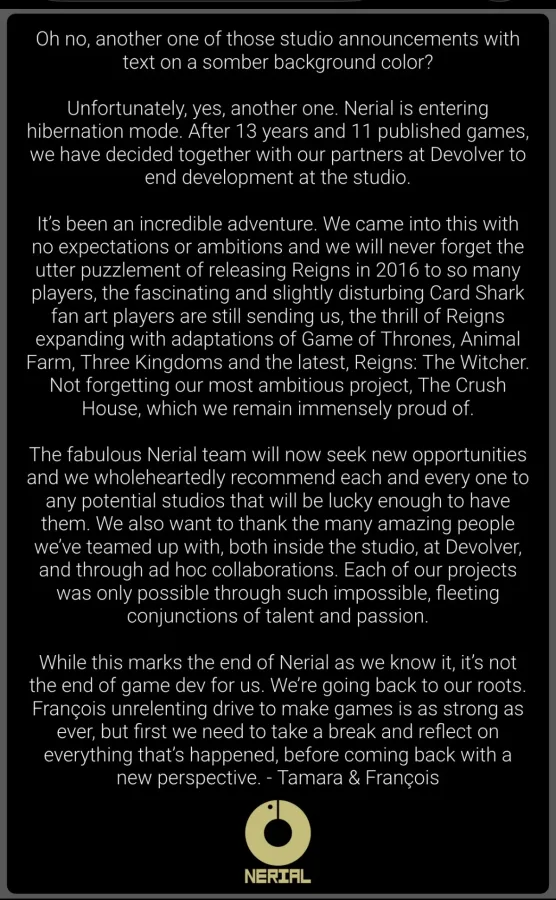
Nerial, the independent studio best known for Reigns, is closing down after nearly 13 years and 11 games. Founder and creative director François Alliot will continue making games with his wife and collaborator, Tamara, but the company's formal closure means seven other staff members will be leaving their salaried positions.
The decision arrives during an especially uncertain period for game development, marked by reduced investment, widespread layoffs, and the rapid emergence of AI-driven imitation and content production. But Alliot's reasons go beyond the difficult financial climate. He is looking to step back from the responsibilities of operating a larger studio and return to a more concentrated, personal form of independent creation.
That next chapter will not mean abandoning game development. Rather, it represents a reset for the people who founded Nerial and a chance for Alliot to pursue ideas without the extra structure, expectations, and coordination that came with being an internal studio.
From Reigns Breakout to a Changing Studio
Nerial's first game, Reigns, became a major success following its 2016 release. Its core idea was immediately legible: players made decisions for a kingdom by swiping left or right through a series of choices, echoing the interface of dating apps while turning every decision into a balancing act between competing resources.
For useful background on this topic, read Isles of Sea and Sky Brings Its Clever Sokoban Puzzles to Nintendo Switch on October 8.
The game's deceptively simple format supported sharp writing about authority, wealth, faith, survival, and inevitable failure. Its success made it one of the comparatively rare mobile games to break into broader mainstream game conversation on the strength of its design and personality, rather than only its monetization model.
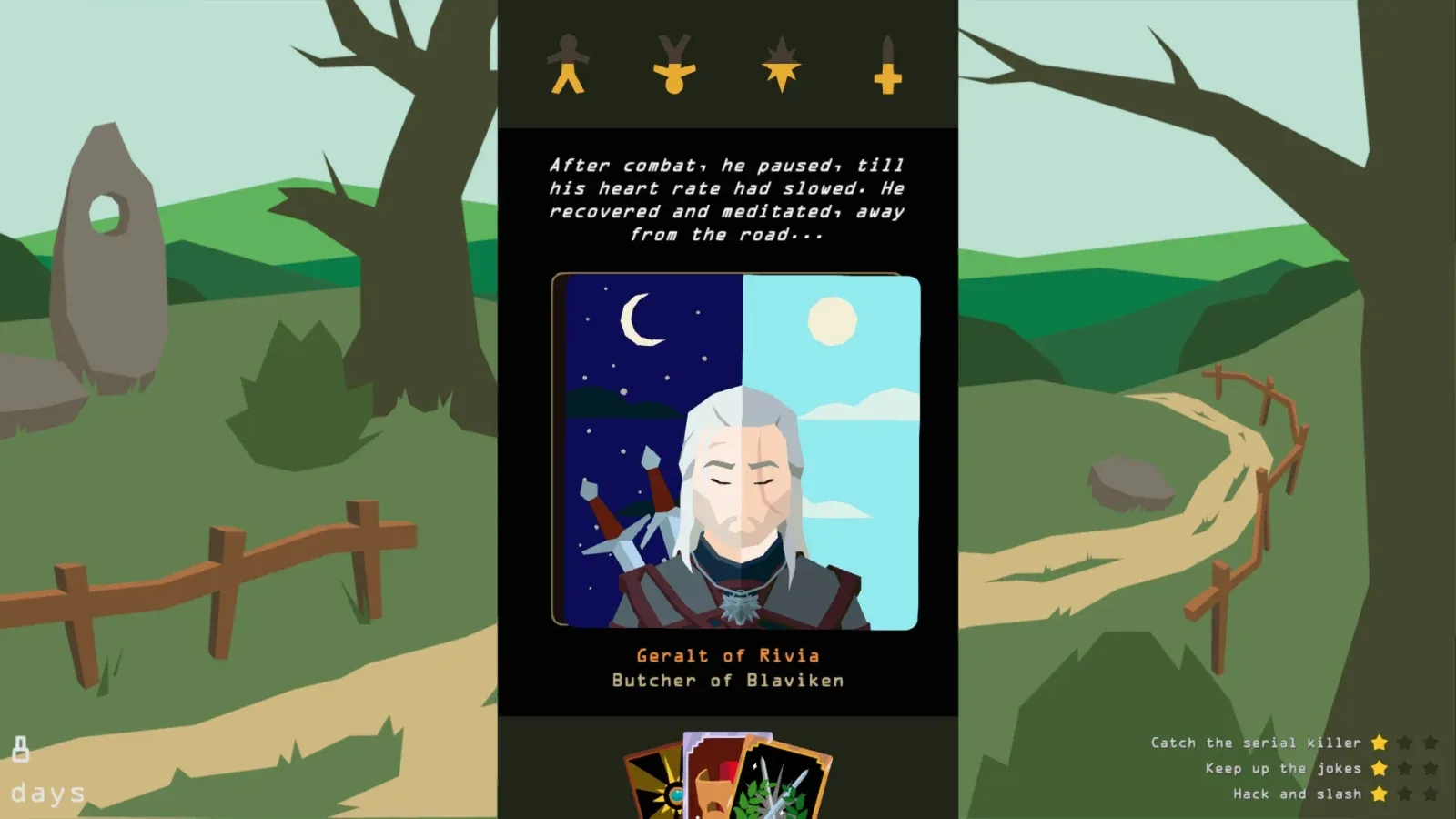
That breakthrough led to further entries and licensed offshoots, including games based on Game of Thrones and The Witcher. Nerial later released projects with very different identities, including the elaborate card-cheating adventure Card Shark and the reality-TV murder mystery game The Crush House.
Alliot made clear that the studio has not simply been defined by failure since the original Reigns success. However, the commercial results of the more recent games were lower, and the experience has prompted him to reconsider what he wants from an indie career. The challenges of the post-pandemic games business are part of that assessment, alongside the need to rebuild from firmer creative and practical foundations.
A Mutual Split With Devolver Digital
Nerial was acquired by Devolver Digital in 2021. Alliot described the decision to close as mutual and spoke positively about the relationship between Nerial and its parent company. Still, becoming an internal studio changed the creative equation.
As an internal team, Nerial's games needed to fit within Devolver's publishing plans and identity. Alliot said that this alignment worked well for projects such as Reigns and Card Shark, where there was a natural common ground. Yet he also described the subtle friction that can emerge when each potential project must be considered through the needs and preferences of more than one party.
For a small independent creator, that can mean spending more time anticipating expectations and less time following a single, immediate instinct. Alliot said he recognizes the loss of focused energy that can occur in that situation, and wants to recover some of the directness that comes with a smaller operation.
The closure does not mean Nerial's past work disappears. Devolver will retain the rights to the studio's existing catalog. Alliot is comfortable with that arrangement, saying that he has already expressed what he wanted to express through those games. Should Devolver decide to pursue another Reigns, a Card Shark 2, or another project connected to the catalog, he expects the company would contact him.
What matters most to Alliot at this stage is retaining his prototypes: the early ideas and experimental work that may become the foundation for something entirely new. It is a notable distinction. The completed games belong to Nerial's history, while prototypes represent possibilities that have not yet been defined by a business plan, audience expectation, or established series.
Seven Team Members Are Leaving
The human cost of a studio closure remains significant even when its founders intend to keep creating. Nerial consists of nine people, and while Alliot and Tamara will continue working together, seven staff members are being let go.
Alliot said he hopes to collaborate with them again as contractors in the future, though he is not currently able to keep them on as employees. He specifically praised the departing team members and highlighted their contributions to Nerial's games:
- Helen O'Dell, artist on Reigns
- AJ Kerr, producer
- Gordon Speirs, developer
- Ben Obikoya, developer
- Neil Goodman, developer
- Oscar Harrington-Shaw, writer of Reigns: The Witcher
- Neil Bull, designer
Alliot particularly noted the long industry experience of Speirs and Goodman, who each have around three decades in games. The acknowledgement is important in an industry where closure announcements can too easily reduce a team's work to a corporate footnote. Nerial's catalog was the result of a group with distinct disciplines: writing, visual art, design, production, and development all helped turn unusual concepts into finished releases.
The timing also makes the transition harder. Game-industry employment remains volatile, with many experienced developers looking for work at the same time. Alliot said he is not personally worried about his ability to move forward, but recognized that this is a harsh moment to release people into an already crowded and unstable job market.
AI, Copycats, and the Speed of Change
Alliot's concerns extend beyond the traditional cycle of investment booms and contractions. He sees a games landscape changing with unusual speed, particularly as AI tools make it easier to reproduce the surface of a new concept and flood digital storefronts with variations.
For creators whose work depends on distinctive hooks, style, and unexpected combinations of familiar ideas, that speed can be alarming. A game may take years to develop, only for its immediately visible premise to be copied or reshaped into countless low-effort alternatives almost as soon as it is shown publicly.
That does not necessarily eliminate the value of the original work. Execution, craft, writing, visual sensibility, and player trust are difficult to reproduce merely by copying a pitch. But it can make the market noisier and make discovery more difficult, especially for small teams without enormous marketing budgets.
Alliot compared the current feeling to being caught in a washing machine running at full speed: disorienting, fast, and hard to predict. He believes the industry is still processing these shifts and suggested it may take years before their longer-term effects become clear. His hope is that the medium ultimately emerges in a healthier position.
Despite that uncertainty, he remains convinced there are still new things to say through games. That conviction is the key reason this is not a retirement story. It is a decision to reduce the scale of the operation in order to protect the conditions that make original work possible.
Looking for Inspiration Beyond the Studio
For the immediate future, Alliot plans to breathe after the pressure of running Nerial. He has been visiting art museums in Paris, including the Louvre and the Musée d'Orsay, almost daily in search of inspiration. He suggested that art could play some role in his next project, though no specific game has been announced.
That open-endedness seems central to the move. Nerial built a recognizable history through compact, clever systems and sharply authored worlds, but Alliot is now seeking room to explore before committing to another production cycle. The next game may be smaller, stranger, or simply shaped by a different set of priorities than those that governed a nine-person studio.
Nerial's closure is therefore both an ending and a reconfiguration. Its established catalog will remain with Devolver Digital, its former team members will move into an extremely challenging employment landscape, and two of its original creative forces will continue independently. For players, the immediate future may be uncertain. For Alliot, the goal is clearer: make space for a new voice, new prototypes, and ideas that have not yet been forced to fit anyone else's definition of what a game should be.
Community
Discussion
Start the conversation.
No comments have been posted yet.