

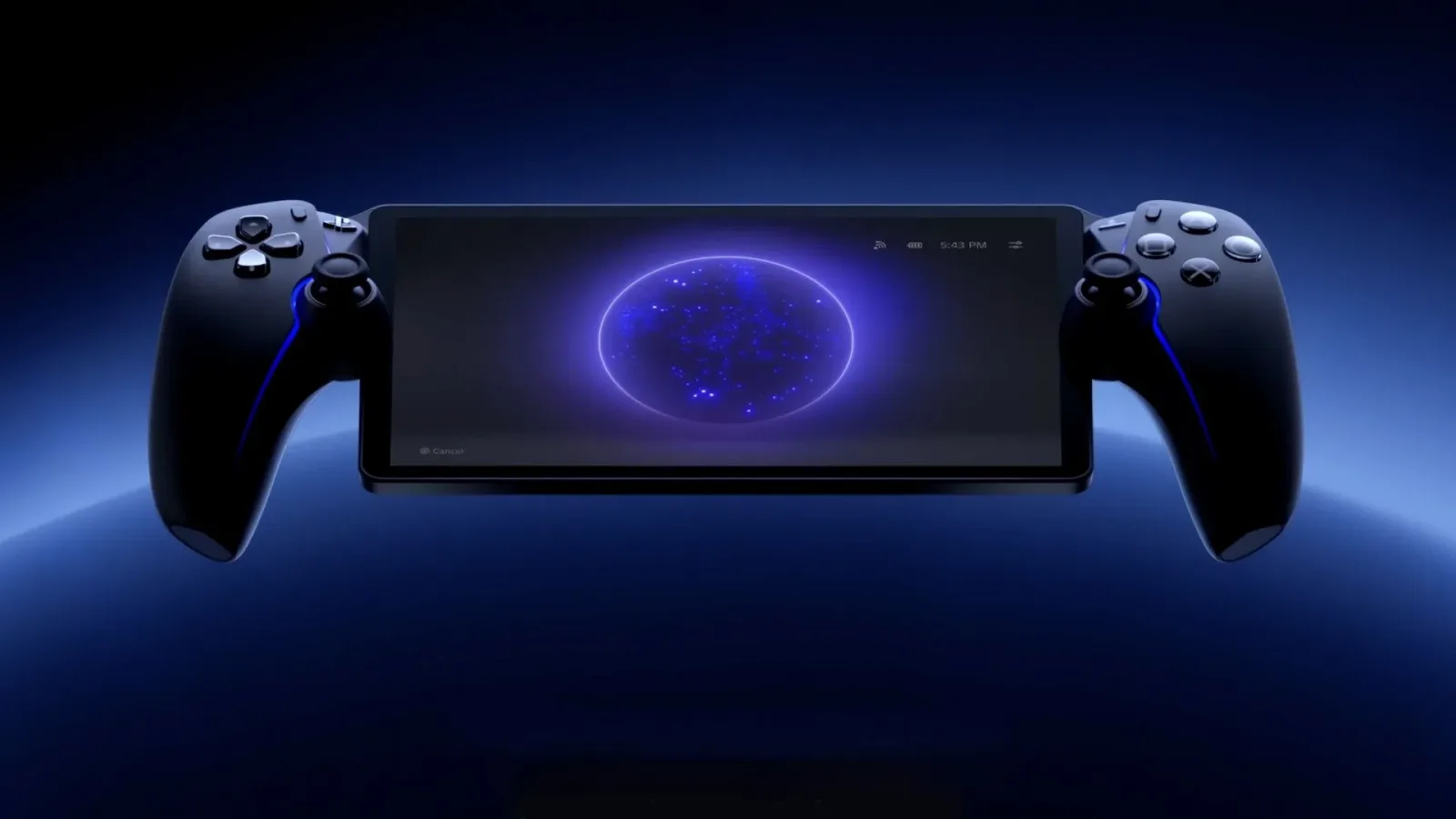
Sony has announced a revised PlayStation Portal model for Japan that retains the familiar remote-play focus of the existing handheld while adding one potentially significant change: internal storage. The company has described that storage as preparation for "future functionality," but has not yet confirmed its capacity, its precise purpose, or when the features it supports might arrive.
On the surface, the update sounds modest. PlayStation Portal remains a dedicated device built around accessing compatible PlayStation 5 games remotely, either from a user's own PS5 console or, in supported circumstances, through cloud streaming tied to a PlayStation Plus Premium subscription. Yet storage is an intriguing addition for a product originally positioned primarily as a streaming and Remote Play companion rather than a conventional standalone gaming system.
That wording from Sony leaves plenty of room for questions. Internal storage could be intended for larger system updates, downloaded applications, offline media, expanded cloud-streaming support, cached content, or another feature that has not been disclosed. There is currently no confirmation that the new Portal can install or run PS5 games natively, and nothing announced about upgraded processing hardware that would make that scenario likely.
A familiar Portal design with an important unanswered question
The original PlayStation Portal launched as an accessory for the PS5 ecosystem, combining an 8-inch display with controls based around the DualSense controller. Its defining feature is Remote Play: games run on a PlayStation 5 and are streamed to the Portal over a network connection. More recently, PlayStation has also expanded its cloud-streaming ambitions on the device for eligible PlayStation Plus Premium users, making it possible to access selected titles without necessarily relying on a locally owned PS5 in every use case.
For useful background on this topic, read Mass Effect Universe Was Intended to Complement Amazon's Planned TV Series, Former BioWare Lead Says.
That role is important context for the new Japan model. The Portal has not traditionally needed substantial user-accessible storage for full game installations because it is not designed to store PS5 software locally. As a result, Sony's decision to specifically highlight additional internal storage, rather than quietly including it as a routine specification revision, invites speculation about where the platform could go next.
Sony has not provided a full feature breakdown for the storage addition. It has also not stated whether owners will see it as usable space, whether any portion will be reserved for system functions, or whether the model's software will initially differ in a noticeable way from the current Portal. More details are expected after the company finalizes the plans surrounding that future functionality.
The lack of a defined use case means it would be premature to treat this announcement as confirmation of native game downloads, a new app ecosystem, or a major change to the Portal's central purpose. The device's existing hardware and positioning still point toward remote and cloud-delivered play. However, the move does suggest that Sony sees value in giving the handheld more headroom for capabilities beyond its original launch configuration.
Why internal storage matters for a streaming-focused handheld
Storage has a straightforward role in most portable gaming hardware: it holds games, save files, downloadable content, screenshots, videos, and system data. The PlayStation Portal is different because its games are generally being processed elsewhere. A PS5 handles locally streamed games, while cloud servers handle cloud-streamed sessions. That architecture lowers the need for a large game-install drive on the handheld itself.
Even so, local storage can become useful quickly as a connected device evolves. Operating systems become larger over time, and new service features may require local files, temporary downloads, security components, interface assets, or cached data. A device that is initially built for one core service can also gain convenience features that make additional storage more practical.
There is some precedent for looking closely at available space on the existing Portal. Shortly after the handheld launched, users found that the device had roughly 6GB of free space. That discovery did not establish an intended storage roadmap, but it showed that the current hardware already contains some room beyond its immediately visible Remote Play function.
The revised model appears to go further, although Sony has not said by how much. The announcement's emphasis on added storage makes it sound more substantial than simply reserving a few extra gigabytes for a routine operating-system update. Until a capacity figure and feature list are confirmed, though, it remains impossible to know whether the difference is small, moderate, or a genuinely meaningful expansion.
Not evidence of a native PS5 handheld--at least not yet
It is easy to see why the news has drawn attention from people watching Sony's wider handheld strategy. Reports and industry discussion have continued to fuel interest in the possibility of a future PlayStation handheld designed alongside the next console generation. The PlayStation 6 is widely expected, though Sony has not formally laid out a complete launch plan or confirmed a companion portable device.
The new Japanese Portal does not settle any of those larger questions. Additional storage alone does not transform a Remote Play handheld into a machine capable of running modern console games directly. Native PS5-class gaming would require much more than a larger drive, including appropriately powerful processing hardware, memory, thermal design, software support, and a distribution framework for downloadable games.
Still, Sony's mention of future functionality is notable because it connects a current consumer product to an unspecified longer-term plan. The Portal has already demonstrated that PlayStation is willing to revisit its handheld approach after the PlayStation Vita era, albeit through a device focused on extending the PS5 experience rather than replacing a console. Adding storage gives Sony more flexibility to develop that approach if it chooses.
For players, the practical takeaway is more restrained: this is an updated Portal with an unannounced storage-related advantage, not a confirmed new generation of portable PlayStation hardware. Any conclusion beyond that would be speculation until Sony explains the feature in detail.
Japan-only launch and regional limitations
The revised PlayStation Portal is set to launch only in Japan. Pre-orders in the region will begin on November 13, and Sony has set the price at ¥39,980, matching the standard model's price there.
It is not currently positioned as an import-friendly edition. Sony has stated that the unit can only be configured in Japanese and requires a Japanese PlayStation Network account to operate. Those conditions make the model primarily relevant to players in Japan, even if collectors or enthusiasts elsewhere are curious about the hardware change.
There has been no announcement of equivalent storage-equipped Portal hardware for North America, the UK, Europe, or other markets. Sony has also not said whether the eventual future functionality will be exclusive to this revised Japanese unit, arrive on existing Portals in some form, or lead to a wider refresh later. Those distinctions could matter considerably, particularly if the storage supports a service expansion that existing models cannot fully accommodate.
What to watch for next
The next official details should clarify several fundamentals. Storage capacity is the obvious one, but it is only part of the picture. Players will also want to know whether the storage is user-accessible, whether it can be expanded, and whether it changes the Portal's day-to-day experience at launch.
The more consequential answers concern software. Sony has not identified the future feature, so observers will be watching for signs of expanded cloud capabilities, changes to the Portal interface, new downloadable utilities, media functions, or other additions. A storage upgrade could support something relatively simple, or it could lay groundwork for a broader update to how the handheld fits into PlayStation's services.
- Storage capacity: Sony has not disclosed how much internal space the new model includes.
- Purpose: The company has said it is intended to support future functionality, without naming that functionality.
- Hardware changes: No significant processing or performance upgrade has been announced.
- Availability: The model is currently Japan-only, with pre-orders beginning November 13.
- Price: It will cost ¥39,980, the same as the regular Japanese PlayStation Portal.
- Regional setup: It is Japanese-language only and requires a Japanese PSN account.
For now, the revised PlayStation Portal is best viewed as a carefully limited hardware update with potentially wider implications. Sony has supplied the clue--more storage intended for something still to come--but not the explanation. Whether that turns into a quality-of-life improvement, a cloud-service expansion, or a hint of a more ambitious portable future will depend on the details Sony has yet to finalize.
Community
Discussion
Start the conversation.
No comments have been posted yet.