

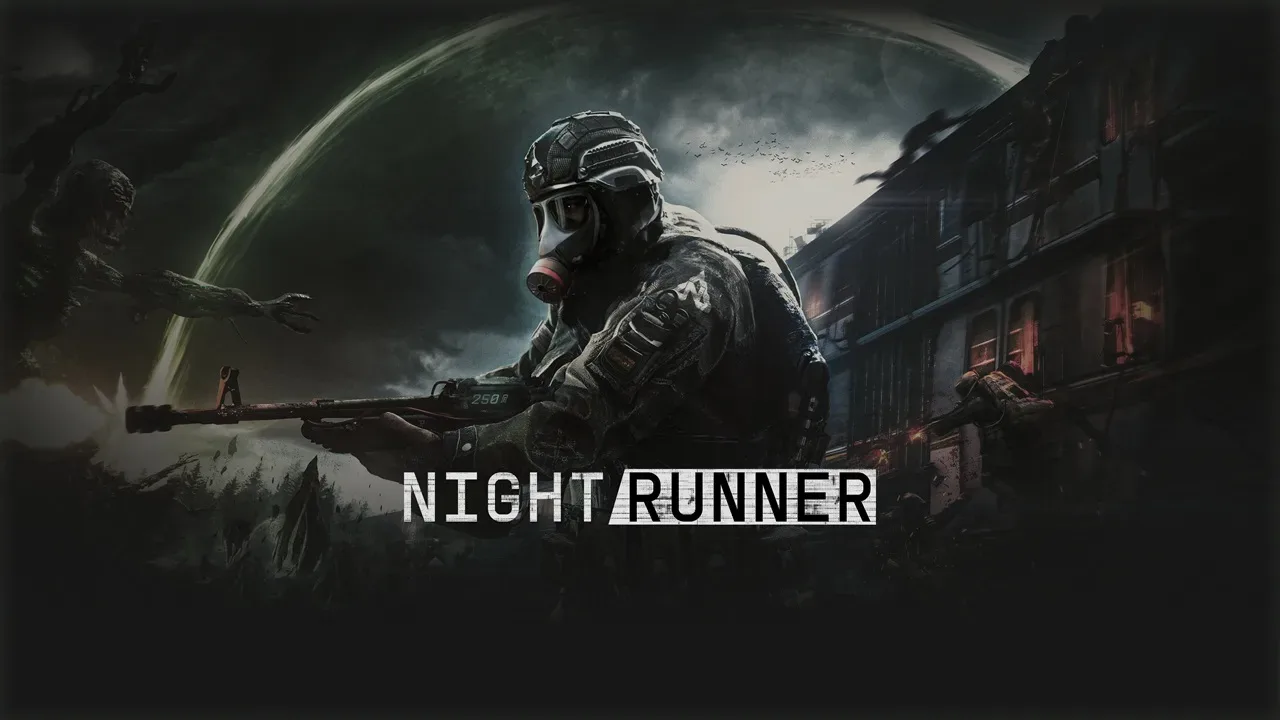
NightRunner, the upcoming co-op survival extraction game from 314 Arts, will begin its first playtest on Saturday, October 3. The test is intended to give players an early opportunity to board the game's dangerous rail network, defend a moving train from mutant attacks, search hostile areas for supplies, and make it back aboard before daylight brings an end to the run.
Announced on September 30, the playtest news arrived alongside a new Devlog trailer offering a more detailed look at the project's current state. NightRunner is planned for Steam in 2027, while sign-ups for the test and Steam wishlist registration are available through the game's Steam page.
At its core, NightRunner is built around squads of one to four players navigating an unforgiving network of rails. The game combines PvE horde survival with extraction-style stakes: players need to complete cargo deliveries and bring back valuable resources, but survival is not guaranteed. A successful crew must judge when to stay out for more loot, when to retreat to the train, and how to defend its most important assets while enemies close in.
A train is both transport and lifeline
Rather than using a static safe house between dangerous excursions, NightRunner places the team's train at the center of its action. The NightRunner rail network serves as the route through hostile territory, and the train functions as the squad's lifeline while they work. Players are not simply travelling from one mission marker to another; they are responsible for ensuring their mobile base survives the journey.
For useful background on this topic, read Allogloom Brings a Hand-Painted Mystery to Steam This October.
The first playable test takes place in an area called The Silent Blocks. Within this setting, crews will defend the NightClaw Wagon against deadly mutants while gathering the resources needed to keep moving. That premise establishes the major pressures at work in every run: the train needs protection, the team needs supplies, and the environment is actively trying to prevent an orderly escape.
NightRunner's day-and-night tension is particularly important to its structure. Squads must fight their way back aboard before the sun catches up. While the announcement does not fully outline what happens when daylight arrives, the phrase frames time as a major threat alongside mutants and dwindling resources. Teams may have to complete objectives under pressure rather than methodically clearing every location, making the decision to extract a meaningful part of the experience.
Defend, scavenge, and extract
The playtest will introduce the game's core gameplay loop: defend the train, leave it to scavenge, then extract with whatever the team has managed to secure. Scavenging zones are designed to offer both ordinary resources and powerful loot. That promise comes with clear risk, since travelling farther from the wagon could expose a squad to greater danger and make it harder to return safely.
For another perspective on this story, read NightRunner's First Playtest Begins October 3 Ahead of 2027 Steam Launch.
In practical terms, this could create a constant division of attention for co-op groups. One player may stay near the NightClaw Wagon to help repel incoming enemies, while others search an area for supplies. Alternatively, a full team might push into a valuable zone together, accepting the possibility that their train is left less protected. How a crew divides its labor, and whether it has the tools to recover from a bad decision, should be central to NightRunner's multiplayer identity.
The game's extraction element also ensures that collecting an item is only part of the job. Players need to survive the return journey and get their haul back on board. Failure can carry serious consequences, with the game presenting an all-or-nothing tension around a squad's gathered rewards. The central question is not merely whether the crew can defeat the next wave, but whether it can leave with anything worth risking the trip for.
NightRunner's setup merges cooperative horde combat with the hard choices of extraction games: protect the train, pursue better loot, and decide when it is time to run.
Four Runners, distinct squad roles
Players will take on the role of one of four playable Runners. Each Runner has an individual kit intended to influence combat, scavenging, and support responsibilities. The announcement does not yet provide the names or a full breakdown of those characters, but the class-based approach suggests that team composition will matter.
Distinct kits can make a significant difference in a game where players are regularly asked to defend a fixed objective and venture into risky supply areas. A squad may want tools that improve its ability to withstand a horde near the train, while another group could prioritize skills that make scavenging runs safer or more efficient. Support-focused options may become especially valuable when a run turns chaotic and a team needs to regroup before making its escape.
That design also gives solo players and smaller parties choices to consider. Since NightRunner supports from one to four players, it will be interesting to see how its Runner systems accommodate crews that cannot cover every role at once. The October 3 playtest should provide the first tangible indication of how flexible the balance is across different squad sizes.
Roguelite runs with persistent advancement
NightRunner is not positioning each outing as entirely disconnected from the next. The game includes Runner-Tech, which can be upgraded through permanent unlocks. This means that although individual scavenging runs carry the danger of losing a haul, progression can continue across the broader experience.
The combination of roguelite mechanics and persistent progression is a notable part of the project's design. Individual expeditions are intended to feel uncertain, with high-value rewards tempting players into increasingly risky situations. At the same time, permanent upgrades can give crews new ways to take on harder work over time. That structure may help establish a long-term rhythm in which players improve their options, attempt more ambitious jobs, and face greater dangers as they become more capable.
There is a natural tension in that model. Persistent unlocks need to feel rewarding without removing the sense that any one run can go wrong. Likewise, powerful loot needs to be enticing enough to make players leave the relative safety of the train, but not so essential that cautious groups feel unable to progress. The first playtest is likely to be a useful early proving ground for those interconnected systems.
What the first test may reveal
For an early playtest, the appeal is not only seeing NightRunner's mutant-filled setting in motion. It is also an opportunity to examine how clearly the game communicates its priorities when several urgent tasks collide. A team may be defending the wagon, managing cargo, searching for resources, and watching the clock at the same time. The best co-op survival games make those overlapping demands understandable while still allowing a crisis to feel genuinely intense.
The Devlog trailer provides the latest extended glimpse at that vision, but a playable build should answer more immediate questions. How punishing are the mutants? How much can a single player accomplish alone? How frequently does a crew need to abandon safety for supplies? And how much room is there for a dramatic last-second return to the train?
Those details remain to be discovered as players get hands-on access. What is clear is that 314 Arts is pursuing a co-op format where the train is more than scenery. The NightClaw Wagon is the target that must be protected, the place a team needs to reach to extract, and the centerpiece around which each run's strategy is built.
NightRunner's road to 2027
The October 3 playtest is the first public step on NightRunner's path toward its planned 2027 Steam release. With its blend of four-player PvE action, horde defense, scavenging, cargo delivery, roguelite-style risk, and ongoing upgrades, the game is aiming for a structure that rewards both quick reactions and coordinated decision-making.
Players interested in participating can register for the playtest through Steam, where NightRunner can also be wishlisted. As development continues, the first test will offer an early measure of whether its dangerous rail expeditions can deliver on the promise of a tense cooperative survival experience where every resource run may be the one that leaves the crew stranded outside after the sun rises.
Community
Discussion
Start the conversation.
No comments have been posted yet.