

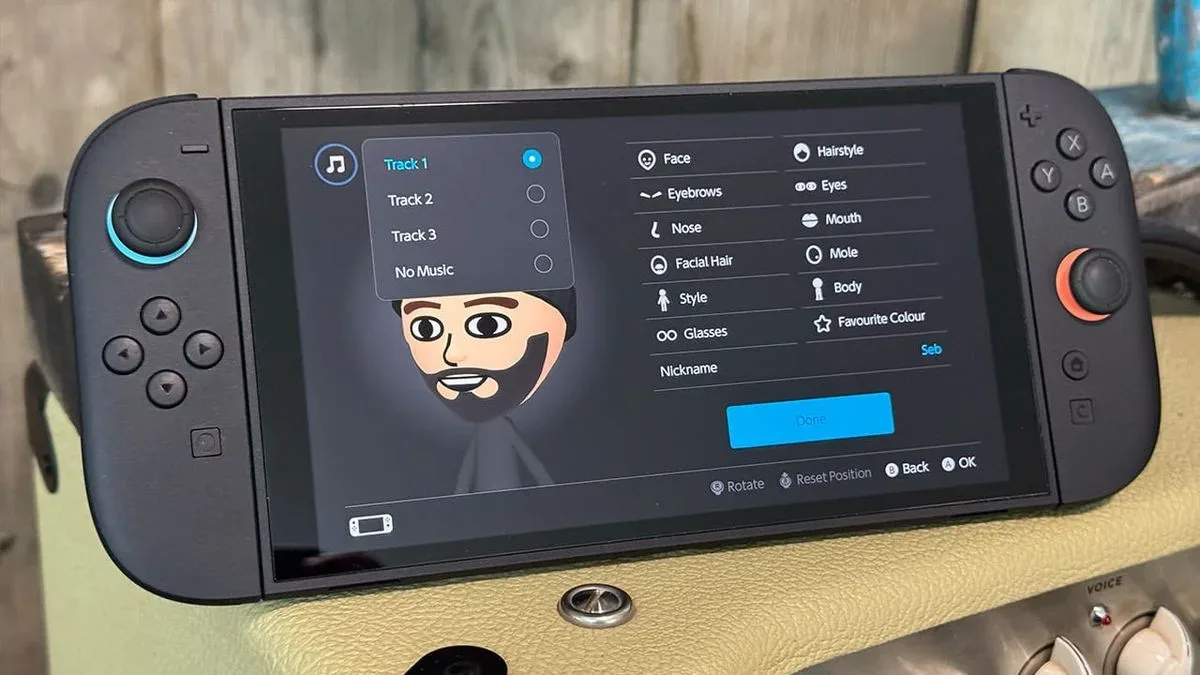
Nintendo has added a small but particularly nostalgic option to Mii Maker on Nintendo Switch and Switch 2. Following a free console update, players can now enable background music while building or editing Mii characters, choosing from themes associated with the feature's appearances on the Wii, Nintendo 3DS, and Wii U.
It is a modest addition on paper: three familiar musical selections inside a character-creation tool. Yet Mii Maker has always held an unusually strong place in Nintendo history. For many players, the sounds of adjusting facial features, hairstyles, and expressions are inseparable from long evenings spent making friends, family members, fictional heroes, celebrities, and increasingly strange creations for use across a range of games.
The update also includes QR code functionality for scanning and creating Mii characters. That feature can be used to share characters with other users, including characters made on Nintendo 3DS and Wii U. Together, the returning music and QR options make the current Mii Maker feel more connected to the systems that helped establish Miis as a major part of Nintendo's identity.
Embedded X/Twitter post
Three eras of Mii Maker, one menu
To find the new audio setting, users can update a Switch or Switch 2 console, open the system settings, and navigate to the Mii Maker section. From there, background music can be selected for the Mii-creation experience. The three tracks represent the Wii, Nintendo 3DS, and Wii U iterations of Mii Maker.
For useful background on this topic, read Alex Kidd in Miracle World ROM Hack Fixes Its Longstanding Punch Collision Problem.
That lineup spans several hardware generations. The original Wii introduced Miis in 2006, presenting them as simplified digital avatars that could be constructed from a wide range of face shapes, eyes, noses, mouths, accessories, and other visual options. The concept was approachable enough for anyone to make a recognizable character in minutes, while the available tools also invited far more elaborate attempts at recreating specific people.
The Nintendo 3DS and Wii U continued that approach, each giving the Mii ecosystem a distinct presentation and musical identity. By putting all three background tracks into the Switch-era Mii Maker, Nintendo is giving players the option to choose which version of that familiar atmosphere they want to hear rather than treating the feature strictly as a functional menu.
The addition is especially notable because Mii Maker music is one of those seemingly minor parts of a console interface that can carry an outsized emotional effect. Hardware menus are often remembered as clearly as individual games, particularly when players spent years returning to them. A short theme heard while crafting an avatar can become linked to school holidays, family game nights, multiplayer sessions, and the excitement of getting a new console.
Why Miis remain a Nintendo fixture
Miis were designed to be flexible. A player could make a straightforward avatar based on themselves, but the appeal quickly grew beyond that. Many households filled their systems with versions of relatives, classmates, actors, musicians, historical figures, and characters from films, books, television, and games. The limitations of the tool were part of the fun: players had to turn a small set of stylized parts into someone recognizable.
Once made, those characters could appear in Nintendo games and applications, helping players bring a personal, often comedic touch to their software. Seeing an approximation of a friend or a famous fictional character appear in a multiplayer race or other activity gave ordinary sessions a more memorable personality. A carefully made avatar could be impressive; a wildly inaccurate one could be just as entertaining.
That communal quality is important to the new QR code support. Sharing has long been central to Mii culture, whether people were passing around creations locally, trading designs online, or trying to reproduce a memorable avatar from scratch. QR codes provide a direct route for moving a character between users, and the ability to use codes with characters created on 3DS and Wii U offers a practical bridge between generations.
For players who accumulated a library of Miis on older Nintendo hardware, compatibility with those character creations can matter more than it might initially seem. These avatars can represent years of in-jokes, family members, or painstakingly tuned designs. Being able to scan and recreate them is not simply about convenience; it can preserve a small collection of personal gaming history.
A free update built around atmosphere
Nintendo's update does not transform what Mii Maker is or introduce an entirely new avatar platform. Instead, it enhances a feature that has become familiar across multiple consoles. That restrained approach suits the nature of the change. Mii Maker is fundamentally a creative utility, and background music is there to make the process more pleasant, more recognizable, and more connected to prior Nintendo systems.
There is also value in allowing players to decide whether they want music playing at all. Character creation can be a quick task when someone only needs a simple avatar, or it can become an extended activity when they are fine-tuning a design. The option to select from multiple themes gives users a little extra control over that experience without placing any barrier in front of the core tools.
For longtime Nintendo fans, the Wii theme may be the one with the strongest immediate pull. The original Wii made Mii creation a highly visible part of setting up and using the console, and its Mii Channel became a cultural touchstone in its own right. But the inclusion of 3DS and Wii U music means the update is not focused on just one nostalgia cycle. Each choice recognizes that different players first encountered Miis on different hardware.
The timing is also fitting for Switch and Switch 2 owners who have continued to use Miis across the modern Nintendo ecosystem. Although Miis may not be as central to every new release as they were during the Wii era, they have not disappeared. The system-level creator remains a way to make an identity that can carry through compatible games and services, while its visual simplicity continues to distinguish it from more detailed modern avatar editors.
Old creations, renewed possibilities
The QR component is likely to be the more practical half of the update for players maintaining a large collection of characters. Rather than manually rebuilding an older Mii feature by feature, users can use supported codes to bring creations into the current setup. That makes it easier to revisit avatars that may have been tied to an older console, whether they were intended as serious likenesses or purely as jokes for local multiplayer.
It also encourages a familiar kind of creativity: sharing designs. Mii communities have always thrived on seeing what other people can make from a limited toolkit. The same collection of eyes, hair, glasses, and face options can produce dramatically different results depending on how they are combined. QR code sharing lowers the effort required to pass along a successful design, allowing another player to scan it instead of attempting to match every setting manually.
For anyone who remembers spending hours populating a system with unusual Mii characters, the update may prompt another visit to the editor. The new music cannot replace the original context of using a Wii, 3DS, or Wii U for the first time, but it can recreate part of the mood. Meanwhile, the QR support gives those old creations a route forward instead of leaving them entirely behind on legacy hardware.
A welcome callback for Switch owners
This is the kind of update that is unlikely to define a console generation, but it does not need to. Nintendo's best interface touches have often been the ones that make a system feel warm, playful, and immediately recognizable. Bringing back Mii Maker music from three earlier platforms is a simple callback, but one with a clear understanding of what players remember.
Switch and Switch 2 users can now revisit the soundtracks of Wii, Nintendo 3DS, and Wii U Mii creation while making a new avatar or restoring an old favorite through QR code support. It is a free quality-of-life addition, a preservation-minded nod to past hardware, and a reminder that some of gaming's strongest memories begin not in a major campaign or competitive match, but in a menu where someone is trying to make a cartoon face look like a friend.
Community
Discussion
Start the conversation.
No comments have been posted yet.