

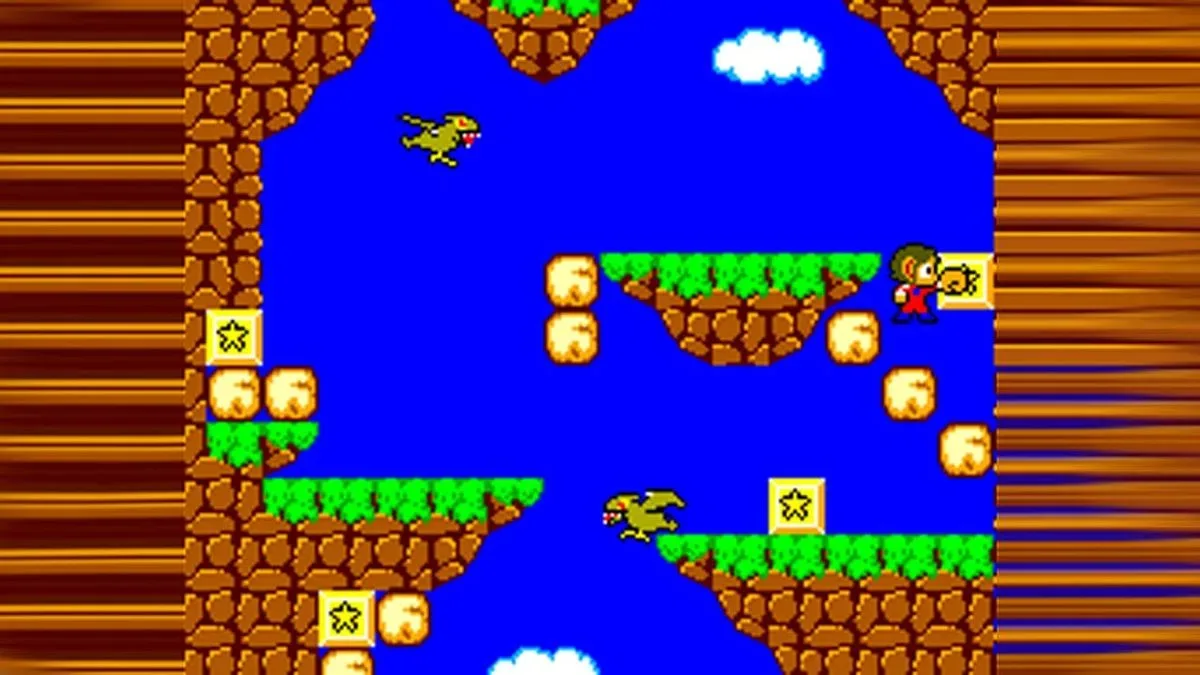
Alex Kidd in Miracle World has received a remarkably focused quality-of-life repair nearly 40 years after its original 1986 release. A new ROM hack by Psicopompo addresses one of the Sega Master System platformer's most irritating technical quirks: punches that appear to hit breakable blocks but fail to destroy them.
For players who grew up with Alex Kidd, the problem may be instantly familiar. Alex's primary action is a punch, used against enemies and to smash blocks that obstruct routes through Miracle World. Yet the game can be unexpectedly fussy about those block hits. A punch delivered while jumping, or one that connects around the corner of a block, may look successful on screen while the game declines to register it. The result is a moment of confusion, followed by another attempt, and sometimes another enemy encounter or lost second in a game where movement is already demanding.
The patch does not redesign Alex Kidd in Miracle World, add new levels, or turn it into an easier game. Its goal is much narrower: make the existing punch behave in a way players reasonably expect. That small distinction is important for a game with a long history and a very recognizable feel. Rather than changing its intended challenge, the hack repairs an unreliable collision check that has frustrated players for decades.
Why Alex Kidd's punches could miss blocks
The original behavior comes down to how the Master System game checks for breakable-block collisions. In the unmodified code, the game performs that check only on the single frame when the punch button is pressed. It also evaluates only one 8-by-8-pixel point.
For useful background on this topic, read Final Fantasy VII Revelation Director Says the Series Can Be More Than a Traditional JRPG.
That approach creates obvious blind spots. If Alex's fist continues moving after the initial input frame, the game does not keep checking whether it reaches a block. Likewise, an attack near a block's edge may fail because the one tested point does not overlap the breakable object, even though Alex's animated fist visibly does. The issue becomes especially noticeable while jumping, a common habit in fast-moving platform games and a natural response to Alex Kidd's level design.
The patch's logic is built around a simple idea: if Alex's extended fist touches a breakable block at any point during the punch, that block should break.
Psicopompo's modification changes the process so collision tests occur continuously on every frame while Alex's fist is extended. Instead of relying on an isolated point checked at the instant the player presses a button, it uses the same fist hitbox already used by the game for striking enemies. That existing enemy-hit area measures 8 by 5 pixels.
For the block check, the patch adds a one-pixel margin on each side, producing a total 10-by-7-pixel tested area. It then samples six points within that space, arranged as three columns and two rows. This prevents gaps across the broader collision area. If any of those points touches a breakable block, the game registers the hit and destroys the block.
On paper, it is a small change to collision detection. In practice, it should make the game's core interaction feel substantially more consistent. The player no longer needs to guess whether the game will acknowledge what the animation appears to show, particularly during airborne punches and attacks near block corners.
A repair rather than a cheat
Retro game patches can sometimes be described as cheats simply because they remove an old inconvenience. This Alex Kidd hack is better understood as a bug fix. It does not give Alex a new move, increase his reach beyond the adjusted collision margin, remove hazards, or bypass stages. It makes the block collision system account for the duration and dimensions of an attack that already exists in the original game.
That distinction matters because Alex Kidd in Miracle World was designed around punching. Unlike many platform heroes who rely on a jump attack, projectile, sword, or other dedicated weapon, Alex must repeatedly use his fists to clear both enemies and environmental obstacles. When punching a block is unreliable, it affects more than a rare edge case. It can interrupt the game's basic rhythm.
The game remains the same Master System adventure, with its colorful stages, vehicles, shops, item choices, enemies, and famous rock-paper-scissors boss encounters. The hack's practical benefit is that a player should be able to concentrate on timing and route selection instead of compensating for a highly limited one-frame collision test.
Button mapping has also been adjusted
Alongside the collision repair, the ROM hack changes the default control layout. Button 1 is assigned to punching, while Button 2 is assigned to jumping.
That mapping may feel more intuitive to many players, as punching is Alex Kidd's most regularly used action. Control preference is naturally subjective, especially for people who learned the original layout decades ago, but the revised order fits the patch's larger purpose: reducing friction in a game whose central mechanics are otherwise left intact.
It is a modest adjustment, but it illustrates the careful scope of the project. The patch is not positioned as an overhaul or a fan-made reinterpretation. It targets a pair of practical usability concerns: reliable punches and a straightforward button arrangement.
Just 121 bytes of new code
One of the most striking details is the patch's size. The entire modification is only 121 bytes. It fits into unused space at the end of the fixed bank in the original cartridge's data layout.
That economy means the hack does not alter the game's checksum or header. For preservation-minded players, that is an appealing technical detail. The patch has been designed to make its correction while keeping changes to the original ROM as contained as possible.
Small patches like this highlight why classic games continue to attract technical attention. Older hardware imposed tight memory limits, and developers often made practical compromises to fit a game into the available space. A one-frame, one-point collision check was an efficient solution, even if it could create situations that feel wrong in play. Decades later, enthusiasts can revisit that logic, identify the cause of a longstanding annoyance, and make an extremely compact correction.
It is also a reminder that an old game's rough edges are not always inseparable parts of its identity. Some are deliberate design decisions. Others are technical shortcuts, bugs, or limitations that players learned to tolerate because there was no alternative. A patch that precisely identifies the latter can improve the experience without erasing what made the original memorable.
What it means for a Master System landmark
Alex Kidd in Miracle World occupies a special place in Sega's 8-bit history. It was one of the Master System's defining games, and for many owners it remains closely tied to the system itself. Its visual style may be simple by modern standards, but its mix of platforming, exploration, item management, vehicle sequences, and unusual boss battles made it stand out in its era.
That legacy also means its quirks have been examined and discussed for a very long time. The unreliable punch-to-block interaction is the kind of issue that experienced players may recognize immediately, even if they never knew the precise code-level reason behind it. Learning that the behavior stems from a single-frame test against one small point makes the old frustration easier to understand.
With the new collision logic, a punch is assessed through the whole period in which Alex's fist is extended, using a broader set of sample points based on the game's own enemy-hitbox behavior. That is a direct technical answer to the feeling that blocks sometimes ignored a legitimate hit.
The patch is available through ROMhacking for players interested in applying it to their own compatible copy. As with any ROM modification, players should make sure they understand the patching process and use game data they are entitled to use.
A tiny update with a visible impact
Not every valuable retro patch needs to be ambitious. This one is only 121 bytes, but it focuses on an interaction players perform throughout Alex Kidd in Miracle World. By making punches register continuously while the fist is out, and by covering the relevant hit area without gaps, it addresses a problem that was both technical and immediately felt at the controller.
For returning Master System fans, the result may be less about discovering a new version of Alex Kidd and more about finally playing a familiar one without a particular recurring irritation. The rocks, blocks, jumps, bosses, and hazards are still there. Alex is simply much less likely to punch directly at a block and be told, by the game's collision code, that nothing happened.
Community
Discussion
Start the conversation.
No comments have been posted yet.