

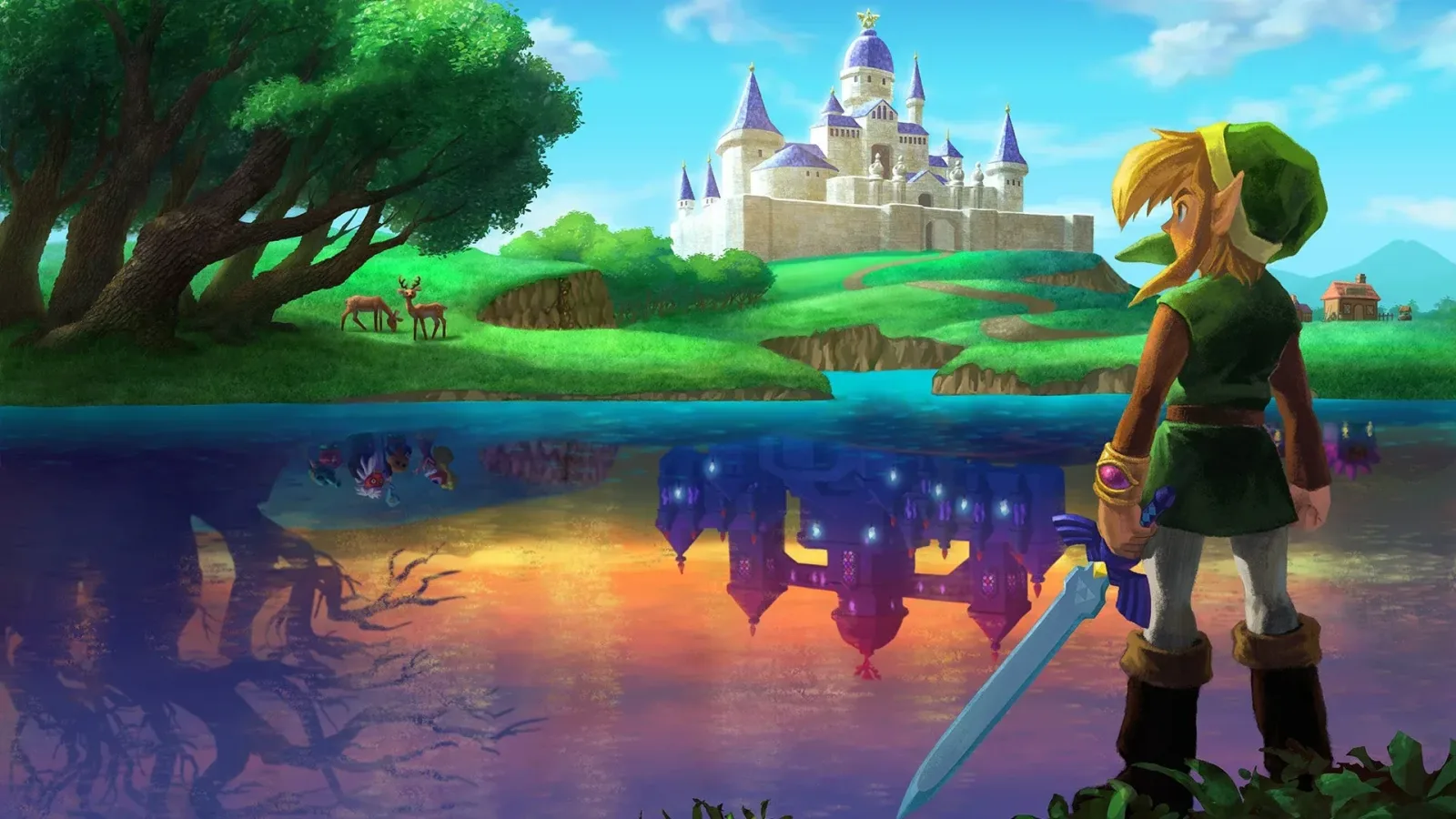
Nintendo has briefly raised hopes that The Legend of Zelda: A Link Between Worlds could one day join Nintendo Switch Online, although there is currently no evidence that a release is actually planned. An official Nintendo anniversary website displayed a Nintendo Switch Online indicator alongside the 2013 Nintendo 3DS adventure, before the marker was removed later the same day.
The appearance was noticed by a Reddit user, who shared a screenshot of the game's entry in the site's History section. The label remained visible into the morning of November 13, 2026. Archived versions of the page indicate that it had been present since at least November 4, when the History section was added to the website. By the afternoon, however, Nintendo had removed the NSO reference.
That timeline makes the situation noteworthy, but it does not make it a confirmation. Nintendo has not announced A Link Between Worlds for Nintendo Switch Online, nor has it publicly explained why the indicator appeared on the anniversary page. Until the company makes an official announcement, the most likely explanation is simply an error in the site's presentation or its underlying metadata.
A promising label with no announced game behind it
The Nintendo Switch Online branding is meaningful because it generally points players toward games available through the subscription service's expanding library of classic software. Seeing that marker attached to A Link Between Worlds naturally invited speculation, particularly among Zelda fans who have been waiting for a convenient modern way to revisit the game.
For useful background on this topic, read PS5 Reaches 100 Million Sales Without a Permanent Price Cut.
But website mistakes happen, especially on large celebratory pages that organize decades of releases, hardware, artwork, and service information. A badge intended for another game, a template element applied too broadly, or an internal placeholder can all create an implication that was never meant to be public. The fact that the label was subsequently removed supports the possibility that it was an accidental listing rather than an intentional tease.
There is also an important distinction between a game being represented on a historical timeline and being confirmed for a subscription catalog. Nintendo's anniversary material is designed to commemorate the company's history, and a Zelda title as acclaimed as A Link Between Worlds has an obvious place there regardless of its current availability. The unexpected part was specifically the NSO designation, not the game's inclusion in Nintendo's wider retrospective.
Still, fans have good reason to watch developments closely. The game remains a major entry in the series, and its original platform creates a real accessibility problem for players who do not still own Nintendo 3DS hardware and software.
Why A Link Between Worlds remains difficult to access
Released for Nintendo 3DS in 2013, The Legend of Zelda: A Link Between Worlds is a spiritual successor to the Super Nintendo Entertainment System classic The Legend of Zelda: A Link to the Past. It revisits the recognizable geography of Hyrule while building an identity of its own through a more flexible structure, a rental-based item system, and its standout wall-merging ability. Link can become a two-dimensional painting and move across walls, opening up puzzles and traversal ideas that could not have existed in the older game.
The title is also regularly cited as one of the strongest Zelda games released on a handheld system. Its balance of familiar top-down action and fresh dungeon design made it an especially welcoming option for newcomers, while its freedom in approaching many objectives gave longtime players room to experiment. It occupies an unusual but important position in the franchise: it is both deeply connected to a beloved 16-bit Zelda and distinctly shaped by the Nintendo 3DS era.
At present, playing it through official means requires access to a Nintendo 3DS-family system and a usable copy of the game, whether physical or previously purchased digitally. With the older console storefronts no longer active for new purchases, that route is much less straightforward than buying a current release or opening an app on Switch hardware.
This is not solely a Zelda issue. Nintendo's DS, 3DS, Wii, and Wii U libraries include many games that remain tied to their original machines. Players who missed those systems, whose hardware no longer functions, or who only entered Nintendo's ecosystem more recently may find that substantial portions of the company's catalog are not readily available through official channels.
Switch Online has expanded, but the 3DS remains outside the service
Nintendo Switch Online has steadily broadened its retro offerings over time. The service began with NES games and later added libraries associated with Super NES, Game Boy, Game Boy Advance, Nintendo 64, Sega Genesis, and GameCube. The addition of Game Boy Advance and GameCube software has made the prospect of more modern Nintendo platforms feel less far-fetched than it once did.
That does not mean every remaining system is equally simple to support. Nintendo DS and Nintendo 3DS games were built around dual-screen hardware, and many used touch controls, microphones, cameras, local wireless features, stereoscopic 3D, or system-specific functions. Bringing those games to a single-screen or hybrid console involves design decisions that go beyond ordinary emulation. Nintendo would need to determine how to display both screens, map touch input, account for interface-heavy software, and preserve the experience without making it cumbersome.
A Link Between Worlds may be a relatively plausible candidate in some respects because its core action is not defined by the 3DS's glasses-free 3D effect. Yet its original design still relies on the handheld's two-screen layout and touch interface. A potential Switch version could require thoughtful adaptation even if Nintendo chose to distribute it through a classic-game application rather than as a separate remaster.
The same questions apply to any hypothetical DS or 3DS expansion for Nintendo Switch Online. Some games may translate elegantly with a split-screen presentation or optional control modes. Others could be awkward without major revision. Nintendo has not said whether either platform is on its roadmap for the service.
What the removed indicator could mean--and what it should not mean
The brief listing is best treated as a curiosity, not a promise. It demonstrates only that an NSO marker appeared on an official page for a limited period and was later taken down. It does not establish that Nintendo has a finished emulator, a 3DS catalog, a remaster, a release window, or a new subscription tier in development.
There are several possibilities, and the mundane ones remain strongest:
- A page-production mistake: A Nintendo Switch Online badge may have been attached to the wrong entry while the anniversary site was assembled.
- A template or database issue: The site could have pulled an incorrect availability field from a broader content system.
- An internal placeholder: A label intended for testing or future planning might have been made visible unintentionally.
- A genuine future consideration: Nintendo may have explored the idea internally, though the public listing alone cannot show whether that consideration has progressed into a release plan.
Only the final possibility would give fans what they want, and even that would not guarantee a Switch Online launch. A game like A Link Between Worlds could theoretically return through a standalone port, a remake, a larger Zelda collection, or another format entirely. None of those outcomes has been announced.
An understandable hope for Zelda preservation
Even if this turns out to be nothing more than a web error, the enthusiastic reaction reflects a larger desire for better preservation and access to Nintendo's handheld catalog. Zelda has been fortunate compared with many long-running series: several foundational games are available in modern forms, and Nintendo continues to celebrate the franchise across new releases and legacy collections. But the path through the full series remains fragmented.
A player can experience some major Zelda eras on current hardware, then encounter gaps created by platform exclusivity. For a franchise with a long history of mechanical experimentation, those gaps matter. The touch-driven ideas of Phantom Hourglass and Spirit Tracks, the 3DS-specific presentation of A Link Between Worlds, and the asymmetrical concepts of certain Wii U titles all illustrate periods that are difficult to preserve through one universal approach.
For now, The Legend of Zelda: A Link Between Worlds remains a Nintendo 3DS game rather than a Nintendo Switch Online title. The removed website label offers a small reason for fans to keep the possibility in mind, but not a basis for expecting an announcement. Nintendo's next move--if there is one--will need to come through a clear official reveal rather than a short-lived icon on a retrospective webpage.
Community
Discussion
Start the conversation.
No comments have been posted yet.