

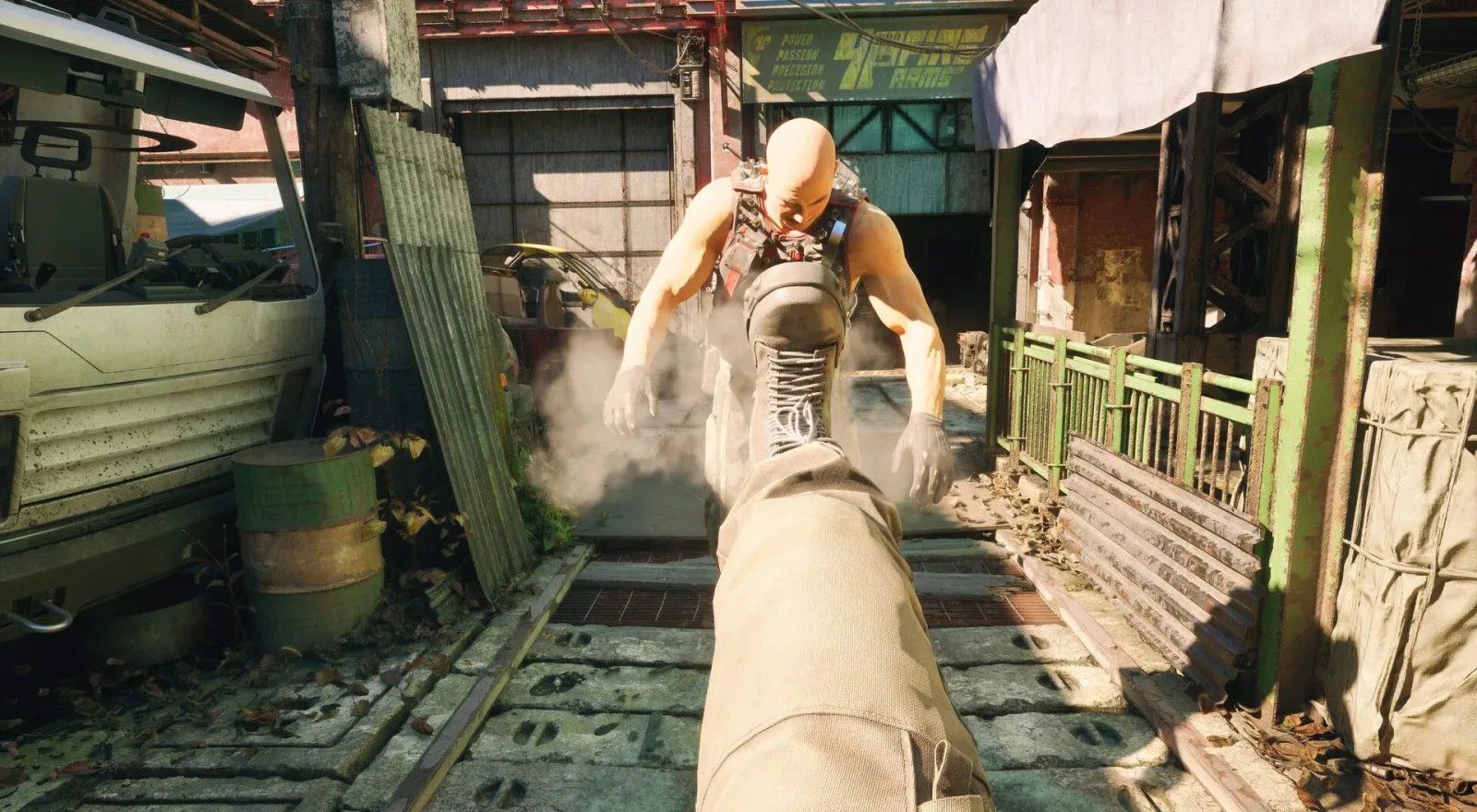
No Law is shaping up to be a cyber-noir RPG that wants players to treat its city as a real place rather than a sequence of combat arenas. Neon Giant's upcoming first-person game is set in Port Desire, an intricate urban setting filled with cramped apartments, shops, stairwells, elevated paths, suspicious residents and seemingly minor objects that may have unexpected uses. Its central promise is simple, but ambitious: players should be able to pursue objectives in the manner they find most satisfying.
That could mean patiently slipping around guards, studying an environment for a hidden route and avoiding violence altogether. It could also mean taking a much louder approach, stealing supplies, firing into a crowded courtyard, and improvising explosive devices from objects found in the world. One demonstrated creation turns a store's entrance chime sensor into a proximity mine when paired with a grenade. Another example shown for the game has a grenade mounted on a Roomba-like robotic vacuum, creating a mobile remote-controlled bomb.
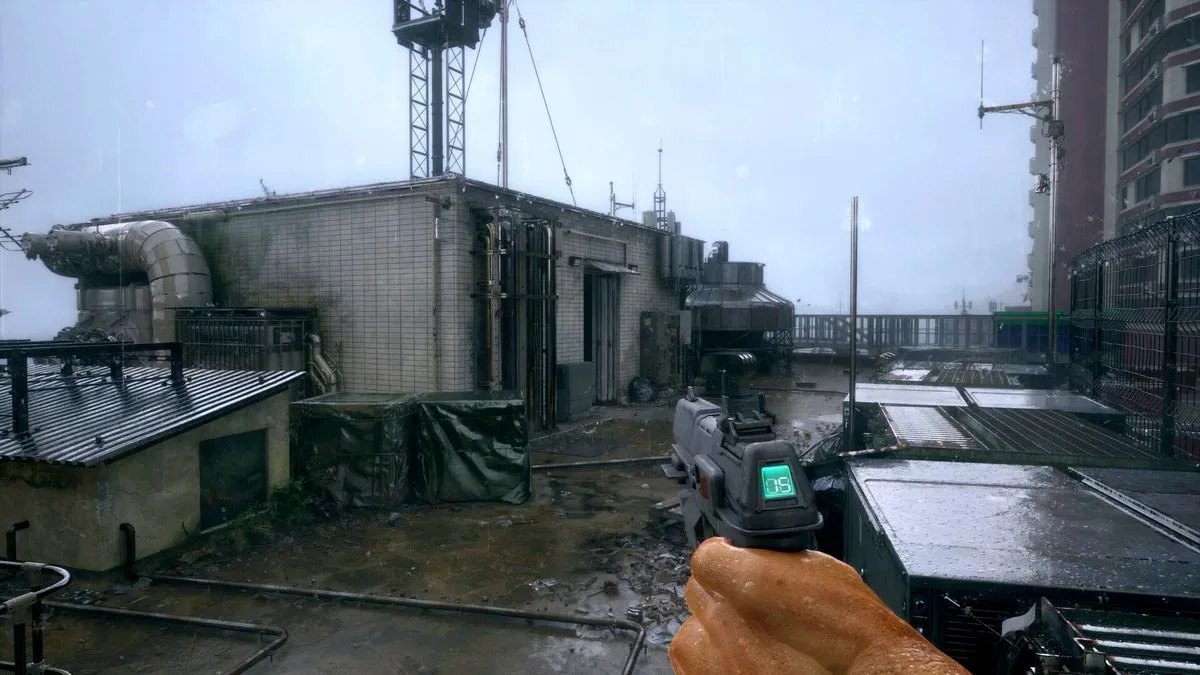
At the center of the experience is Grey Harker, a gruff detective navigating Port Desire and its many layers. The city combines Southeast Asian and Mediterranean influences, giving it an identity that extends beyond a familiar neon-drenched cyberpunk skyline. During daylight hours, greenery, crowds and small urban animals contribute to the sense that people live and work there. At night, the mood changes: pedestrians become scarcer, more dubious figures linger in the streets, and neon lighting overwhelms much of the environment's natural color.
That contrast is important to No Law's atmosphere. Port Desire is intended to feel inviting enough to inspect closely, while also retaining the grime, menace and social tension expected of a cyber-noir setting. Harker's detective role gives players a natural reason to look carefully at what is around them, but the game is not designed to demand the same level of scrutiny from everyone.
For useful background on this topic, read Super Mario Odyssey Helped Shape Onimusha: Way of the Sword's Tactical Combat.
"You can't play No Law wrong," creative director Arcade Berg said while discussing the game's flexible design.
The statement reflects Neon Giant's broader approach to progression and role-playing. The game is not expected to reward a combat-heavy player with more experience than someone who relies on stealth or conversation. Rather than presenting one route as the most efficient or correct way to advance, the team is building scenarios with room for different methods and different versions of Harker.
A Compact City With Vertical Space to Explore
No Law does not let players drive vehicles, a limitation that appears closely tied to its world design. Since traversal happens on foot, locations are being arranged within walking distance of one another. But Port Desire is not meant to be small in a simplistic sense. Its density comes from verticality, interiors and the promise of accessible spaces.
Buildings stack opportunities on top of each other. Stairways, awnings, windows, ducts and apartments provide routes that are not immediately obvious from the street. The developers have said that every door encountered can be accessed, suggesting that exploration will extend well beyond the city's exterior paths. A single building may offer enough rooms, passages, secrets and inhabitants to occupy players for a significant amount of time.
That focus can help distinguish No Law from open-world games built around long drives between objective markers. Instead of emphasizing sheer landmass, Neon Giant appears to be concentrating on a dense playable space where a store, a courtyard and an apartment complex can all become interconnected pieces of a larger problem. The appeal is not merely reaching the next mission destination. It is seeing whether a vent, a sensor, a sleeping guard or a locked door can be turned to the player's advantage.
One Objective, Very Different Infiltrations
A demonstration of an apartment-complex mission illustrates how No Law's systems may work in practice. The objective is to locate a missing informant inside the building. Before approaching the complex, Harker can visit a convenience store to restock. Rather than handling purchases through abstract menus, the store's products are fully modeled and placed on shelves, allowing players to look through its inventory in the environment itself.
There is also an immediate moral and practical decision: players can pay the clerk, or they can steal. That choice is not just decorative. In a more aggressive run through the mission, the clerk is killed and the store is looted before the player leaves the area to avoid attention from authorities. The game's design seems keenly interested in giving players the tools to make bad decisions, while ensuring those decisions have consequences.
On a stealth-oriented attempt, the approach to the apartment building begins from above. Harker climbs onto an awning and bypasses guards outside. Looking through a window reveals a room where a guard is asleep, with a conveniently open doorway nearby. Inside the complex, the manager initially blocks direct access to the rooms upstairs. Rather than shooting through the obstacle, Harker can use conversation and a modest investigative puzzle to earn passage to the upper floor.
Even then, the target room remains out of reach through conventional means. The solution is to return to the open room seen from outside, carefully pass the sleeping guard and crawl through filthy air ducts. Cockroaches scatter, cobwebs catch and break, and the building's deterioration becomes part of the route. This is the kind of tactile environmental detail that can make a stealth path feel more like an actual infiltration than a binary prompt to press.
The more forceful version of the same mission takes a dramatically different shape. After taking supplies from the convenience store, the player removes the sensor responsible for its welcome chime. Combined with a grenade, it becomes a proximity-based explosive trap. A harmless piece of retail hardware is therefore transformed into a weapon, demonstrating that No Law's crafting is about contextual invention rather than only following familiar crafting recipes.
From the awning overlooking the complex, the player opens fire on guards in the courtyard with an SMG and explosives. The manager who previously required persuasion is eliminated, and the route to the apartment changes again. Instead of solving the earlier problem, the player navigates around locked doors, finds the master key and gains access that way. Sleeping enemies can also be handled differently: rather than killing them, a taser offers a non-lethal option even during a generally violent run.
Violence Is Possible, but It Is Not Invisible
No Law's freedom does not mean the city will ignore player behavior. Every NPC can apparently be killed, but death is permanent. That principle gives weight to the game's chaotic possibilities. Players may be able to clear a path through lethal force, yet they cannot expect Port Desire to reset emotionally around them once the shooting stops.
Leaning into violence affects how the city's citizens see Harker. The more fear the player creates, the more people in Port Desire come to fear them. The full extent of that reaction system has not yet been detailed, so it remains unclear how broadly it will alter quests, dialogue, prices, access or future encounters. Still, it establishes a meaningful distinction between being allowed to cause destruction and being encouraged to do so without consideration.
This creates an interesting role-playing tension. A player can build Harker into an intimidating figure who solves problems with weapons, shock devices and improvised explosives. Another can approach the same city as an investigator, avoiding casualties, searching rooms and exploiting overlooked paths. Neither style is framed as the route that earns more experience or represents the intended way to play.
For games that advertise player freedom, this balance can be difficult to achieve. A title may technically permit stealth while making combat clearly more rewarding, or offer dialogue choices that ultimately return to the same firefight. No Law's early demonstration suggests Neon Giant is trying to support divergent approaches at the system level, from infiltration and access solutions to citizen reactions and item combinations.
A Cyberpunk Playground With Room for Curiosity
Perhaps the most encouraging element of No Law is its attention to small, seemingly unnecessary details. A chime sensor near a shop entrance would be easy to dismiss as set dressing. Making it interactive is one thing; suggesting it can become part of an explosive trap is another. That kind of detail encourages players to wonder what else might be useful, removable, combinable or worth investigating.
The same applies to windows revealing interior spaces, sleeping guards who create opportunities, and buildings with doors that can be opened rather than merely viewed. No Law's vision of Port Desire is not only that of a beautiful city to look at, but of a place whose components can be manipulated. Its world design appears to ask players to be observant without insisting they must inspect every corner.
There is even one playful caveat to the game's flexible character-building philosophy: the developers have indicated that removing Grey Harker's moustache is the one truly incorrect choice. Beyond that facial-hair warning, No Law seems prepared to accommodate wildly different player instincts.
No Law is planned for a 2027 launch. There are still major questions to answer before release, including the full scope of Port Desire, the depth of its consequence systems and the range of possible item combinations. But its early showing presents a compelling premise: a focused, vertical cyberpunk city where conversation, stealth, exploration, theft, gadgets and outright mayhem can all be legitimate ways forward. For players who want an RPG that rewards curiosity as much as firepower, Port Desire may be a city worth watching.



Community
Discussion
Start the conversation.
No comments have been posted yet.