

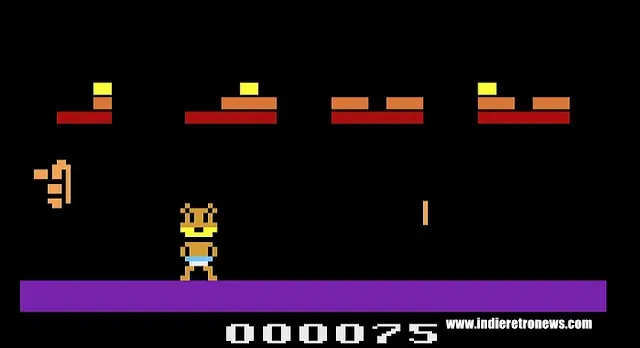
No Quarter is a newly announced platformer for the Atari 2600 from developer ArugulaZ, built around a simple but demanding survival-and-collection challenge. Players guide the returning character Byron, now also known as Kid Kodiak, through four playable stages while gathering enough coins to move on and avoiding an increasingly dangerous fall of acid rain.
It is a concept that sounds direct in classic arcade terms: stay alive, keep moving, collect the required money, and do not fall through the floor. But No Quarter's premise suggests that its tension will come from how quickly those demands collide. The rain grows more severe as a run continues, while holes in the stage create another constant threat. Progress is tied to collecting $1.50 in coins, giving each level a concrete goal beyond merely lasting as long as possible.
For Atari 2600 enthusiasts, the project is also another example of developers continuing to make new games for a machine whose original commercial era ended decades ago. No Quarter embraces the compact, immediate structure associated with early console action games, yet it is being presented as a fresh game rather than a reissue or revival of an older release.
Kid Kodiak Returns With a Different Motivation
No Quarter brings back Byron, a character associated with ArugulaZ's earlier work. This time, the character has received the affectionate Kid Kodiak nickname and has apparently set aside a familiar appetite for fruit in favor of chasing arcade cash. That playful setup establishes the game's tone, but the objective itself is serious: collect $1.50 in coins to advance through the stages.
For useful background on this topic, read Mario Kart World Adds 10 Super Mario Kart Retro Tracks in Free Update.
The use of a specific dollar amount is especially fitting for a game drawing from arcade-minded design. Coins are not just a scoring abstraction here; they are the key to moving forward. Every movement decision is therefore likely to carry an immediate trade-off. A coin may be close to a gap in the floor, positioned in a more exposed part of the level, or tempting enough to pursue while the acid rain is becoming harder to manage.
That combination gives No Quarter a recognizable risk-and-reward structure. The player cannot simply find a safe position and wait for a stage to end. Survival must be paired with active collection. At the same time, rushing blindly for money creates danger because both the terrain and the rain can end a run. The four-level format means the game has a defined finish line, but the final stage is described as particularly brutal.
Acid Rain Is the Central Escalating Threat
The defining hazard in No Quarter is a deadly downpour of acid rain. Rather than functioning as a static obstacle, the storm intensifies while players are trying to complete their coin total. This creates a built-in escalation curve: early moments may allow room to understand the stage and plan a route, while later moments put increasing pressure on reaction speed and positioning.
Hole-hopping forms the other half of the challenge. Falling through openings in the floor is fatal, so the player must pay attention to the ground as well as the sky. That dual focus is well suited to the Atari 2600's action-game heritage. Limited visual space can become part of the tension when the player is simultaneously tracking safe footing, incoming hazards, and the location of the coins still needed for advancement.
ArugulaZ has framed failure with deliberately absurd humor. Kid Kodiak is not merely defeated after falling or being caught by the toxic deluge; the punishment is jokingly described as an eternity at the Earth's core listening to Rick Wakeman concept albums. The gag helps underline the game's knowingly punishing nature without disguising it. No Quarter is clearly aimed at players who enjoy repeated attempts, fast learning, and the satisfaction of finally surviving a demanding stage.
Four Playable Levels and a Tough Final Test
No Quarter contains four fully playable levels. That is a concise structure, but it does not necessarily mean a brief experience for players facing the game's hazards. In difficult arcade-style platformers, replayability frequently comes from mastering routes and timing rather than from sheer level count. The intensifying rain mechanic should make efficient movement important, while the coin requirement ensures that a player must engage with each stage rather than only avoid danger.
The fourth level is presented as the game's ultimate challenge. ArugulaZ jokingly suggests that anyone able to conquer it has earned a bear patch, even if obtaining one requires swindling a local Cub Scout. It is not a formal in-game reward announcement, but it is a clear indication of the intended level of difficulty. Players who are drawn to the project should expect the last stage to demand the strongest grasp of its movement, terrain reading, and hazard management.
That tone matters because it sets expectations honestly. No Quarter is not being positioned as a relaxed retro diversion. Its premise is playful, its character naming is whimsical, and its failure text is comic, but the core loop is built around pressure. The game wants players to earn progress through persistence.
A Modern Homebrew Made for Vintage Hardware
The development story behind No Quarter is as notable as its premise. ArugulaZ created the game from the ground up using Random Terrain's Batari BASIC web guide and a dedicated sprite editor. Batari BASIC has long been an important route into Atari 2600 homebrew development, allowing creators to work with a programming language and tools designed around the system's distinctive constraints.
Making a new 2600 game is not simply a matter of reproducing an old visual style. The platform has famously strict technical limitations, and developers must make careful decisions about display elements, movement, timing, collision behavior, and how much can happen on screen at once. A project such as No Quarter turns those restrictions into a design framework. The holes, falling rain, player movement, and collectible coins all need to communicate clearly in the middle of rapid arcade action.
ArugulaZ described the creative process as a "vibe-coding" approach, comparing it with the sound-generation tools used on the developer's later ColecoVision and Master System projects. In this context, the phrase points to an experimental, hands-on process of creating and iterating with accessible development tools. It also links No Quarter to a broader body of work spanning more than one retro platform.
The developer additionally emphasizes that No Quarter was made entirely by a human and without artificial-intelligence assistance. That declaration is part of the project's presentation and speaks to the personal, maker-driven character of the modern homebrew scene. Retro development communities often thrive on individual experimentation, custom tools, technical problem-solving, and the challenge of putting new ideas onto old hardware. No Quarter is being framed firmly within that tradition.
Why the Atari 2600 Still Gets New Games
The Atari 2600 remains a compelling platform for creators precisely because its boundaries are so clear. Developers cannot rely on elaborate cinematics, vast worlds, or dense interface systems to carry an idea. A game needs an instantly understandable hook and mechanics that remain engaging within a tightly constrained presentation. No Quarter's hook is easy to explain: gather enough coins, jump over holes, and outlast worsening acid rain.
That clarity can be a strength. Players immediately understand what is at stake and why each second matters. The escalating storm offers a natural source of urgency, while the floor gaps prevent the action from becoming a simple exercise in dodging projectiles. The result is a premise with room for skill expression even though its controls and goals are straightforward.
There is also an appealing contrast in placing such a hostile scenario on the Atari 2600. Acid rain, a cash-hungry bear protagonist, and a joke about progressive-rock purgatory are all decidedly unusual ingredients for a console frequently remembered through broad, iconic arcade concepts. Homebrew creators are not restricted to repeating the genres and themes most associated with the machine's original library. They can use its hardware language to create stranger, more personal ideas.
What Players Can Expect From No Quarter
- Platform: Atari 2600.
- Developer: ArugulaZ.
- Playable content: Four levels.
- Primary goal: Collect $1.50 in coins to advance.
- Main dangers: Gaps in the floor and acid rain that intensifies over time.
- Featured character: Byron, also called Kid Kodiak.
- Development tools: Random Terrain's Batari BASIC web guide and a dedicated sprite editor.
Details on a release date, price, distribution method, and cartridge availability have not been provided in the available announcement information. For now, No Quarter stands as a promisingly severe addition to the ongoing Atari 2600 homebrew catalog: a compact platformer with a defined objective, escalating environmental pressure, and an openly punishing final hurdle.
Players looking for an approachable premise with difficult execution may find plenty to like in Kid Kodiak's coin hunt. No Quarter does not need a complicated setup to make its point. The rain is getting worse, the floor is unsafe, the money still needs collecting, and there is no quarter to be given.
Community
Discussion
Start the conversation.
No comments have been posted yet.