

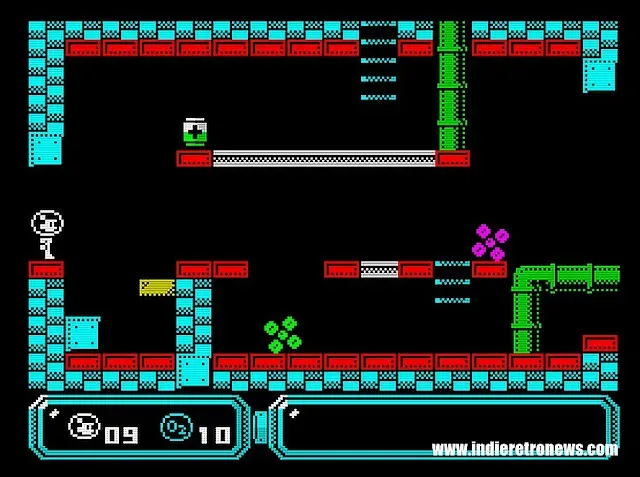
Outpost is a newly announced platform-adventure built for the ZX Spectrum 48K, pairing the compact, screen-by-screen appeal of classic Spectrum games with a more interconnected exploration structure. Created entirely by Juan J. Martínez, the game casts players as the survivor of a spacecraft crash on an alien planet, where an apparently abandoned mining facility quickly proves to be anything but safe.
The premise has the directness expected of an old-school adventure: wake up, assess the disaster, avoid the creatures trying to kill you, and find an escape route. Yet Outpost's design aims beyond a simple run from left to right. Its world is made up of 90 individual screens, and progress depends on locating eight key items that open routes into previously inaccessible parts of the installation. That combination of platforming, inventory-driven progression, and revisiting locations gives the project a clear metroidvania influence while retaining a distinctly 8-bit presentation.
A crash landing with nowhere safe to hide
Outpost begins after the player's ship comes down on a hostile world. The protagonist awakens in a medical pod inside a mining outpost that initially seems deserted. The sense of relief does not last: alien life has taken over the facility, and the base is populated by aggressive creatures that turn every route into a survival problem.
The ultimate objective is to leave the planet alive, but that goal requires a methodical search through the outpost. Rather than simply handing players an exit, the game asks them to learn the layout of the base, survive its hazards, and assemble the tools or objects needed to advance. It is a familiar sci-fi setup, but one that fits especially well with the Spectrum's tradition of atmospheric adventures built around mysterious rooms, dangerous obstacles, and carefully placed items.
For useful background on this topic, read Phantom Blade Zero Early Reviews Praise Its Combat, Weapons and Carefully Tuned Challenge.
Because the environment is a mining facility rather than an open natural landscape, Outpost can lean into the idea of a sealed, navigable complex. Each new screen has the potential to reveal another threat, a platforming test, a useful object, or a locked-off path that will make sense only after further exploration. The game's alien setting also gives its creator room to combine industrial interiors with hostile extraterrestrial danger without losing the clarity needed for play on original 48K hardware.
Exploration built around 90 screens and eight vital items
Outpost's 90-screen map is central to its identity. Screen-based worlds were a defining part of many Spectrum games, where entering the edge of one room immediately loads the next. Here, that classic format supports an adventure designed around discovery and backtracking. Players will need to move through the outpost, identify obstacles they cannot yet overcome, and return when an essential item has changed what is possible.
There are eight crucial items to find. These objects unlock hidden sections of the map and are ultimately necessary to secure the escape from the planet. The announcement does not detail the exact functions of the individual items, leaving open whether they will act as tools, access devices, protective equipment, or other forms of environmental progression. What is clear is that their placement and use are the main drivers of advancement through the game.
That structure separates Outpost from a purely linear action platformer. Fast reflexes matter when navigating tight spaces and avoiding enemies, but players will also need to pay attention to the wider map. A blocked passage is not necessarily a dead end. It may be a reminder to keep searching, to consider where an item could be used, or to revisit an earlier area from a new direction.
The result is a format that should be immediately understandable to fans of exploration-focused games, even though it is being delivered within the technical and visual boundaries of the ZX Spectrum 48K. The term metroidvania can mean many things across modern gaming, but in Outpost's case the important elements are the linked world, the gated routes, and the item-based expansion of the player's options.
Dizzy inspiration meets a darker science-fiction setting
Martínez's project also draws inspiration from the Dizzy series created by the Oliver Twins. Those games remain closely associated with British home-computer culture, especially for their mix of platforming, item collection, environmental puzzles, and a world that encourages players to explore beyond the immediate screen.
Outpost does not reuse Dizzy's fantasy-comedy world or its egg-shaped hero. Instead, it carries forward aspects of the adventure-game rhythm that made those titles memorable: searching for objects, working out where they belong, navigating rooms filled with hazards, and slowly turning an initially confusing environment into a comprehensible route forward.
Its sci-fi framing creates a notably different mood. Where Dizzy frequently delivered whimsical locations and playful encounters, Outpost begins in the aftermath of a crash and confines the player to a creature-infested mining installation. The pressure comes not only from the question of how to use an item but also from the immediate need to avoid dangerous aliens while moving between areas. That contrast could give Outpost a more tense tone while preserving the satisfying, puzzle-led exploration that fans of Spectrum adventures recognize.
A one-person production for original Spectrum hardware
Juan J. Martínez has handled every part of Outpost's development. He wrote the code, produced the graphics, and composed the game's music and sound effects. Solo development remains an important part of the modern retro scene, where creators continue to make new software for hardware that was originally sold decades ago. In this case, the all-in-one approach means the game's programming, art, and audio have been shaped through a single creative vision.
Audio will use authentic 1-bit beeper music and sound effects. On the ZX Spectrum 48K, the beeper is an instantly recognizable part of the machine's sound identity. Its limited output demands economical composition and bold, readable sound design rather than the layered audio associated with later systems. For a game set in an alien outpost, that style can suit alarms, threats, discoveries, and the unnerving isolation of the setting particularly well.
The visual side likewise has to work within the expectations of Spectrum hardware. Although Outpost's announcement does not outline its specific graphical techniques, the platform's limitations have historically encouraged developers to make every screen visually purposeful. Clear platforms, noticeable hazards, recognizable enemies, and useful objects are crucial when players are exploring a large map and trying to remember routes. In an item-gated adventure, visual readability is more than an aesthetic concern; it is part of how players solve the game.
Why projects like Outpost still matter
New ZX Spectrum releases are not merely nostalgic replicas of older games. They are also opportunities to revisit established design ideas with decades of hindsight. Outpost takes concepts that have remained popular in contemporary games--interconnected spaces, acquired abilities or items, secrets, and environmental progression--and scales them to a machine with severe memory and audiovisual constraints.
That constraint can be a feature rather than a drawback. A 90-screen adventure with eight central items offers a defined scope: large enough to invite exploration, but structured enough that every area and object can have a deliberate role. Players accustomed to enormous digital maps may find a different kind of satisfaction in learning a carefully assembled screen network, especially one designed for a hardware format where the next room can feel like a meaningful discovery.
Outpost also demonstrates that the ZX Spectrum's legacy is still active rather than purely archival. The 48K model remains a viable destination for new games from developers interested in the platform's character, its community, and the design discipline created by its limitations. By combining a recognizable Spectrum-adventure sensibility with modern metroidvania ideas, Martínez is making a game that speaks to both long-time retro players and those interested in seeing how contemporary genre structures translate to 8-bit hardware.
What players can expect from Outpost
Outpost's announced ingredients point to an adventure centered on careful movement, observation, and persistence. Players can expect hostile alien encounters, tight platforming sections, a 90-screen mining-base map, and eight essential objects that reveal new ways through the outpost. The journey begins with a stranded survivor in a medical pod and ends, if the player can uncover the necessary route, with a chance to escape the planet.
For ZX Spectrum enthusiasts, the appeal is immediate: a fresh game designed specifically for the 48K machine, complete with beeper audio and an original screen-by-screen world to master. For fans of Dizzy-style item adventures and metroidvania progression, Outpost offers a compact retro interpretation of those ideas. Its challenge will lie in surviving the alien-infested facility while piecing together the route home--one dangerous screen, hidden section, and crucial item at a time.
Community
Discussion
Start the conversation.
No comments have been posted yet.