

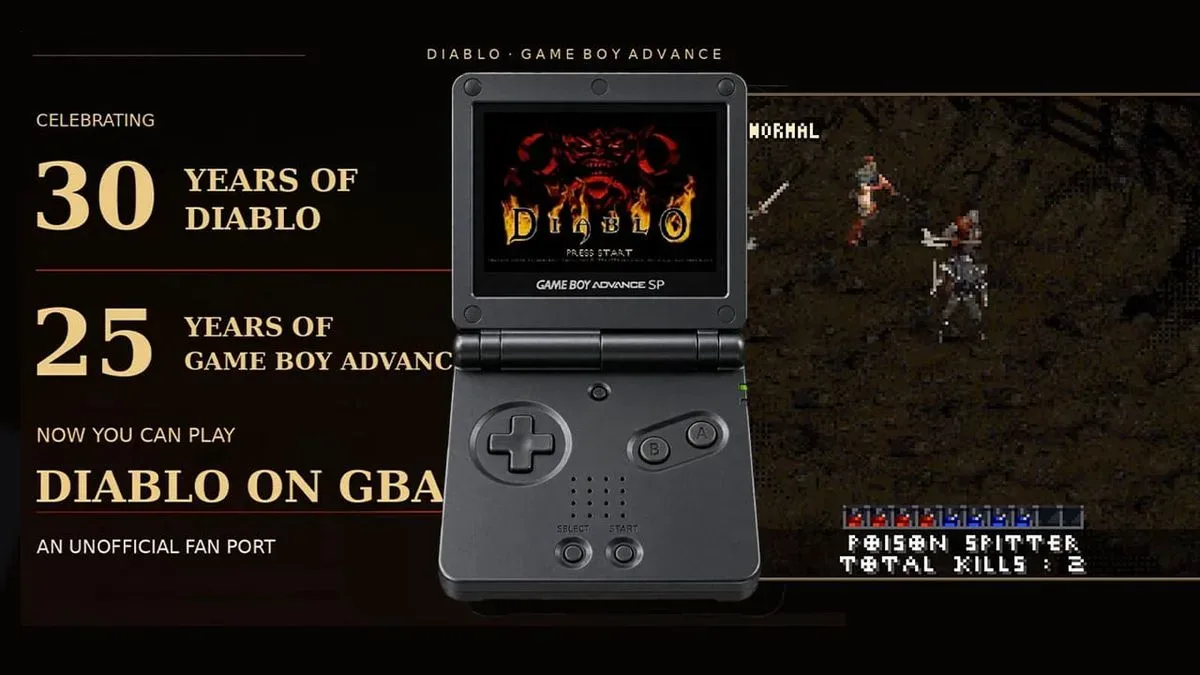
Diablo, the landmark action RPG first released on PC on December 31, 1996, has received an unofficial new home on the Game Boy Advance. A fan-made remake is attempting to fit the full original dungeon-crawling experience onto Nintendo's 2001 handheld, with a feature list that includes three character classes, 16 floors, dozens of spells, extensive loot, CPU-controlled companions, and even support for up to four players through the Game Boy Advance link cable.
It is an ambitious technical and design exercise for a machine better known for compact adaptations, original handheld adventures, and sharply scaled-down versions of console games. Rather than simply borrowing Diablo's setting or recreating a small portion of its gameplay, the project presents itself as a complete remake designed around the limitations and controls of the GBA. Its tagline, "hell fits in your pocket," makes the goal clear: take the original journey beneath Tristram and make it playable away from a desktop PC.
Diablo reaches its 30th anniversary in 2026, while the Game Boy Advance is now 25 years old. Bringing the two together is the kind of retro project that immediately raises practical questions. Diablo depends on menus, inventory management, randomized equipment, character development, spells, enemy swarms, and a dark atmosphere that was especially striking on late-1990s computers. The Game Boy Advance, meanwhile, has a small screen, limited buttons, and hardware constraints that require careful compromises. The remake's appeal lies in how directly it tackles those challenges rather than avoiding them.
A full descent designed for a handheld screen
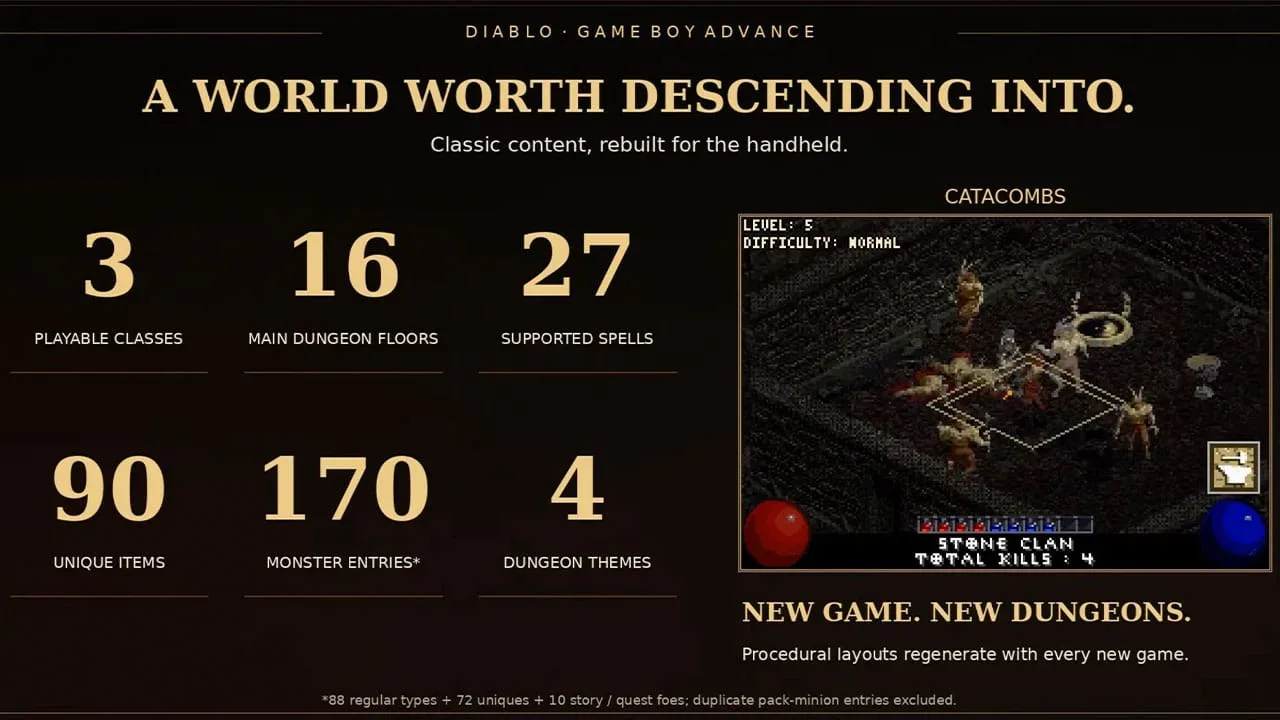
The port includes 16 floors spread across four familiar dungeon themes: Cathedral, Catacombs, Caves, and Hell. Those environments form the backbone of the original Diablo's descent, moving players from the haunted spaces beneath Tristram toward increasingly hostile and infernal territory. Retaining that structure is important, because Diablo's simple but compelling rhythm is built around pushing deeper, returning to town, upgrading gear, and risking another trip below.
For useful background on this topic, read Tim Sweeney Calls Steam's AI Disclosure Rules 'Political' and 'Abhorrent'.
Players can choose from three classes, mirroring the core approach of the original game. The class choice gives the adventure distinct play styles centered on martial strength, magic, or agility and ranged combat. That variety matters even more on a portable system, where repeatable runs and alternate character builds can help make a lengthy dungeon crawler feel suited to shorter play sessions as well as longer stretches of exploration.
The remake also lists 27 supported spells, alongside quick spell slots built specifically for the GBA interface. On PC, Diablo could lean on a mouse-driven control scheme and an array of visible interface elements. A Game Boy Advance adaptation has to make choices about what can be immediately accessible and what must sit behind a menu. Quick spell slots suggest the project is trying to preserve the fast switching between abilities that is central to combat, while ensuring those actions remain manageable with the handheld's buttons.
Character sheets, quest logs, and menus have likewise been redesigned for the smaller display. This may be one of the most significant parts of the conversion. A convincing port is not only about getting monsters and dungeon rooms running on the hardware; it also needs to make the game readable and navigable. Diablo asks players to compare equipment, monitor attributes, review quests, organize an inventory, and decide how to develop a character. Reworking those systems for a handheld is essential if the remake is to feel like a playable adventure rather than a technical showcase.
Loot, monsters, and the familiar Diablo loop
The game's stated content includes 150 monster entries in its Bestiary and 90 unique items to discover. Those numbers speak to the scale of the project and to the elements that made Diablo so enduring. The series' influence rests heavily on its satisfying loop of fighting enemies, finding a better weapon or piece of armor, and becoming just strong enough to press into more dangerous territory. Even in its earliest form, Diablo made the next room, the next drop, and the next level feel difficult to resist.
For a GBA version, preserving that loop means more than fitting a recognizable hero and a few dungeon tiles onto the screen. The loot has to remain meaningful, the monsters need to create varied threats, and the progression needs to give players reasons to continue beyond the novelty of seeing Diablo running on unusual hardware. A Bestiary with 150 entries and a set of unique items indicates that the remake is reaching for that broader sense of discovery.
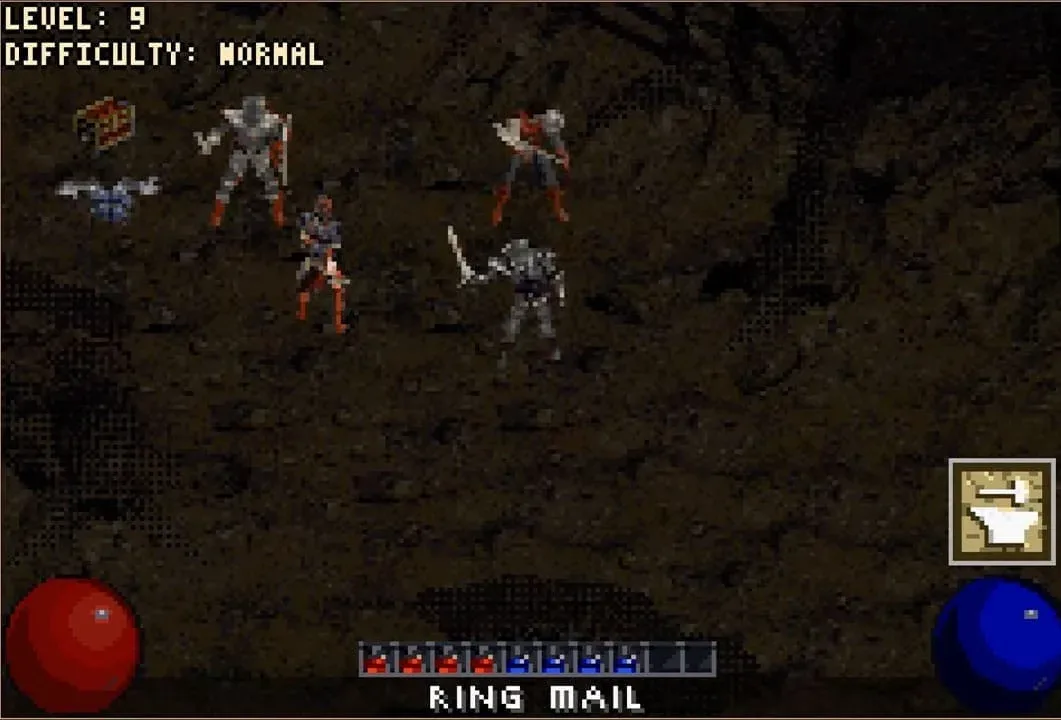
Visually, the project remains recognizably close to the PC original despite the expected reduction in clarity and screen space. The Game Boy Advance cannot match the capabilities of the computers that originally ran Diablo, and its display places obvious limits on detail. Even so, the goal appears to be a faithful conversion rather than a radically reimagined handheld demake. The dungeon settings, interface concepts, and overall presentation are intended to look like Diablo translated to another platform, not merely inspired by it.
That distinction is worth making. Demakes often deliberately reinterpret a game as though it had appeared on much older hardware, changing its visuals and systems to suit a different era. The GBA arrived after Diablo, so this project is better understood as a late-arriving port or remake for a contemporary-but-less-powerful handheld. It is a fascinating alternate-history version of the game: the sort of release that could plausibly have existed in the early 2000s if the original Diablo had been adapted for Nintendo's portable audience.
Four-player link-cable multiplayer is the headline feature
Perhaps the most eye-catching feature is support for up to four players using the Game Boy Advance link cable. Diablo has always had a strong multiplayer identity, with cooperative expeditions making its dark dungeons more manageable, more chaotic, and often more entertaining. Recreating that social side of the experience on original handheld hardware is a particularly appealing idea.
Game Boy Advance link-cable play requires the kind of in-person setup that feels increasingly unusual in an era dominated by online matchmaking and voice chat. It means multiple systems, compatible cables, and a group gathered in the same space. That effort is part of the charm. A four-player session would turn Diablo into a distinctly physical retro-gaming event, with players sitting together and coordinating their descent through the Cathedral, Catacombs, Caves, and Hell.
Not everyone will have the hardware or the group needed for link play, however. The remake accounts for solo players by allowing a party to be filled out with three CPU-controlled companions. That option should make the game more approachable for someone playing alone on a commute or during a break, while still keeping the idea of a four-member adventuring group intact.
A project for original hardware enthusiasts
The Game Boy Advance remains a popular platform for enthusiasts thanks to its extensive library, modifications, flash cartridges, and comparatively portable form factor. For this particular Diablo remake, screen quality will likely be an important consideration. The original front-lit and unlit GBA models can make darker games difficult to see, while a Game Boy Advance SP AGS-101, with its brighter backlit display, is a more comfortable fit for a dungeon crawler built around shadowy interiors and dimly lit caverns.
The project is being distributed through a ROM conversion process referenced in its accompanying video materials, allowing interested players to prepare the game for use on GBA-compatible hardware. As with many fan-made retro projects, anyone exploring it should be mindful of the legal and technical requirements surrounding the original game's data, the tools involved, and the hardware they choose to use. The existence of a conversion tool does not change the fact that this is an unofficial fan production rather than an official Blizzard release.
That unofficial status also makes the accomplishment more interesting. Fans continue to revisit Diablo because its design remains immediately understandable: enter a dungeon, defeat monsters, find treasure, grow stronger, and confront what waits farther below. The Game Boy Advance version has to express all of that through a much smaller screen and a much more constrained control layout. Its redesigned menus, spell shortcuts, cooperative support, and retained dungeon structure show an effort to solve those problems from the perspective of people who know both the original game and Nintendo's handheld.
Diablo's legacy finds another unexpected format
Thirty years after its PC debut, Diablo remains a foundational name in action RPG history. Its dark fantasy setting, instantly readable mouse-driven combat, randomized rewards, and multiplayer dungeon runs helped establish ideas that countless later games would build upon. The series has changed dramatically over the decades, but the first game still holds a special place for players who remember the atmosphere of Tristram and the tension of hearing danger beyond the edge of the screen.
An unofficial Game Boy Advance remake is not replacing the original PC release, nor is it an official new chapter for the franchise. It is something more specific: a retro preservation-minded experiment that lets players consider how one of PC gaming's defining experiences might have worked in their pocket. With 16 floors, three classes, 27 spells, 90 unique items, 150 Bestiary entries, CPU allies, and link-cable co-op for four players, it is aiming far beyond a novelty conversion.
For collectors, handheld modders, and Diablo fans with a taste for unusual ports, the prospect is easy to understand. The idea of gathering a few friends, connecting several Game Boy Advances, and heading into Hell together is a reminder that even a 30-year-old PC classic can still find new ways to surprise people.
Community
Discussion
Start the conversation.
No comments have been posted yet.