

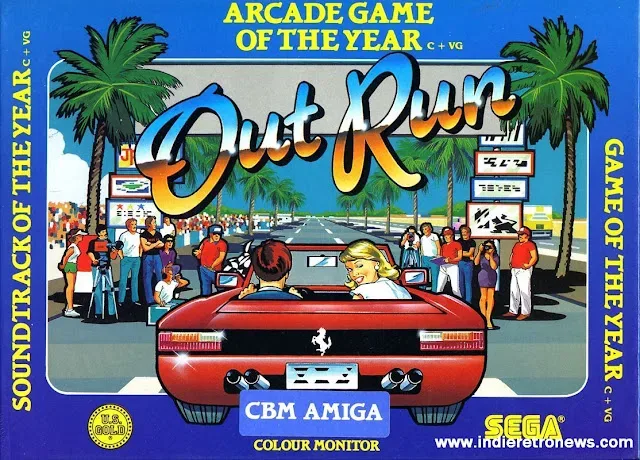
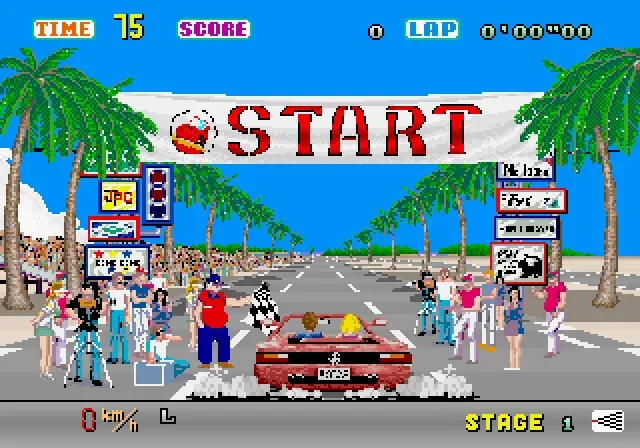
OutRun Amiga Edition, the ambitious Commodore Amiga recreation of Sega's defining 1986 arcade racer, has received a new update timed to the game's 40th anniversary. The release does not add tracks, modes, or other headline features, but its technical changes could make a substantial difference for players using original Amiga hardware: the project's developer, reassembler, says performance can improve by up to 50% in the right circumstances.
That is an impressive claim for a project already built around squeezing arcade-style speed and presentation from mid-range Amiga machines. OutRun remains one of the most celebrated driving games of the 1980s, remembered for its branching routes, Ferrari-inspired convertible, vibrant roadside scenery, and musical identity. Recreating its sensation of velocity on home computers has always been a difficult technical task, particularly on systems whose graphics hardware operated very differently from Sega's arcade board.
The latest OutRun Amiga Edition build is intended as a focused refinement rather than a broad rework. It is especially relevant for enthusiasts playing on real Commodore hardware, where every rendering improvement can help the game look and feel closer to the smooth, immediate arcade experience that made Yu Suzuki's original so influential.
A milestone update for a milestone racer
Sega launched Out Run in arcades in 1986, and it quickly became much more than another racing cabinet. Its design placed the emphasis on a stylish road trip rather than conventional competition. Players raced against a clock through changing environments, chose their path at forks in the road, avoided traffic, and aimed to reach one of several endings. It paired that accessible structure with a famous selectable soundtrack and striking pseudo-3D visuals.
For useful background on this topic, read Crash Bandicoot Turns 30: A Guide to Celebrating Three Decades of Spins, Wumpa Fruit and Platforming.
The game became a commercial phenomenon and an enduring piece of arcade history. Its influence spread through racing games, synth-pop culture, cabinet design, and even the naming of the vaporwave-adjacent "outrun" aesthetic. Four decades later, it remains a title that inspires fan projects, ports, technical experiments, and homebrew efforts.
OutRun Amiga Edition exists in that tradition, but it is not simply a cosmetic tribute. The project was created as a ground-up assembly-language rewrite designed specifically to bring the arcade game closer to Commodore Amiga systems. Its stated goal has been to address the shortcomings associated with the machine's earlier official conversion, an adaptation that has long drawn criticism from fans for its compromises in speed and overall arcade feel.
The developer has described the new version as an optimized port drawing upon the original 68000 assembly code while being tailored to mid-spec Amiga computers. Although the arcade hardware and the Amiga are not identical, the intention is clear: retain as much of the original game's look and responsiveness as practical within those technical limits.
What changed in the anniversary build
The 40th-anniversary update concentrates on rendering efficiency. Reassembler explained that the improved performance comes from three principal optimizations, each addressing a different part of how the game constructs and displays a frame.
- More efficient Chunky-to-Planar processing: The update changes how the game uses C2P, or Chunky-to-Planar conversion. Crucially, areas that have not changed no longer need to be refreshed every frame.
- Improved sprite transparency and shadow handling: The routines responsible for transparent sprite pixels and shadows have been optimized, reducing the processing burden of cars, scenery, and visual effects.
- A rewritten frame-rendering process: The engine no longer waits for the next display refresh in the same way, a change intended to make the overall rendering pipeline more efficient.
Those may sound like highly specialized programming details, but they are exactly the sort of changes that matter on vintage platforms. A racing game like OutRun constantly redraws the road, traffic, roadside objects, and scrolling backgrounds to sustain its illusion of high speed. Reducing unnecessary work means the machine can devote more of its limited resources to the parts of the screen that actually need updating.
The reported "up to 50%" gain should not necessarily be read as a universal result for every moment of every configuration. Performance can vary depending on the hardware being used and the scene being rendered. Still, the scale of the stated improvement highlights why this modest-looking update is significant. It is the kind of release that may not radically alter a feature list, yet can noticeably improve the moment-to-moment feel of play.
Built for the Amiga, not emulation
A major point of distinction for OutRun Amiga Edition is what it is not. The project is not an emulator, and it is not derived from MAME, Cannonball, or another pre-existing OutRun recreation. Instead, it is presented as a fresh assembler rewrite focused on performance for Commodore Amiga hardware.
That approach gives the project a particular appeal within the retro-computing community. Rather than asking an Amiga to emulate a more powerful arcade platform, the software is designed to work with the Amiga's own characteristics and restrictions. The system uses planar graphics, for example, whereas arcade hardware and modern development methods often favor other ways of organizing image data. Getting fast-moving arcade visuals onto the platform requires careful engineering, especially when trying to preserve the original game's identity.
The use of original 68000 assembly code as a reference point is also fitting. Both the arcade game and many Amiga models are associated with Motorola's 68000 family, but sharing a processor lineage does not make a direct conversion simple. Memory arrangements, graphics systems, sound capabilities, timing, and supporting chips all influence what a game can do. OutRun Amiga Edition's work lies in bridging those differences rather than pretending they do not exist.
Small compromises have been made to account for the gap between the original arcade hardware and Commodore's home computer, but the project aims to reproduce the arcade title's appearance and play as closely as possible. That balance between accuracy and platform-aware optimization is the heart of the release.
No asset rebuild required for existing v0.9.2 users
Players who already have version 0.9.2 installed have an easier path to the anniversary update. Reassembler has said there is no need for those users to regenerate their game assets. Since the release does not introduce new content or other changes beyond the performance work, existing players who were satisfied with the prior build are not required to upgrade.
That makes this a genuinely optional enhancement: the earlier version remains valid, while users seeking better performance on their own machines can move to the newer build. For retro software enthusiasts, this is a welcome approach. Asset preparation can be one of the more involved parts of setting up projects based on arcade originals, so avoiding that step lowers the barrier for established users.
New players should also be aware of an important requirement. OutRun Amiga Edition may need the original graphics and audio data from the arcade ROMs. Those files are not included with the project, and users must obtain any required data themselves. This is not a complete package containing Sega's original copyrighted arcade assets; it is a software project that relies on users handling the necessary game data independently.
A focused release while work continues elsewhere
The developer characterized this as a smaller anniversary release, explaining that time has also been devoted to Aonic, a port of Sonic the Hedgehog for the Amiga A1200. That context helps explain the update's narrow scope. Instead of delaying a commemorative release until a larger feature set was ready, reassembler chose to share meaningful optimization work now and reserve broader changes for a later opportunity.
For a project such as OutRun Amiga Edition, that decision makes sense. Performance is not a side issue in a fast arcade racer; it is central to the experience. Better frame delivery, less wasted rendering work, and smoother visual updates all support the qualities that made Out Run so memorable in the first place: flow, speed, and the fantasy of racing into the horizon with the radio turned up.
The update also demonstrates why the Amiga remains such a fertile platform for new retro development. Its library has been examined, celebrated, and criticized for decades, yet developers are still finding new ways to revisit its technical potential. Sometimes that means making an entirely new game. Other times, as with OutRun Amiga Edition, it means returning to a beloved arcade benchmark and asking how much closer modern coding expertise can bring the machine to an experience it once struggled to capture.
Why OutRun Amiga Edition matters
There is a special satisfaction in projects that revisit a historically underwhelming port and attempt to set things right. The original Amiga version of Out Run is part of the platform's history, but it does not have to be the final word on what the computer can do with Sega's racer. OutRun Amiga Edition is an argument that better results are possible when development is centered on the hardware's strengths and when performance receives obsessive attention.
For existing players, the anniversary release is a reason to revisit the road and see how the optimized rendering feels on real hardware. For newcomers, it is another reminder that retro gaming is not frozen in time. New tools, new code, and years of accumulated technical knowledge continue to change what is possible on machines released generations ago.
OutRun's 40th anniversary is an appropriate moment for that kind of celebration. The arcade original endures because it captured a feeling that hardware specifications alone cannot explain. This Amiga update honors that legacy not with empty nostalgia, but with carefully targeted engineering intended to make the drive faster, smoother, and more convincing than before.
Community
Discussion
Start the conversation.
No comments have been posted yet.