

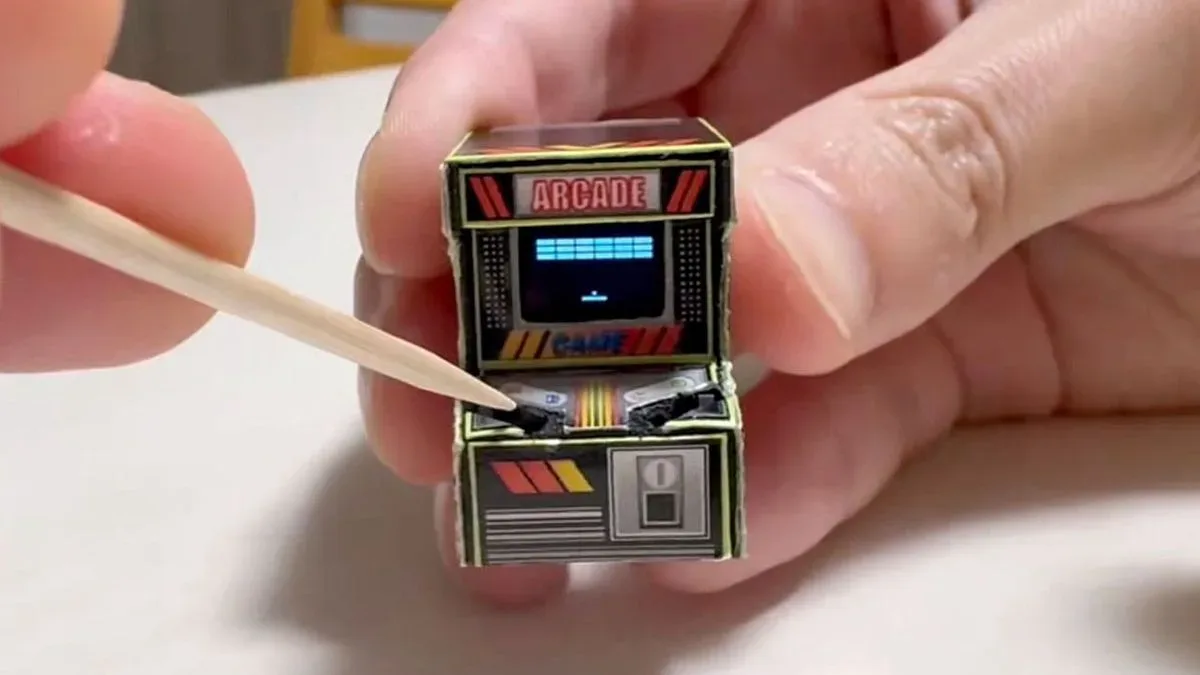
A tiny homemade arcade cabinet is drawing attention for squeezing a working display, playable games, and an unusual control method into a body made from paper. Shared by creator BitBlt_Korry on X, the miniature machine resembles a classic upright arcade unit, but its scale means conventional buttons and joysticks are not part of the experience. Instead, games are controlled with a toothpick.
The project is an especially striking example of miniature game-making because it is not simply a decorative model. The screen is active, gameplay is visible, and the cabinet can run at least two games shown in videos: Brick Breaker and Space Shooter. The latter strongly resembles the arcade classic Space Invaders, right down to its familiar formation-based alien shooting setup.
It is an impressive collision of papercraft, electronics, retro-game affection, and extreme patience. It also looks profoundly difficult to play. BitBlt_Korry has described the controls as the "absolute worst," an assessment that feels entirely reasonable once the toothpick enters the frame.
Embedded X/Twitter post
A functioning arcade at an absurdly small scale
Miniature gaming hardware has a particular appeal: it takes a form that players immediately recognize and shrinks it until it becomes closer to a technical curiosity than a practical device. This papercraft arcade cabinet takes that idea to a far smaller and more delicate place than many commercially produced micro consoles.
For useful background on this topic, read Prime Day retro gaming deals Spotlight Handhelds, Arcade Cabinets and Classic-Inspired Gear.
The cabinet has the visual language of an old-fashioned arcade machine. Its upright shape, screen placement, and compact control area make the design instantly readable, even before the moving game display confirms that it is functional. The choice to build its outer shell from paper gives it a handmade quality that separates it from the polished plastic, metal, or 3D-printed builds often seen in the miniature-hardware space.
That paper construction is part of the charm, but it also underlines just how carefully the device has to be handled. A normal arcade cabinet is designed to survive repeated button presses, enthusiastic joystick movements, and years of use in public spaces. This one is the opposite: an intricate, tiny object that looks like it could be damaged by an overly forceful finger, let alone an excited round of arcade action.
Rather than reducing the ambition of the project, that fragility makes the result more memorable. The machine feels less like an attempt to replace a full-size gaming device and more like a playful demonstration of what can be built when scale is treated as the main challenge.
Brick Breaker played with a toothpick
The clearest demonstration of the mini arcade's operation shows Brick Breaker running on its small screen. The game is a natural fit for the build. Like the classic paddle-and-ball games that inspired it, Brick Breaker is simple to understand at a glance: move a paddle, bounce a ball, and clear away rows of blocks.
That straightforward format does not make the hardware easy to use. A toothpick is brought to the machine to operate the controls, requiring a level of precision far beyond what most players expect from a quick arcade session. The player has to direct a narrow piece of wood onto an exceptionally small input area while tracking the ball on a correspondingly tiny display.
It is difficult to imagine this being the preferred way to chase a high score. Even tiny handheld systems generally benefit from buttons built for thumbs, while standard arcade controls are intentionally large, tactile, and resilient. Here, the challenge is not just reading the game state or reacting quickly enough. It is physically landing the toothpick in the correct spot without nudging, bending, or otherwise upsetting the paper cabinet itself.
Still, the fact that Brick Breaker is playable at all is the point. The build transforms a familiar, accessible game into a test of dexterity. The control compromise is not an accidental drawback hidden away from view; it is central to the novelty of the project.
Space Shooter brings an arcade icon to miniature form
A follow-up video shows another game, called Space Shooter, being played on the device. Its design is immediately recognizable to fans of early arcade games. A player ship sits near the bottom of the screen, while enemies advance above in rows, creating a setup that looks remarkably close to Space Invaders.
That visual connection makes the tiny cabinet feel even more appropriate. Space-invader shooters are among the games most closely associated with the arcade era, and seeing one run inside a miniature upright machine is a clever use of the format. The cabinet is small enough to seem almost toy-like, yet the game on screen evokes an era when arcade units were imposing fixtures in amusement spaces, shops, and dedicated game halls.
The contrast is part of what makes the project so effective. Classic arcade games were made to be instantly legible, with bold shapes and simple actions visible from a distance. The papercraft cabinet takes those same ideas and asks the viewer to appreciate them on a scale where a toothpick becomes the controller.
It also demonstrates that the build is more than a single-game novelty. Showing both Brick Breaker and Space Shooter suggests a compact gaming setup capable of supporting different kinds of retro-styled play, even if the physical interface makes extended sessions unlikely.
Why impractical projects can be the most memorable
There is no shortage of devices designed to make retro games portable and convenient. Small handhelds, keychain-sized systems, and ultra-compact emulation devices all aim to make familiar games easier to take anywhere. This miniature cabinet has a different mission. Its appeal is not convenience, comfort, battery life, or competition-grade responsiveness. It is the sheer delight of seeing an arcade machine made improbably small.
That distinction matters. Gaming hardware is often judged by practical standards: screen size, input quality, build durability, performance, and game library. On those measures, a toothpick-controlled paper arcade would naturally face limitations. But maker projects are not always meant to compete with retail hardware. Sometimes their value comes from skill, inventiveness, and the unusual perspective they offer on objects players take for granted.
In this case, the project turns several apparent weaknesses into features. The paper exterior is delicate, but it gives the cabinet character. The tiny controls are awkward, but they make the demonstration unforgettable. The display is minuscule, but it reinforces the surprising fact that this is a working machine rather than a static diorama.
The result sits somewhere between a technical prototype, a collectible miniature, and a piece of playable art. It invites the same reaction as other extreme-scale recreations of classic hardware: first disbelief that it works, then curiosity about how it was assembled, followed by the immediate realization that actually using it would demand a very steady hand.
A celebration of retro gaming's physical identity
There is a reason arcade cabinets remain such a powerful symbol of video games. Even people who did not grow up during the height of arcade culture can recognize the silhouette: the upright body, glowing display, control panel, and the promise of a game waiting behind the screen. A miniature replica does not need to reproduce every feature at full scale to evoke that identity.
BitBlt_Korry's creation captures the essential idea of an arcade cabinet while radically changing its proportions. It proves that the appeal of the form is not tied only to size. Even as a small paper-bodied object, it still reads as an arcade machine because the fundamentals are there: a screen, an interface, and a game that responds.
For retro-game fans, that is likely the biggest reason the project resonates. Brick Breaker and Space Shooter are mechanically simple games, but their presence in a tiny cabinet connects them to the tactile history of arcade play. The toothpick controls may be impractical, yet they make the act of play visible in a way that ordinary buttons would not.
Whether anyone would want to play for more than a few minutes is another question. The creator's own criticism of the controls sets realistic expectations, and the paper construction hardly suggests a machine built for aggressive score-chasing. But as an inventive tribute to arcade gaming, the papercraft mini arcade succeeds precisely because it embraces its weirdness.
It is a tiny functioning cabinet that asks players to bring their own toothpick, their patience, and perhaps a willingness to accept that the most difficult opponent may not be the game on screen. It may be the controller.
Community
Discussion
Start the conversation.
No comments have been posted yet.