

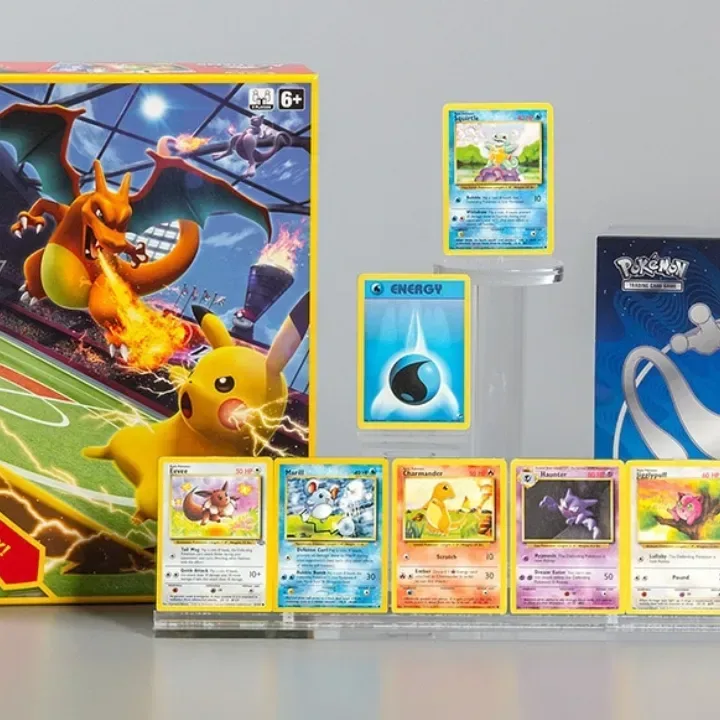
The Pokémon Trading Card Game has officially been inducted into the National Toy Hall of Fame, a major recognition for one of the most widely known tabletop games in the world. The announcement arrived on Thursday, November 5, during Pokémon's 30th-anniversary year, placing the card game in a celebrated group of playthings and games whose impact has extended across generations.
Pokémon cards enter this year's class alongside Bingo, Care Bears, and the classic slide. Their selection came ahead of other finalists including Bop It!, mahjong, and Polly Pocket. It is an honor that acknowledges far more than the rarity or value of individual cards: the Hall of Fame's criteria focus on cultural standing, staying power, opportunities for discovery, and innovation in play.
For a game that has connected school playground trades, kitchen-table battles, hobby-store tournaments, online pack openings, and competitive events around the globe, the induction is a fitting summary of Pokémon TCG's unusual reach. Its identity has always covered multiple kinds of play at once. It is a strategy game, a collection hobby, a social activity, and, increasingly, a high-profile market for sealed products and sought-after singles.
A Hall of Fame honor built around lasting play
The National Toy Hall of Fame was founded in 1998 and is housed at The Strong Museum of Play in Rochester, New York. Its purpose is to recognize toys that have supported creative play while maintaining widespread popularity over a long period. The museum is also home to the World Video Game Hall of Fame, making it a notable destination for the preservation and study of both traditional toys and interactive entertainment.
For useful background on this topic, read Take-Two CEO Highlights Red Dead, Borderlands and More Beyond GTA 6.
The Hall of Fame's definition of a toy is deliberately broad. Its previous inductees range from household staples and classic toys such as LEGO, Barbie, and the Slinky to less conventional choices including the cardboard box and sand. That approach makes room for the Pokémon TCG not simply as a commercial card product, but as a framework for imagination, competition, collecting, and shared experiences.
Anyone can nominate a toy for consideration. The final choices are evaluated by a panel of museum curators, historians, and educators using four central standards:
- Icon status: whether an item is broadly recognized and remembered.
- Longevity: whether it has remained popular over multiple generations.
- Discovery: whether it encourages learning, creativity, or exploration through play.
- Innovation: whether it changed toy design, play patterns, or the wider culture.
Pokémon cards have a compelling case in each category. The game's yellow-bordered cards, evolving creatures, Energy cards, and prize-card structure are instantly recognizable to an enormous audience. Its core rules have continued to welcome new players while creating room for evolving strategies, and the Pokémon brand has introduced generations of children and adults to the idea of trading card games.
Why Pokémon TCG stood out
Curator Mirek Stolee highlighted Pokémon TCG's combination of familiarity and approachability when discussing the induction. He said the game's worldwide appeal was impossible to ignore, and noted that it built upon card-game systems developed before it while making the experience more accessible through the appeal of Pokémon creatures.
"Pokémon TCG's widespread appeal and global presence are undeniable," Stolee said. "The Pokémon TCG successfully adapted card game formulas established by its predecessors, making it more accessible and infusing it with the lovable Pokémon creatures."
That balance is a significant part of the game's legacy. Pokémon did not invent collectible card games, but it translated their systems into a format that felt immediately inviting to a young, mainstream audience. Players could start by recognizing favorites from the video games and animated series, then gradually learn how HP, attacks, weaknesses, resistances, Evolutions, Trainer cards, and Energy combined into a functioning deck.
The game's design also made the act of collecting meaningful even for people who never entered a tournament. A child could value a favorite Pikachu, Charizard, Eevee, or starter Pokémon regardless of competitive utility. At the same time, more dedicated players could refine decks around particular mechanics and follow a rotating competitive environment. That flexibility has helped the cards remain visible in everyday culture for decades.
There is precedent for a tabletop game receiving this kind of recognition. Magic: The Gathering was inducted into the National Toy Hall of Fame in 2019, while Dungeons & Dragons joined the list nearly a decade earlier. Pokémon TCG now stands beside those landmark games, underscoring how card games and tabletop experiences can be as historically important as physical toys.
From video-game roots to cards, handhelds, and apps
Pokémon's journey to the Hall of Fame is especially distinctive because the franchise originated in video games. The trading card game brought those digital creatures into a physical format, then later returned to gaming hardware and software in several ways. The Pokémon Trading Card Game received its own Game Boy video game, giving handheld players a way to learn and play a version of the card game outside of face-to-face matches.
Today, the game's reach also includes an app available across multiple platforms. This circular relationship between games, cards, and digital play has helped Pokémon continually meet players where they are. Someone may first encounter a Pokémon in a mainline game, receive cards as a gift, trade with friends, battle with a beginner deck, and later engage with the hobby through an app or competitive community.
The Strong Museum of Play's dedicated Pokémon TCG material emphasizes that role as an entry point. For millions of people, Pokémon cards were their introduction to the larger trading card game hobby. The franchise's creature designs gave the system an emotional hook, while its packs and expansions created an ongoing reason to discover new cards and revisit familiar Pokémon in new forms.
The scale behind the induction
The numbers associated with Pokémon TCG show why its presence is so difficult to overlook. As of March 2026, more than 85 billion Pokémon cards had been printed and distributed around the world. The game is printed in 13 languages, reflecting a truly global player and collector base. Rough estimates have placed its total market capitalization above $15 billion.
Those figures represent an extraordinary level of endurance for a physical card game in an era increasingly shaped by digital entertainment. Pokémon cards have persisted through changing console generations, the growth of online gaming, and huge changes in how fans buy, trade, and discuss collectibles. Packs are opened at local game stores and family gatherings, but also in videos watched by vast online audiences.
That visibility has brought new energy to the hobby. Content creators opening packs, often called "ripping" packs, have made the suspense of finding a rare card into a spectacle. Grading, display cases, auctions, and social-media showcases have likewise made older cards visible to people who may not have played the game when those cards were new.
Success has also created accessibility problems
The same collector boom that has made Pokémon cards more visible has also created serious frustrations for ordinary fans. Scalping has affected the community for years, with high-demand releases often bought in bulk and quickly resold at inflated prices. Products meant for casual collectors, children, and active players can become difficult to find at their intended retail price.
That tension is notable given the Hall of Fame's praise for Pokémon TCG's accessibility. The game remains easy to recognize and approachable in concept, but access to particular sealed products and chase cards is not always simple. A hobby that once centered heavily on casual trades and affordable packs has, in some areas, developed into a far more aggressive collector market.
The Pokémon Company has acknowledged the supply issue on multiple occasions and stated its intention to increase stock in an effort to counter scalpers. Increased production appears to have had an effect on the recent 30th-anniversary product line. Some resellers have complained that the set has not been profitable enough, an outcome that suggests more product may be reaching fans rather than immediately commanding steep secondary-market premiums.
That does not erase the broader challenge facing the hobby, but it illustrates an important divide in what players and collectors want from Pokémon cards. For many fans, the ideal result is not a dramatic spike in resale value. It is finding packs on a shelf, building a deck without excessive expense, sharing duplicates with friends, and having the chance to pull a card that feels special.
What may come next at The Strong
Pokémon TCG's induction will likely lead to new exhibits and events at The Strong Museum of Play in the coming year. The museum now has an opportunity to present the card game's history through its changing artwork, rules, expansions, community traditions, and connections to Pokémon's video-game origins.
Any such presentation could also explore the many different ways people have engaged with the cards: competitive players memorizing matchups, collectors searching for a favorite illustration, children swapping cards at school, parents rediscovering their own childhood collections, and viewers tuning in for pack openings. Few modern toys have managed to remain so recognizable while serving so many distinct communities.
Thirty years into the Pokémon franchise's history, the trading card game's Hall of Fame induction confirms what fans have long understood. Pokémon cards are not merely a side product of a larger brand. They are a cultural force in their own right, one that has changed hands across generations and helped define what a collectible game can be.
Community
Discussion
Start the conversation.
No comments have been posted yet.