

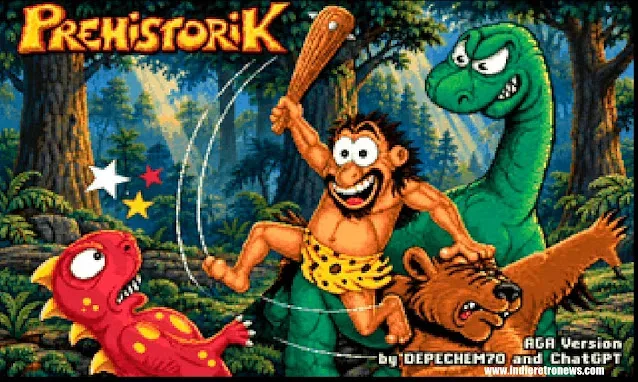
Prehistorik AGA, a substantial fan-made overhaul of Titus Software's 1991 platformer Prehistorik, has been released by creator Depechem70 for enhanced Amiga hardware. The project revisits the food-hunting Stone Age adventure with redesigned art, far more environmental animation, smoother transitions, technical fixes, and extra presentation features for WHDLoad and Amiga CD32 users.
The original Prehistorik is remembered as a colourful, deliberately cartoonish platform game in which its club-wielding caveman protagonist raids each stage for enough food to satisfy an enormous appetite. Its absurd enemies, exaggerated item pickups and playful prehistoric setting made it a distinctive release of the early 1990s. This new edition does not attempt to replace that identity. Instead, it aims to make the existing game feel fuller, more animated and more visually refined while retaining its familiar characters and broad visual style.
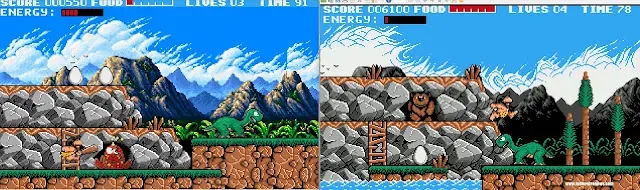
At the center of the update is a wide-ranging rework built around the Amiga's AGA graphics capabilities. Depechem70 has enhanced backgrounds, environmental textures and collectible items with increased contrast and finer visual detail, using 256-colour palettes. The work deliberately retains the heavy outlines and eccentric cartoon designs that define the original game, an important decision for a project based on a title whose charm has always relied on bold, immediately readable visuals.
A richer take on a familiar prehistoric world
Rather than limiting the overhaul to static art touch-ups, Prehistorik AGA gives many of the game's creatures and locations additional motion. Dinosaurs, birds and fish have received new animation work, helping stages feel less like a sequence of isolated screens and more like living environments. The winter areas have also been expanded visually, with animation incorporated into polar bears, penguins, walruses and snowmen.
For useful background on this topic, read 19 PS Plus Horror Games to Play This Halloween, From Bloodborne to Silent Seas.
The aquatic environments are among the places where those additions may be most noticeable. Rising bubbles and small drifting fish add continuous movement to the water-themed rooms, while other backdrop enhancements are intended to add a sense of activity without fundamentally changing the original level layouts. In snowy stages, falling snow now accompanies a subtly twinkling night sky, giving these areas a more atmospheric finish than their earlier presentation.
Boss encounters have received reworked graphics as well. Since the bosses are among the most memorable visual punctuation points in a platformer of this era, improving their look while preserving their recognizable forms is a sensible focus for a fan edition. The update also introduces stronger hit feedback effects, designed to make successful attacks and impacts more immediately satisfying on screen.
These are the kinds of changes that can matter a great deal in a retro game restoration. A platformer can retain the same routes, hazards and core controls, yet feel significantly different when its backgrounds have more depth, its creatures react with more animation and its action is easier to read. The stated intention here appears to be enhancement rather than reinvention: Prehistorik should still look and play like Prehistorik, simply with a more elaborate audiovisual layer built for a later class of Amiga hardware.
AGA hardware and optimization for 68020 systems
The release is designed for AGA-equipped Amiga systems using a 68020 processor. Its listed requirements are 2 MB of Chip RAM and 4 MB of Fast RAM, with the CD32 edition included in those requirements. That makes this a project for users with more capable Amiga configurations than the hardware targeted by the 1991 original.
AGA, short for Advanced Graphics Architecture, was introduced in Amiga computers and consoles during the early 1990s and notably expanded their available colour capabilities. For a fan project focused on 256-colour artwork, that hardware foundation is central rather than incidental. The increased palette range gives the overhaul room to add shading, texture detail and smoother colour transitions while maintaining a classic pixel-art appearance.
Depechem70 has also optimized the game's core code and memory architecture around the 68020. Technical work of this kind is less immediately visible than new creature frames or a revised boss sprite, but it can be just as important to an enhanced edition. In a game built around frequent screen changes, collectibles, enemies and animated effects, careful handling of memory and processing resources helps support the extra art and animation without losing the quick, responsive feel expected from a platformer.
The release additionally addresses a collection of older loading, gameplay and graphical issues. Specific fixes have not been individually detailed, but the stated goal is to remove legacy problems while improving the overall flow. Room-to-room screen transitions have been smoothed out as part of that effort. In a title structured around many compact challenge spaces, reducing friction between rooms can make repeated runs feel more cohesive, especially for players revisiting the game after decades away.
New sequences for WHDLoad and CD32 players
Prehistorik AGA also goes beyond the in-game stages with new framing material for certain ways of playing. Users running the game through WHDLoad, along with those playing the Amiga CD32 edition, receive a new family-oriented introduction sequence and a fully animated custom ending movie.
That is a notable addition because fan restorations often concentrate solely on gameplay screens. Fresh opening and closing sequences give the project a more complete presentation, treating the release as an edition with its own identity rather than merely a graphics patch. For returning players, an added introduction offers something new before the familiar opening challenges begin; a bespoke animated ending gives the adventure a similarly distinct sign-off.
CD32 owners have a further feature specific to their version: it uses CD audio music taken from the CDTV release. The Amiga CD32 was a CD-based console, and CD audio can lend a different character to a game originally associated with floppy-based computer releases. Bringing in the CDTV soundtrack creates a presentation that combines the upgraded AGA visual work with music from another branch of Amiga history.
The separate attention paid to WHDLoad and CD32 setups should be particularly welcome for modern Amiga enthusiasts. WHDLoad remains an important way to run classic software from hard drives or compatible storage solutions, while the CD32 remains a notable part of the platform's console legacy. Supporting both routes, with tailored presentation extras rather than a bare one-size-fits-all conversion, gives the edition broader relevance within the Amiga community.
An unconventional idle animation
Perhaps the most unexpected new feature is an idle behavior programmed for the caveman hero. Leave the joystick untouched for more than 20 seconds and he will pull out a vape, producing thick animated vapour clouds that gradually fade away. It is an intentionally odd modern touch in a game otherwise rooted in broad early-1990s cartoon humour.
The animation is unlikely to affect the platforming itself, but it speaks to the playful fan-project spirit behind the release. Idle animations are often a small way for developers to add personality to a protagonist, rewarding players who pause long enough to see a joke or character flourish. In this case, the gag stands apart from the prehistoric setting precisely because it is so anachronistic.
It may not appeal to every player, particularly those looking for a strictly preservation-minded edition, but it is also not presented as a replacement for the original game. The untouched 1991 release remains available for anyone who prefers its original visuals, behaviour and technical profile. Prehistorik AGA is best understood as an alternate fan interpretation: one that adds substantial technical and artistic work while allowing the classic version to remain its own thing.
A fan edition built around enhancement, not replacement
Retro-game fan projects can take several forms, from straightforward bug-fix releases to radical remakes that alter design, mechanics or tone. Prehistorik AGA sits in an interesting middle ground. It appears to preserve the foundation of Titus Software's platformer while greatly expanding how that foundation is presented on compatible Amiga systems.
Players can expect refined colour work across the world, more detailed objects and scenery, animated animals and effects, revised bosses, enhanced environmental atmosphere, cleaner transitions and bug fixes. They can also expect platform-specific presentation features, including the new introduction and ending material, plus CD audio on CD32. The result is a package aimed at those who want to revisit the game in a more elaborate AGA-focused form rather than simply replay it exactly as it first appeared.
For the Amiga retro scene, that combination is the project's strongest appeal. It is not only an exercise in adding colours or effects; it is an effort to revisit an established platformer through the capabilities of hardware that arrived after its initial release. Whether players come for the 256-colour artwork, the expanded animation, the CD32 soundtrack treatment or simply curiosity about a caveman with an unusually modern idle habit, Prehistorik AGA offers a distinctly ambitious new way to experience a 1991 cult favourite.

Community
Discussion
Start the conversation.
No comments have been posted yet.