

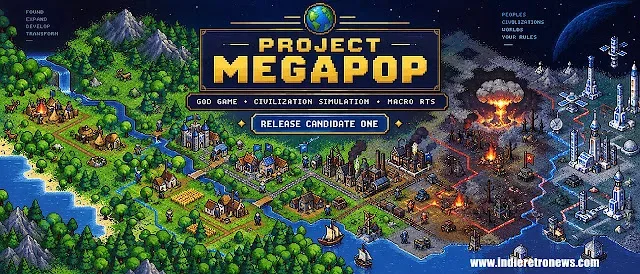
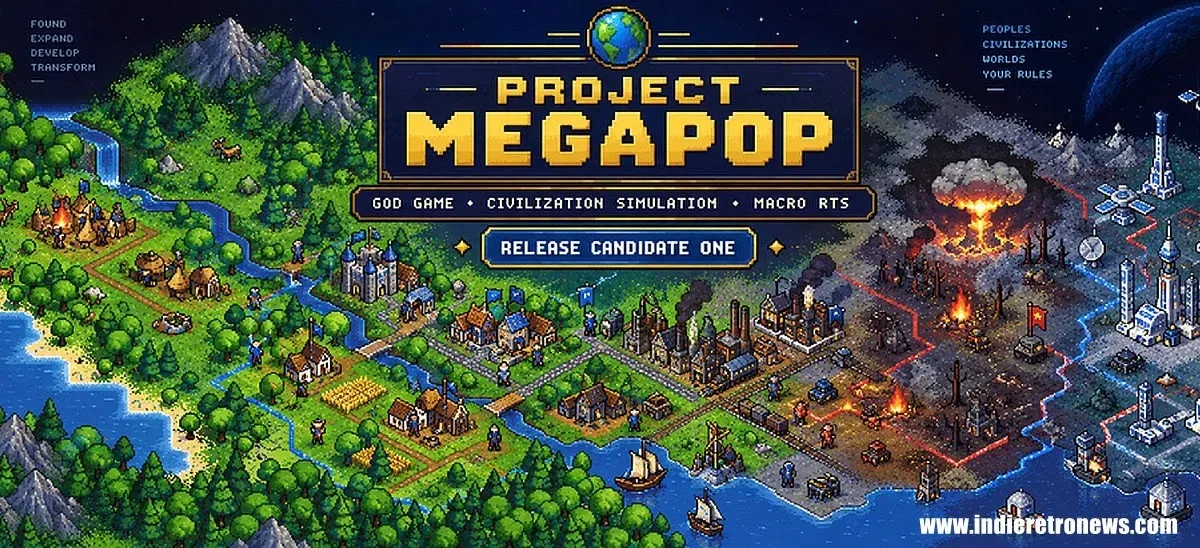
PROJECT MEGAPOP is a browser-based strategy game that looks back to the formative god games of the Amiga era while pursuing a simulation-led approach of its own. Created by solo developer D.B. Waldtier, the project draws clear inspiration from Populous and Mega-lo-Mania, two influential strategy titles associated with the Amiga 500. Its central idea is familiar to fans of those classics: players do not command every citizen directly. Instead, they guide an emerging society from above, changing the landscape, influencing broad priorities and calling on extraordinary powers when their people need intervention.
That setup puts PROJECT MEGAPOP in an increasingly rare corner of strategy design. Many modern real-time strategy games focus on tight unit control, build orders and constant selection of individual soldiers or workers. PROJECT MEGAPOP deliberately shifts attention away from that kind of micromanagement. Its followers are intended to handle their own day-to-day activity, including farming, mining, research and combat. The player's role is not that of a field commander issuing every order, but an overseeing force shaping the conditions in which a civilization can grow, survive and confront rivals.
A god-game perspective rather than unit micromanagement
The most important distinction in PROJECT MEGAPOP is its macro-scale focus. Rather than placing every structure and directing each worker toward a resource node, players influence the world underneath an autonomous population. Terrain becomes a strategic tool: reshaping land can affect routes, settlement opportunities and the practical limits facing a growing community. In a genre built on the satisfaction of altering an entire world with a few decisive actions, that terrain-driven interaction is a major part of the appeal.
Players can also adjust societal priorities. While the exact set of options and the degree of control have not been detailed, the concept suggests that leadership comes through policy and broad direction rather than through a conventional command interface. A society may need to emphasize production, technological development, expansion or military readiness at different moments. The challenge is likely to come from recognizing which priority matters most before a problem becomes irreversible.
For useful background on this topic, read New York Comic Con 2026 cosplay Highlights Span Games, Anime, Comics and Kaiju.
This makes PROJECT MEGAPOP a strategy game about indirect control. Followers retain agency over their work, discoveries and fights, while the player seeks to steer the collective outcome. That can create a different kind of tension from traditional RTS play. Instead of asking whether a single unit has been positioned perfectly, the question becomes whether the world, incentives and available resources have been prepared well enough for the population to make good decisions on its own.
Classic Amiga influences remain at the center
Populous is one of the clearest reference points for the project. That landmark god game made terrain manipulation central to its strategy, allowing players to alter the physical world to help their followers build and expand. PROJECT MEGAPOP similarly frames land shaping as a core power rather than a decorative feature. The comparison establishes an expectation of strategic geography: hills, flat ground, obstacles and access can matter as much as the number of people in a settlement.
The other major influence, Mega-lo-Mania, points toward civilization-building across periods of technological and military development. Although PROJECT MEGAPOP's full progression structure has not been outlined, its inclusion of research, mining, fighting and adjustable societal priorities indicates that development will be more involved than simply spreading followers across a map. The game appears interested in the relationship between economic foundations, knowledge and conflict, all viewed from the high-level perspective of an overseeing power.
For another perspective on this story, read PROJECT MEGAPOP Brings Populous-Style God-Game Strategy to the Browser.
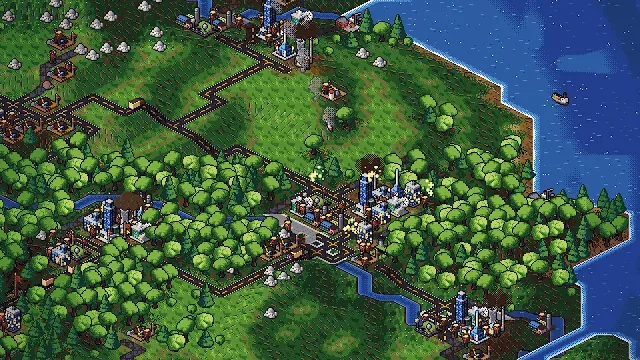
For Waldtier, the Amiga 500 connection is personal as well as mechanical. The developer grew up with the machine, and PROJECT MEGAPOP channels that background through both its inspirations and its visual style. The game uses pixel art, giving its world a deliberately retro-facing appearance rather than aiming for photorealism or a heavily rendered modern 3D look. That aesthetic choice fits the subject matter, but it also helps make the project feel like an interpretation of old ideas instead of a direct attempt to reproduce a specific classic.
Autonomous followers create an evolving simulation
PROJECT MEGAPOP's citizens are designed to operate independently. They farm to support the population, mine for materials, conduct research and enter combat without requiring the player to manually assign every action. The promise of this model is an active simulation in which a community feels like it has routines and pressures of its own.
Autonomy also changes what success looks like. A player may have the power to raise or lower terrain and influence the direction of society, but those powers must support the followers' ability to function. An isolated settlement may struggle even if it looks secure. A population without appropriate economic priorities may fall behind in research. A society that develops peacefully may still need to respond when fighting begins. The player is therefore encouraged to think in systems, anticipating the consequences of a change across the whole population.
There is room for satisfying emergent stories in that framework. A strategic decision that initially appears minor could alter access to land or resources, changing how followers develop over time. Since the population can farm, mine, study and fight on its own, the player may spend less time repeating commands and more time observing how competing needs play out. Fans of simulation games often enjoy exactly that balance: enough authority to meaningfully guide events, paired with enough independence that the world can still surprise them.
Worship powers offer a supernatural layer
Alongside terrain control and societal influence, PROJECT MEGAPOP gives players supernatural abilities powered by worship. This places the player firmly in the role of a deity-like presence rather than an invisible administrator. Worship is not merely thematic; it serves as the energy source behind interventions that can potentially change the direction of a match or rescue followers from danger.
The available supernatural powers have not been specified, so it is too early to define how they will affect combat, expansion or resource management. Still, the worship-based system presents an interesting strategic loop. Followers provide the spiritual foundation for the player's most dramatic actions, while those actions can in turn help protect or empower the followers. Such a loop can make population health, expansion and survival important for more than economic reasons.
It also reinforces the game's contrast between long-term planning and sudden intervention. Terrain shaping and societal priorities suggest careful preparation, whereas supernatural powers could provide a more immediate response to crisis. A strong god-game design often makes both approaches valuable: thoughtful world building establishes a stable civilization, but a well-timed divine act can turn a difficult moment into an opportunity.
An AI-assisted solo project with browser accessibility
PROJECT MEGAPOP is described as an AI-assisted game. That label establishes that artificial intelligence tools have played a role in its creation, though the available details do not specify which parts of development they supported. What is clear is that the project is being developed by Waldtier as a solo creation. For an independent strategy game built around terrain, simulation, autonomous behavior, research and combat, that is an ambitious scope.
Its browser-based format is equally notable. Strategy games with simulation ambitions have historically often lived on desktop platforms, while browser projects can offer a more immediate path into a game world without the usual installation process. No additional platform availability has been confirmed, so players should treat PROJECT MEGAPOP as a browser game rather than assuming releases on consoles, handhelds or mobile devices.
Browser delivery also suits the project's old-school inspiration in an unexpected way. While its influences trace back to the Amiga 500, the game is not restricted to vintage hardware or emulation. It instead uses contemporary web access to present a new take on systems associated with an earlier generation of strategy design. That combination could appeal to players who remember god games from the 1980s and 1990s, as well as younger strategy fans curious about why those ideas remain so influential.
Why PROJECT MEGAPOP stands out
PROJECT MEGAPOP arrives with a recognizable pitch, but its ingredients are compelling. It combines pixel-art styling, classic god-game ideas, an autonomous population, terrain manipulation, changing societal directives and worship-fueled miracles. Most importantly, it asks players to guide a civilization indirectly instead of reducing strategy to rapid clicking and exhaustive unit management.
Much remains to be revealed about the project's specific systems, scope and long-term structure. There are no confirmed details on a release schedule, pricing model or additional platforms. Even so, the foundation is easy to understand. D.B. Waldtier is building a strategy experience rooted in the pleasure of watching a world react to broad decisions: reshape the land, set a direction for society, nurture the people who believe in you and intervene when ordinary solutions are no longer enough.
For players who miss the perspective and imagination of classic god games, PROJECT MEGAPOP is a browser project worth watching. Its approach does not appear to be about recreating the past exactly. Instead, it uses enduring ideas from Populous and Mega-lo-Mania as the starting point for a modern, AI-assisted solo-developed simulation where the biggest decisions are made from above.
Community
Discussion
Start the conversation.
No comments have been posted yet.