

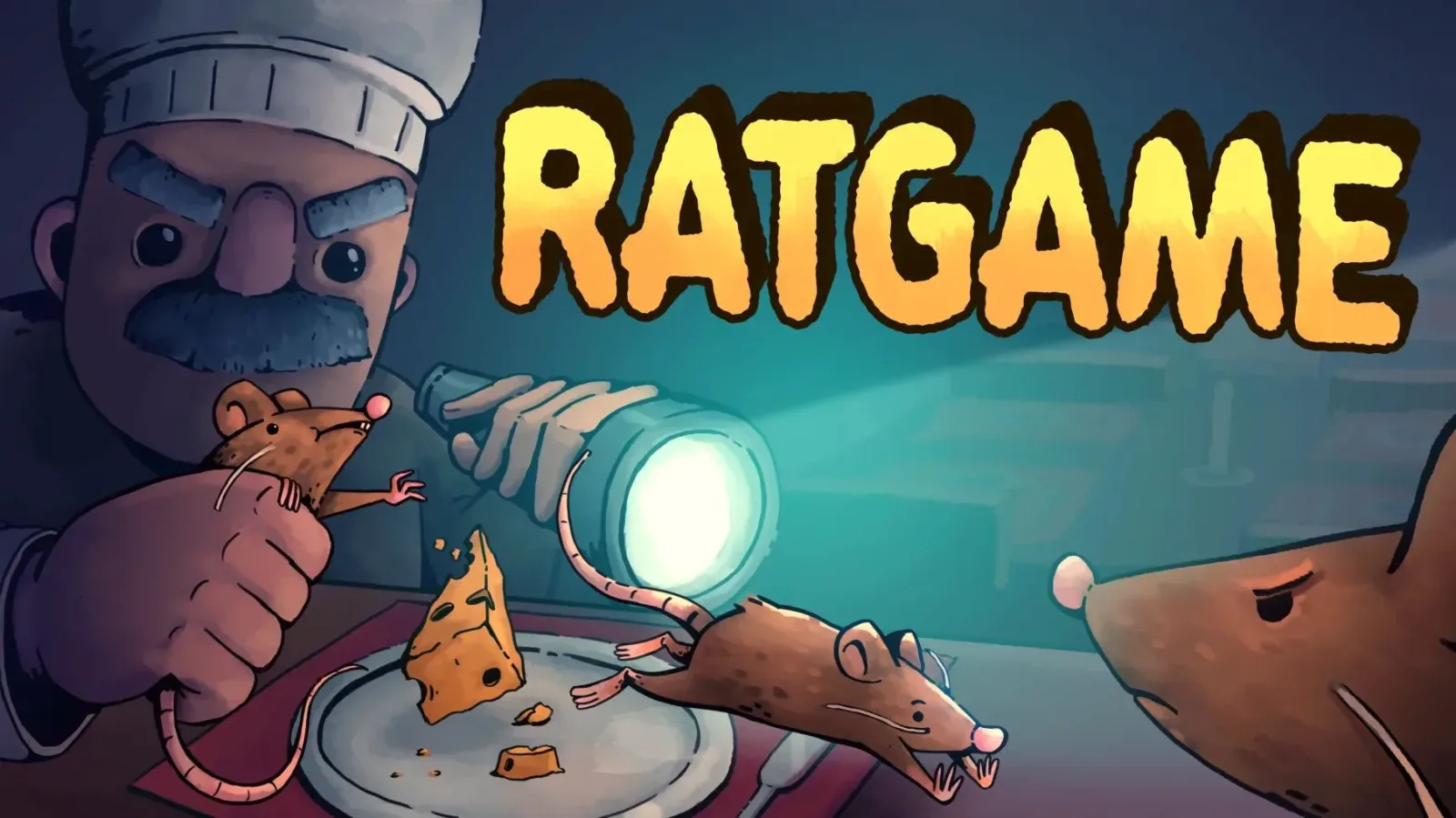
Rat Game, a new asymmetrical comedy-horror multiplayer game from indie developer Aran Koning of Sokpop, has launched for PC. Its central setup is immediately mischievous: one player takes control of a Chef trying to keep a restaurant operational, while a team of two to seven rats attempts to turn the entire establishment into a disaster zone.
The game supports both competitive matches against a human-controlled Chef and a co-op-focused alternative in which the rats take on ROBO CHEF, a robot-controlled opponent. That means players who want the tension of an uneven player-versus-player hunt have an option, but so do groups that would rather work together against an AI threat while causing as much culinary chaos as possible.
Rather than framing rats as simple scavengers, Rat Game gives the small saboteurs a surprisingly broad menu of restaurant-wrecking jobs. They can gnaw through wires, block toilets, access the staff computer, and use hidden routes to evade capture. The Chef, meanwhile, must pay attention to the sounds echoing through the building, locate the source of the trouble, and catch the intruders before the restaurant collapses into total disorder.
A restaurant becomes the battleground
Rat Game is built around an interconnected restaurant map filled with shortcuts, secrets, and scurryways intended for its tiny playable troublemakers. The rats are not simply asked to outrun a pursuer in open spaces. Their advantage comes from teamwork, access to concealed pathways, and their ability to interact with key parts of the restaurant environment.
For useful background on this topic, read Minimap Indie Game Showcase: Mystery Edition Streams November 4 With 24 Investigation-Focused Games.
For the rat team, sabotage appears to be as much about planning as it is about improvisation. One player might create an obvious problem, such as a clogged toilet or damaged wiring, while another slips through a hidden passage toward a separate objective. The restaurant's linked layout encourages players to learn routes, identify escape options, and make the most of the fact that a rat can reach places the Chef may not be expecting.
That structure gives the game's comedy-horror angle room to work. A group of rats causing trouble in a restaurant is inherently silly, but the presence of a hunter who can cage them creates a more anxious counterpoint. The rat players are small, vulnerable, and strongest when they cooperate. The Chef is alone, but has the job of restoring order and stopping the infestation before it spreads too far.
The stated focus on last-one-standing gameplay further raises the stakes once a match begins to narrow. A coordinated group can quickly become a scattered set of survivors if the Chef starts successfully catching rats. For anyone left alone, the map's secret routes and sound cues could become especially important.
For another perspective on this story, read Rat Game Launches on PC With One Chef, Up to Seven Rats and Restaurant Ruin.
One Chef, up to seven rats
The core competitive format supports one Chef versus two to seven rats. That range should let groups adjust a match around the number of people available, whether that means a smaller team trying to outsmart a single opponent or a larger pack overwhelming the restaurant with simultaneous disruptions.
Asymmetrical games often depend on giving each side a sharply different perspective, and Rat Game leans into that contrast. The rats have numbers, mobility through their specialized routes, and cooperative sabotage tools. The Chef has the responsibility of responding to trouble across the whole venue, interpreting what is happening, and physically removing rats from play by catching and caging them.
Audio is a key part of that contest. The Chef listens for the sound of scrabbling claws, turning the rats' movement into a potential liability. A rat that rushes recklessly through the restaurant may reveal its location, while a careful group can try to use noise, distractions, and the map's connections to confuse its pursuer.
There is also an additional wrinkle for the Chef: a gun may be somewhere within the map. Its mention adds another element of uncertainty to the hunt, without changing the basic premise that the Chef must manage a restaurant-wide rodent crisis. For the rats, discovering that their opponent has gained access to an extra tool would make communication and evasive movement even more valuable.
Proximity chat puts the squeaks close by
Rat Game includes proximity chat, described as squeaky proximity chat, which fits both the game's rat theme and its emphasis on spatial awareness. In games where players are separated across a detailed map, proximity voice systems can turn casual chatter into a tactical resource. Talking loudly in the wrong room may give away a position; hearing distant voices may suggest that a group is working on a nearby objective.
The feature should also help support the social, comedic side of the experience. A rat team hurriedly trying to coordinate a plan while fleeing a Chef is a naturally chaotic situation, and proximity-based communication means those moments are tied to where players are physically located in the restaurant rather than being detached from the action.
For the Chef, the game's sound-based design means listening is not merely atmosphere. Scratching, scurrying, and nearby voices can all contribute to the sense that something is happening just out of sight. For rats, managing those same audio cues becomes part of staying alive. They may need to decide whether to make a loud move that advances sabotage quickly or take a slower route that leaves less evidence of their presence.
Dynamic music for shifting restaurant chaos
Alongside its sound design, Rat Game uses a dynamic soundtrack. That is an appropriate fit for a match that can move from quiet sneaking to sudden pursuit in a matter of seconds. As objectives are disrupted, rats are discovered, or the Chef closes in, adaptive music can reinforce the changing pressure of a round.
The game's audio work was created by Tumult Kollektiv, consisting of Alexander van der Kruijf, Jonathan Howe, and Leonhard van Voorst. Their contribution covers both sound design and dynamic music, two parts of the presentation that appear central to how Rat Game builds its comedy-horror identity.
In a game with hidden passages and a hunter relying on sound, environmental audio has a practical role beyond setting a mood. Players need to be able to identify activity, judge danger, and react quickly. At the same time, the bizarre premise leaves space for lighter moments: a tense pursuit can still be funny when the people being chased are a squad of panicked rats attempting to destroy restaurant infrastructure.
ROBO CHEF offers a cooperative route
Not every group wants to nominate one friend as the Chef, and Rat Game accounts for that with ROBO CHEF. This robot-controlled Chef allows the rats to team up in a co-op-only mode, preserving the shared objective of sabotaging the restaurant while replacing the human hunter with an AI-controlled threat.
The mode provides a different way to engage with the game's systems. Instead of competing against a player who can adapt through deception and instinct, rat teams can concentrate on coordinating tasks and surviving the robot Chef together. The fundamental tension remains: the rats need to damage and disrupt the restaurant, while their pursuer is trying to stop them from getting away with it.
Having both a human-controlled Chef option and an AI alternative also makes Rat Game's premise more flexible for different play groups. A group can switch between a competitive contest and a fully cooperative session without leaving the restaurant setting or abandoning the game's core sabotage loop.
A small-scale premise with room for big messes
Rat Game's concept is simple enough to understand at a glance, but its match structure suggests plenty of opportunities for emergent multiplayer stories. A Chef may hear an odd noise and discover too late that it was a diversion. A rat may escape capture through a route that another player did not know existed. A nearly completed sabotage effort may fall apart when the final surviving rat has to make a risky run through the restaurant alone.
The combination of a connected map, hidden scurryways, shifting audio, proximity chat, and uneven team sizes is designed to make every restaurant disaster feel reactive. Rats can overwhelm a Chef through coordination, but they also need to avoid making enough noise to become easy targets. The Chef has a more direct role in the hunt, yet must cover a building full of potential trouble spots without knowing exactly where the next disruption will occur.
Developed by Aran Koning, Rat Game is now on PC with its blend of rodent mischief, restaurant sabotage, co-op play, and asymmetrical pursuit. Players can choose to protect the kitchen as the lone Chef, join a pack determined to ruin service, or confront ROBO CHEF with friends in a cooperative attempt to make the restaurant's worst day even worse.
Community
Discussion
Start the conversation.
No comments have been posted yet.