

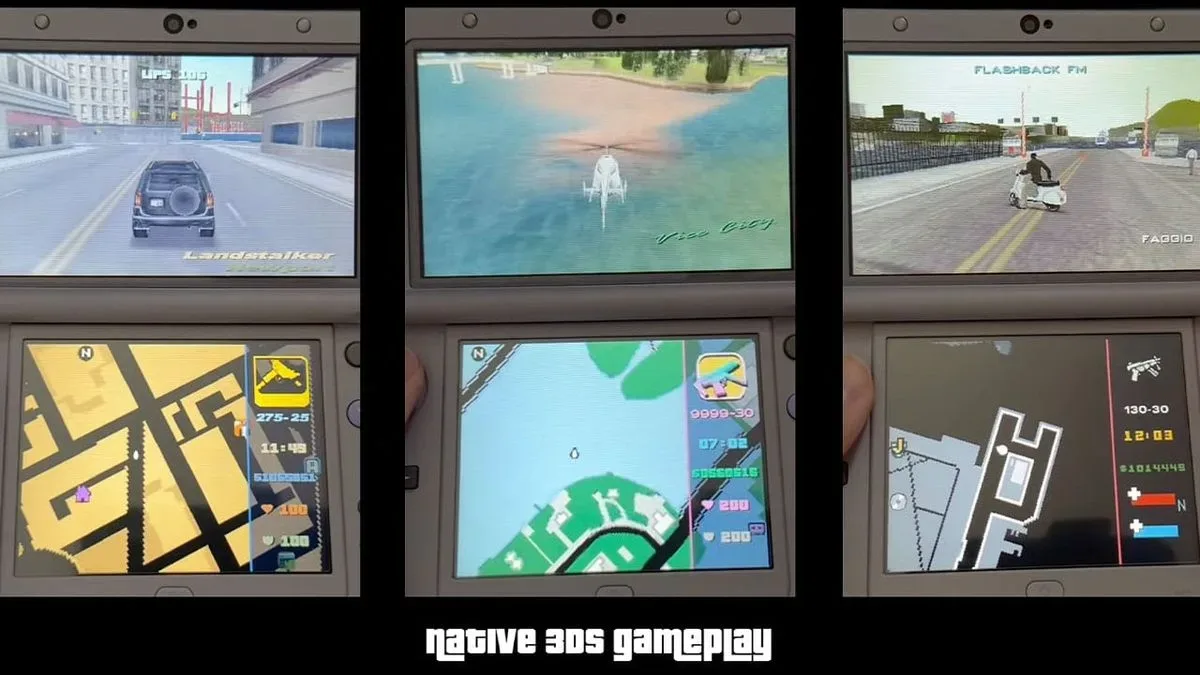
The Nintendo 3DS may have left production years ago, but its homebrew scene continues to find ambitious new uses for the handheld. The latest example is the reGTA Collection, a fan-made project that brings reverse-engineered versions of Grand Theft Auto III, Grand Theft Auto: Vice City, and Grand Theft Auto: Liberty City Stories to compatible members of the New Nintendo 3DS family.
Completed by developer EpicReds0817, the collection adapts the projects commonly known as re3, reCV, and reLCS for Nintendo's dual-screen portable hardware. It is not an official Rockstar Games release, and it is not a simple emulation package. Instead, it is built around community reverse-engineering work that allows these games to be compiled and tailored for different devices.
That distinction is important, because the project has been designed around the 3DS hardware itself. Controls have been reorganized for the handheld, the lower touchscreen is used for an interface that includes the map, and touch input can be used alongside a keyboard for cheats. The result is intended to make three early 3D-era GTA adventures feel more at home on a system that was never officially given native versions of any of them.
Three GTA games, adapted for a dual-screen handheld
The reGTA Collection covers three distinct points in the franchise's history. GTA III established Liberty City as a fully explorable 3D crime sandbox in 2001. Vice City expanded that formula with its neon-soaked 1980s setting, while Liberty City Stories originally arrived as a PSP-focused prequel before later being adapted elsewhere. Putting all three into one 3DS-oriented project creates an interesting match between portable GTA history and Nintendo's own later handheld generation.
For useful background on this topic, read Multisystem Pocket 2 Reveals Its Game Gear-Inspired FPGA Handheld Design.
Each title receives a separate visual identity on the lower display. GTA III uses a dark-blue interface, Vice City uses pink, and Liberty City Stories uses red. These details may seem cosmetic, but they give each game its own immediate look when navigating the collection and make the second screen feel like more than a generic overlay.
The bottom-screen setup is also practical. A persistent map is particularly useful in GTA games, where missions regularly ask players to cross large city districts, locate targets, or escape police attention without losing track of a destination. Moving that information off the primary screen can leave the upper display clearer during driving, shooting, and exploration. Touch controls and the cheat keyboard further lean into the 3DS's unusual hardware rather than treating it as a conventional single-screen console.
GTA III changes target performance and stability
For Grand Theft Auto III, the 3DS build includes faster loading and smoother streaming. Streaming is a major consideration for an open-world game, since the city must bring in roads, vehicles, pedestrians, and nearby environment data while the player moves through Liberty City. Improvements in this area can make driving across districts feel less disruptive.
The port also removes motion blur, fixes vehicle materials, and addresses several crashes. Those changes suggest the work has extended beyond simply getting the game running, with effort spent on presentation and stability within the limitations of the target hardware. The project notes a final-mission music selection of "Push It to the Limit" for this entry.
As with all three games, the key takeaway is that the main campaign is reported to be playable from beginning to end. That is a substantial milestone for a community port on aging handheld hardware, particularly for games built around broad city maps, dynamic traffic, missions, scripted scenes, and a large variety of vehicles.
Vice City receives restored effects and flight fixes
Grand Theft Auto: Vice City has its own set of adjustments. In addition to faster loading, its build restores particles and vehicle highlights. Those effects contribute heavily to the game's atmosphere, from the visual activity of the streets to the stylized shine of its cars. Their inclusion is a notable part of preserving the colorful look associated with Vice City's Miami-inspired setting.
The project also resolves issues involving character and vehicle polygons, water seams, and crashes connected to flight. Aircraft-related instability would be especially troublesome in a game whose later missions and free-roaming options make use of helicopters and planes, so that category of fix matters for players attempting a full story run.
For the final mission, the Vice City version uses "Self Control" as its featured music choice. Along with the pink lower-screen design, it helps distinguish the game's 3DS build from the darker Liberty City entries surrounding it.
Liberty City Stories completes previously unfinished campaign work
The Liberty City Stories component may be the most technically notable part of the collection. The project completes the previously unfinished reStories/reLCS campaign implementation for the New Nintendo 3DS. That means the effort is not limited to a partial proof of concept or a handful of working areas; its stated goal is a full campaign-capable version of the game on the system.
Its red lower-screen interface is joined by lightweight vehicle reflections, a compromise that aims to retain some extra visual detail without placing too much burden on the handheld. Fixes cover missions, save functionality, world-state changes, cutscenes, and vehicle-related bugs. These are all essential systems for a story-driven open-world game, where a broken mission trigger or unreliable save can prevent players from progressing even when the core city is otherwise functional.
This version also includes custom text cheats and uses "Chase" as final-mission music. The combination of campaign work, technical fixes, and 3DS-specific controls makes it clear that the collection is being treated as a serious adaptation effort rather than merely a novelty.
Only New 3DS-family hardware is supported
There is an important hardware limitation. The reGTA Collection is intended for the New Nintendo 3DS, New Nintendo 3DS XL, and New Nintendo 2DS XL, as well as systems capable of running 3DSX builds. The original Nintendo 3DS, Nintendo 3DS XL, and Nintendo 2DS are not supported.
The dividing line is the extra processing power and memory available in the New 3DS family. While the two generations look similar and share much of the same software library, the revised systems included stronger internals and additional controls. For these GTA ports, that expanded headroom is a requirement rather than an optional performance benefit.
Anyone considering the project should therefore confirm exactly which version of the hardware they own. A standard 3DS or 2DS cannot be expected to run these builds, regardless of whether it can access other homebrew software. The New branding is central to compatibility here.
A build-it-yourself project with legal game files required
The reGTA Collection is not distributed as a ready-to-install package containing the commercial games. Users must build the ports themselves and provide legally acquired game files for each title. Runtime overrides and HOME Menu artwork are included, but the executables and the devkitARM toolchain are not bundled.
That setup reflects the legal and technical boundaries common to reverse-engineered game projects. The code and platform work can be shared separately, while the copyrighted assets required to run a game must come from copies obtained by the user. It also means this is a project aimed primarily at people already comfortable with homebrew, file preparation, and compiling software rather than a plug-and-play release for a typical 3DS owner.
EpicReds0817 has cautioned that side missions and other optional activities have not yet all been verified. The main stories in all three games are reported to be completable, but completionists should keep that remaining uncertainty in mind. A campaign may be functional while individual diversions, challenges, or edge-case activities still need more testing.
Another sign of the 3DS homebrew scene's staying power
The reGTA Collection is a reminder that discontinued hardware can remain relevant through dedicated community development. The New 3DS line already has a large catalog, but projects like this give it experiences that would have been hard to imagine during its retail life: substantial open-world games adapted with bespoke touchscreen interfaces, platform-specific optimizations, and continued bug fixing.
For GTA fans with compatible New 3DS hardware, the appeal is easy to understand. GTA III, Vice City, and Liberty City Stories are all games with deep connections to the era when portable gaming increasingly pursued console-scale worlds. Seeing them reshaped for Nintendo's glasses-free 3D handheld is both a technical curiosity and a potentially compelling way to revisit them.
There are caveats: users need supported hardware, they need to compile the software, they need legal game files, and optional content still requires further verification. Even so, the main campaign support across all three titles represents an impressive achievement for a fan-led 3DS project. Long after the system's commercial run ended, the New Nintendo 3DS family is still gaining unexpected destinations to explore.
Community
Discussion
Start the conversation.
No comments have been posted yet.