

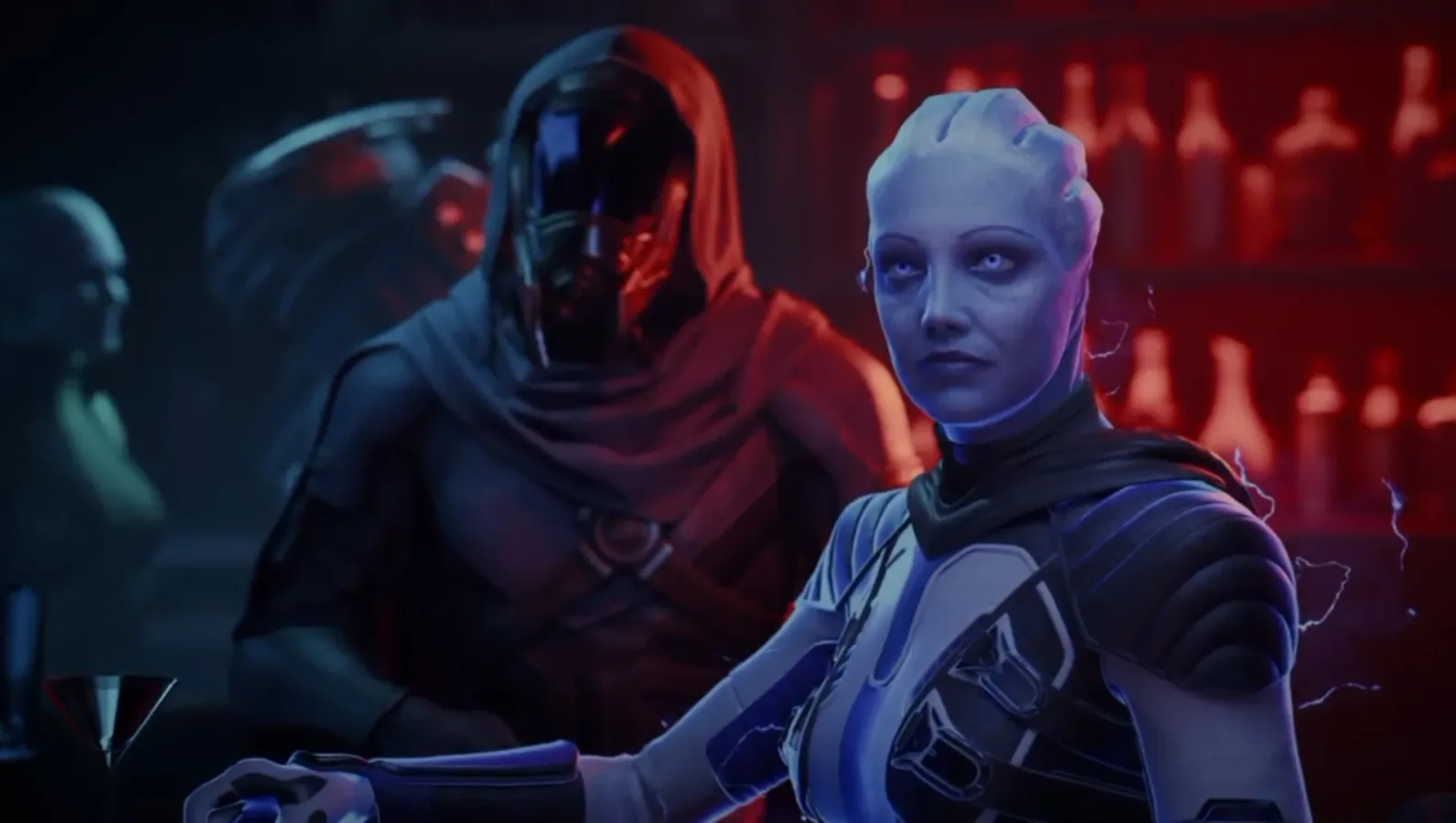
More details have reportedly emerged about the development of Mass Effect: Universe, the now-canceled BioWare project that was positioned as the next major entry in the long-running science-fiction RPG series. Accounts attributed to anonymous former developers describe an ambitious game set long after the original Mass Effect trilogy, with a new lead character and an important role for Liara T'Soni.
The same reporting also raises questions about the atmosphere surrounding internal presentations late in the project's life. One former developer reportedly said a flag in a demo was removed because it resembled a Pride flag and the team feared it might create friction with executive leadership. The reported decision was not characterized as a move to erase inclusive material from the game itself, but as an attempt to avoid negative reactions during a period when the studio was already concerned that Mass Effect was not being treated as a priority.
Electronic Arts had not publicly detailed the reported incident at the time these claims emerged. As with any account based on unnamed development staff, the specifics should be regarded as unverified beyond the accounts provided by those former employees. Still, the picture that emerges is of a team developing a substantial new Mass Effect game while navigating missed milestones, corporate uncertainty, and a major change in engine technology.
Embedded X/Twitter post
A New Era for Mass Effect
Mass Effect: Universe was reportedly planned around a setting roughly 600 years in the future. That distance would have given BioWare room to establish a fresh status quo without completely severing the game from the events and choices that defined the trilogy starring Commander Shepard.
For useful background on this topic, read GMKtec G10 Mini PC Drops to $290, Offering a Compact Option for Casual PC Gaming.
The project was said to feature a new protagonist rather than returning to Shepard as its central playable hero. However, Liara T'Soni, one of the most recognizable companions from the original trilogy, was reportedly intended to have a major part in the narrative. Liara's exceptionally long lifespan has always made her a natural bridge between distant points in the franchise timeline, and her involvement could have connected a far-future story to familiar galactic history.
Former developers reportedly said the team had already developed concepts for broad portions of the game, including story material and narrative-design systems intended to acknowledge choices made across the Mass Effect franchise. Precisely how those legacy decisions would have been imported, selected, or represented was not detailed. Mass Effect has a long history of carrying player choices between games, but the practical challenges of honoring a huge range of possible outcomes have grown considerably since the original trilogy.
That reported focus suggests Universe was not merely an early pitch or a small-scale prototype. The team apparently had a defined creative direction and was considering how to preserve one of the series' central appeals: the sense that player decisions can leave a lasting mark on characters, alliances, and the wider galaxy.
Reported Progress and an Unreal Engine Shift
Despite missed deadlines during development, the project was reportedly progressing well from the team's perspective. One major factor was BioWare's move to Unreal Engine after the studio's experience using Frostbite for Mass Effect: Andromeda.
The Frostbite engine has powered a range of Electronic Arts games, but it has often been described as a difficult fit for projects outside the kinds of games for which it was initially designed. Building an expansive, dialogue-heavy RPG involves needs that differ greatly from the technology requirements of a sports title or first-person shooter. The reported transition to Unreal was therefore viewed internally as helpful for Mass Effect: Universe's development.
Engine changes are never trivial. They require teams to establish new workflows, rebuild tools, and rethink how art, design, cinematics, and gameplay systems are produced. But Unreal Engine is widely used across the game industry, offering a large support ecosystem and a pool of developers familiar with its toolset. For a studio tasked with making a cinematic RPG of Mass Effect's scale, the switch could have reduced some of the technical friction associated with the previous production process.
A late-2028 launch was reportedly being considered by BioWare. That target underscores how far away the game still was, even if foundational narrative and design work had taken shape. A plan is not a guarantee, particularly in large-scale game development, and the reported schedule should not be read as a release date that had been officially announced. It instead gives a sense of the project's apparent stage before its cancellation.
Presentation Concerns and the Removed Flag
The most troubling part of the report concerns a visual element that was allegedly removed from a presentation intended for EA management. A former developer reportedly described a flag that was close in appearance to a Pride flag. The team allegedly removed it before showing the demo because it could have caused friction with executives.
The journalist who compiled the former developers' accounts later clarified that the reported choice was made in anticipation of potentially negative feedback tied to EA's ownership structure, rather than from a desire to conceal inclusive elements within the game. That distinction matters. The account does not establish that an executive issued a direct instruction to remove the flag. Instead, it describes what can happen when creative teams believe particular decisions may attract unwanted scrutiny from people with power over a project's future.
For creative workers, anticipated objections can be as consequential as formal mandates. A direct order creates an obvious record of interference. Self-censorship driven by uncertainty, meanwhile, can be quieter and harder to document. A team that worries a small piece of environmental storytelling might jeopardize a presentation may decide to remove it before anyone asks, especially when a project's funding, staffing, or continued existence feels insecure.
Mass Effect and BioWare have long been associated with player-driven relationships, diverse casts, and stories that make room for queer characters and themes. The reported incident has consequently drawn attention not only because of one flag in one demo, but because it is being interpreted through the series' history and the broader question of whether a changing corporate environment could influence future creative work.
Ownership Changes and Studio Uncertainty
The report places these concerns in the context of Electronic Arts' reported acquisition by a consortium involving Saudi Arabia's Public Investment Fund, Silver Lake Partners, and Affinity Partners. Following the acquisition, employees reportedly received assurances from EA management that the new owners would not make creative decisions.
Those reassurances did not eliminate employee anxiety. Saudi Arabia's government has faced sustained criticism over human-rights issues, including its treatment of queer people. Affinity Partners founder Jared Kushner's association with the Trump family also contributed to concerns among some employees about what the ownership changes could mean for studios and franchises known for inclusive storytelling.
It is important to separate reported fears from confirmed policy. There is no indication in the available account that the new owners directly dictated the contents of Mass Effect: Universe or issued a specific instruction involving the flag. The former developer's claim instead describes a perceived risk that influenced an internal choice. Even so, the perception itself can shape creative decisions, particularly when the staff involved believe they are trying to protect a vulnerable project.
BioWare was subsequently shuttered following the acquisition, ending development on Mass Effect: Universe and leaving the franchise's immediate future unclear. The closure also means that many of the reported plans--its future setting, its new protagonist, its treatment of player choice, and Liara's intended role--may never move beyond development materials and internal concepts.
What the Cancellation Means for the Series
Mass Effect: Universe appears to have been conceived as a chance to build forward while retaining an emotional connection to the trilogy. A setting six centuries later could have let BioWare explore the consequences of earlier events without becoming trapped by every practical limitation of continuity. Liara's involvement could have provided a human--or rather asari--link between generations, while a new hero could have given players another perspective on the galaxy.
Its cancellation removes a potentially significant chapter from a series that has already experienced a complicated recent history. Mass Effect: Andromeda launched under difficult circumstances, and the franchise has spent years in a state of intermittent revival, uncertainty, and anticipation. The reported engine transition and broad narrative planning suggest the team had been attempting to address some of the production lessons associated with the prior game.
For now, there is no confirmed path forward for Mass Effect: Universe. No official release window, platforms, footage, or full plot outline had been announced. The reporting provides a glimpse at what BioWare may have been trying to make, but it also illustrates the instability that can surround major games long before audiences ever see them.
The fate of other inclusive EA franchises, including The Sims, remains an open question as the company adjusts to its ownership situation. What is clear from the former BioWare employees' accounts is that corporate change can affect development teams well before any public creative policy is declared. In the case of Mass Effect: Universe, that uncertainty now sits alongside the loss of a game that reportedly still had years of development ahead of it.

Community
Discussion
Start the conversation.
No comments have been posted yet.