

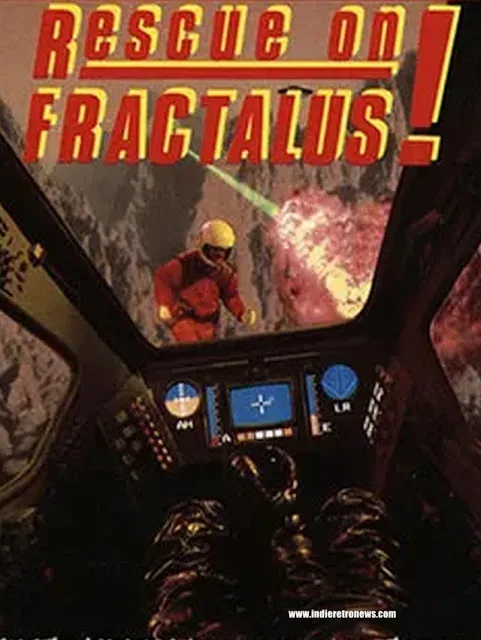
Rescue on Fractalus!, one of the most memorable early releases from Lucasfilm Games, has arrived on the Commodore Amiga through a new version 1.0 port by Vesuri. The project gives retro players another way to revisit the 1985 alien-world rescue game, whose distinctive mountain landscapes and uneasy cockpit atmosphere made it stand out among the home-computer releases of its era.
This is not a port intended for every stock Amiga configuration. Vesuri's release needs an Amiga with 1 MB of RAM, meaning an unexpanded 512 KB Amiga 500 does not have sufficient memory. Development and testing were carried out on an A500+ using Kickstart 3.1, while the game is also stated to run under Kickstart 1.3 PAL. Those specifications will be important for anyone preparing original hardware, choosing an emulator profile, or assessing whether an existing Amiga setup can run the new build.
For a game so closely linked with Atari 8-bit computers and the earliest history of Lucasfilm's game-development arm, an Amiga release is a notable addition to its long afterlife. Rescue on Fractalus! has been remembered not only as a technical showcase, but also as a tense, imaginative action game built around a simple mission that could go unexpectedly wrong.
A rescue mission with a sinister twist
At its core, Rescue on Fractalus! puts the player in the cockpit of a small craft tasked with flying through hostile terrain on an alien planet. The objective is to find stranded pilots, land nearby, and bring them aboard. On paper, it is a rescue operation. In play, the mountain passes, limited room to maneuver, enemy fire, and uncertainty surrounding every pickup turn that assignment into a suspenseful survival challenge.
For useful background on this topic, read The AmiGoonies Brings the 1986 MSX Classic to Commodore Amiga.
The game's most famous idea is its willingness to undermine the player's expectations. Not every apparent survivor is necessarily a friendly pilot in need of extraction. That uncertainty is central to the game's identity and remains one of the reasons it has stayed vivid in the memories of players decades later. Rescue on Fractalus! uses the confined perspective of the cockpit and the ritual of stopping for a figure outside the ship to create tension that was unusually effective for the period.
Rather than relying on elaborate narrative presentation, the game communicates its character through situation and sensation: the approach toward a mountainous landing area, the need to watch the surroundings, the expectation of a rescue, and the possibility that the encounter will not proceed as planned. It is a compact design, but one that demonstrates how much atmosphere early home-computer games could create with a focused premise.
Fractal mountains defined the visual experience
The "Fractalus" in the title points directly to the technology behind the game's signature landscapes. Rescue on Fractalus! uses fractal techniques to produce its jagged alien mountains, allowing the world to feel more varied and rugged than many of the flatter or more regularly patterned environments common in games of the time.
For another perspective on this story, read Rescue on Fractalus! Reaches Amiga in a New v1.0 Port.
That use of fractal terrain was not merely a graphical talking point. It shaped the entire experience. Mountains become obstacles, cover, navigational hazards, and an ever-present visual marker of the planet's hostile nature. Flying low through uneven valleys creates a sense of movement and danger that complements the limited visibility from the ship. The terrain is not background decoration; it is the game's defining environment.
For players returning to Rescue on Fractalus! today, that technology is part of its historical appeal. The game represents a period when developers were actively exploring ways to make relatively modest home hardware suggest large, unfamiliar spaces. Its alien vistas may be constructed from the technical tools available in the mid-1980s, but their role in building immersion remains clear.
An early Lucasfilm Games landmark
Rescue on Fractalus! originated in 1985 and was developed by Lucasfilm Games, then part of the Lucasfilm Computer Division's Games Group. The group was led by Peter Langston, and the title was among its first two products. That context makes the game especially significant: it arrived well before the studio would become widely associated with a long line of influential adventure games and other major releases.
David Fox served as project leader and designer on Rescue on Fractalus!, placing him at the center of a game that combined technical experimentation with a strong sense of player experience. The music was mainly composed by Charlie Kellner. Together, those elements helped give the title an identity that went beyond its flight-and-rescue framework.
Looking back, the game provides an interesting glimpse at a studio in its formative years. Later Lucasfilm Games projects would earn recognition for cinematic presentation, humor, storytelling, and interface design, but Rescue on Fractalus! reveals another important part of that legacy: a willingness to pursue novel technology and build a game around a compelling emotional response. Its fear factor, its unfamiliar terrain, and its cockpit perspective all serve a coherent mood.
The new Amiga version therefore has value beyond simple preservation. It places a foundational Lucasfilm Games work onto a platform with its own deeply devoted retro community. Amiga owners and collectors frequently celebrate the machine's library of arcade conversions, European computer originals, demos, and technically ambitious projects. A modern port of Rescue on Fractalus! fits naturally into that continuing interest in discovering how classic concepts translate to Commodore hardware.
From Atari systems to a broad 8-bit legacy
The original release is strongly associated with Atari hardware, including the Atari 8-bit line and Atari 5200. However, Rescue on Fractalus! also reached a range of other systems over time: Amstrad CPC, Apple II, Commodore 64, Color Computer 3, and ZX Spectrum. Its broad distribution helped make it one of the better-known computer games of its generation.
Each platform had its own strengths and limitations, making ports an important part of how players encountered the game. The arrival of an Amiga version decades later continues that tradition, though the circumstances are very different. Rather than being a contemporary commercial conversion launched during the original release window, Vesuri's version is a modern retro-computing effort that brings the game to a machine absent from the initial platform list.
That distinction matters because retro ports are often acts of both technical adaptation and historical appreciation. They invite players to consider what a classic might have felt like on another system, while respecting the constraints and characteristics of that platform. In this case, the stated 1 MB memory requirement underscores that the Amiga release has been designed around a configuration beyond the base 512 KB Amiga 500.
What Amiga users need to know
The key compatibility details are straightforward, but worth emphasizing:
- Memory: 1 MB of RAM is required.
- Not supported: An unexpanded 512 KB Amiga 500 does not have enough memory for the game.
- Development and testing: The port was developed and tested on an Amiga 500+ running Kickstart 3.1.
- Additional compatibility: It also runs on Kickstart 1.3 PAL.
For original-hardware users, those details should help avoid a common frustration with new Amiga software: assuming a title designed for an A500-era machine will automatically fit inside the earliest base memory configuration. The Amiga family developed through many revisions and expansions, and even software aimed at classic systems can target a particular memory or ROM setup.
For emulation users, reproducing a compatible 1 MB configuration and selecting an appropriate PAL Kickstart environment should be the practical starting point. The stated testing hardware offers a useful reference point, although it does not establish a complete compatibility list for every Amiga model, accelerator, or emulated configuration.
A welcome addition for classic-game preservation
Rescue on Fractalus! remains a fascinating game because its individual ingredients are so direct: fly, navigate, land, rescue, survive. Yet the combination of fractal landscapes, cockpit tension, hostile encounters, and a strong audiovisual mood made it much more than a routine action title. Its influence is tied not only to its technology, but to its ability to make a player uneasy about the next landing.
Vesuri's version 1.0 Amiga port brings that experience to another classic computer platform and offers a fresh reason to revisit one of Lucasfilm Games' earliest landmarks. It is particularly welcome for Amiga enthusiasts who enjoy new software built for vintage hardware, as well as for players interested in tracing the technical and creative roots of a studio that would go on to become one of gaming's most celebrated names.
With the proper 1 MB Amiga setup, Rescue on Fractalus! can now once again send players into the mountains of an alien world--where the mission is to save stranded pilots, and where caution remains as important as courage.
Community
Discussion
Start the conversation.
No comments have been posted yet.