

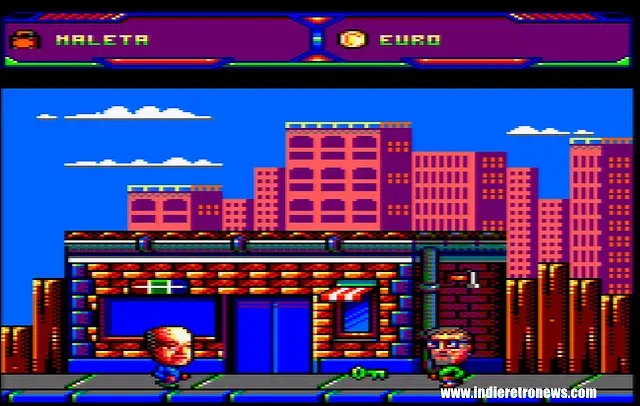
The Amstrad CPC's remarkably durable homebrew scene has another new release in Roland&Mej Build, an adventure platformer developed by TheQProyect. The game takes a playful route through the history of 8-bit computing, casting its two leads, Roland and Marc, as technology spies charged with an especially ambitious assignment: breaking into rival corporate offices and obtaining the designs for the era's most legendary computers.
It is a premise designed for players who enjoy both old-school platform games and the long-running rivalries that helped define the home-computer landscape. Instead of treating Spectrum, Commodore and MSX as distant names from a hardware history book, Roland&Mej Build turns them into locations at the center of its adventure. Each represents a competing technological stronghold, and each is protected by a famous figure who is not interested in letting unauthorized visitors walk away with valuable blueprints.
Roland and Marc must make their way through the headquarters of Spectrum, Commodore and MSX while pursuing the schematics. The task is not simply a brisk office visit. The people overseeing these companies' turf are personally standing guard: Clive, Jack and Nishi. Being spotted means immediate expulsion, giving the game's corporate-espionage setup a clear platforming tension. Players are expected to navigate these spaces carefully if they want to complete their mission.
A platform adventure built around 8-bit history
Roland&Mej Build draws on a particularly fitting setting for an Amstrad CPC release. The CPC existed in a period when computer brands competed fiercely for attention, software and cultural influence. Spectrum, Commodore and MSX each carry their own identity in the broader 8-bit story, whether players remember them through particular machines, games, regional communities or magazines. Placing all of them inside one fictional spy operation gives the game a knowingly affectionate framework.
For useful background on this topic, read Retroid Announces Pocket Duo Lite+ Days After Lite Preorders, Offering Exchange Window.
The goal of stealing computer schematics also makes the mission more specific than a generic rescue or treasure hunt. The protagonists are pursuing the technical foundations of famous machines, with their route blocked by the figures guarding rival headquarters. That gives the adventure a comic-book style of escalation: Roland and Marc are not merely sneaking past office staff, but attempting a theft at the heart of competing computer empires.
At the same time, the game's concept leaves room for the kind of direct, readable challenge that suits an 8-bit platformer. A player immediately understands the stakes: infiltrate, avoid being caught and advance toward the plans. The details of how the individual locations are structured, as well as the game's overall length and specific mechanics, have not been detailed here. What is clear is that stealthy infiltration is central to its fiction, with discovery carrying the consequence of being thrown out by the guards.
Roland and Marc take on the competition
The two playable heroes are Roland and Marc, who have been reimagined as tech spies for this outing. Their assignment takes them through the offices of rival brands in a playful crossover of computing history and platform-game storytelling. The names of their opponents are similarly significant. Clive, Jack and Nishi are presented as the pioneers defending their respective domains, creating a set of recognizable adversarial presences around the game's three company locations.
That approach gives Roland&Mej Build a fan-focused character. Its setting is rooted in the hardware culture surrounding classic computers rather than using a detached fantasy world. For Amstrad CPC enthusiasts, the premise can work on several levels: as a straightforward adventure about infiltrating guarded territory, and as a celebration of the personalities and platforms associated with the 8-bit period.
There is an appealing sense of mischief in having the Amstrad-side heroes race through the offices of their competitors. The mission does not suggest a dry historical comparison between machines. Instead, it turns those long-remembered rivalries into the backdrop for action, hazards and pursuit. The result is a concept that seems intentionally tailored to players who appreciate classic-computer nostalgia alongside their platforming.
Created with cpctelera
TheQProyect has said that Roland&Mej Build was made entirely with cpctelera, the development toolkit widely used for Amstrad CPC projects. That technical detail is important in the context of a contemporary CPC homebrew release. Tools such as cpctelera enable developers to create new software for a machine that remains beloved decades after its original commercial era, while still working within the character and constraints of its hardware.
Homebrew development is not only about revisiting the past. It is also about continuing a platform's creative life in the present. New games give longtime owners and retro players fresh reasons to return to original systems, compatible hardware and modern setups built around classic machines. A project such as Roland&Mej Build demonstrates how a familiar platform can still host original ideas, even when those ideas are deliberately tied to its own historical moment.
The developers describe the project as a labor of love made by fans for fans, with enjoyment placed at the center of the design. That sentiment matches the game's wider approach. The corporate-spy story, the rival-machine locations and the use of recognizable computing pioneers all suggest a project that wants to share its enthusiasm for the CPC era rather than merely borrow its visual language.
A collaborative production
Although Jose Antonio Quijada Lopez programmed Roland&Mej Build in its entirety, the game is the work of a larger group of contributors. TiTan created the in-game graphics, while WYZ composed the chip music. In a genre and on a platform where audiovisual identity matters enormously, those roles will be central to how players experience the infiltration adventure from moment to moment.
Sencico supplied the cover art, adding another creative component beyond the software itself. Cover illustration remains especially meaningful for physical retro releases and collector-oriented projects, where the object, packaging and presentation can be a substantial part of the appeal. The physical collector's edition was designed by Fran Quijada, highlighting that Roland&Mej Build has contributors working across both the game and its tangible presentation.
The credits also include special thanks to SpDizzy Special. Together, the listed roles show how many forms of creative work can sit behind an independently produced game: programming, graphics, music, cover design, physical-edition design and supporting contributions. It is an appropriate reminder that even a project aimed at classic hardware can bring together a broad mix of specialist skills.
Why new CPC games continue to matter
New releases for systems such as the Amstrad CPC have a special appeal because they connect eras. They are modern projects, made by current creators, but built for machines that carry decades of personal and cultural history. Players may approach them on original hardware, through compatible devices, or as part of a wider retro-gaming hobby. Whatever the setup, the arrival of a fresh title creates the feeling that the platform's library is still growing.
Roland&Mej Build also understands that the CPC's story was never isolated from the machines around it. Spectrum, Commodore and MSX were part of the same broad 8-bit conversation, sometimes competitors and always points of comparison. Building a game around those connections gives this release an identity that is more specific than nostalgia alone. It is using shared computer history as the engine for an adventure.
For fans of Amstrad CPC homebrew, the key takeaway is simple: Roland&Mej Build is a newly released adventure platformer with a distinctly 8-bit espionage premise, a CPC-focused production pipeline and a collaborative creative team. Roland and Marc's mission to obtain legendary computer schematics offers a lighthearted tribute to classic technology rivalries, while its guarded offices promise an obstacle-filled route through some of the best-known names of the era.
Its arrival is another sign that classic hardware communities remain active because they continue to make things. Roland&Mej Build is not framed as a relic recovered from the past; it is a new game that looks back at that past with humor, affection and a platforming mission built around getting one over on the competition.
Community
Discussion
Start the conversation.
No comments have been posted yet.