

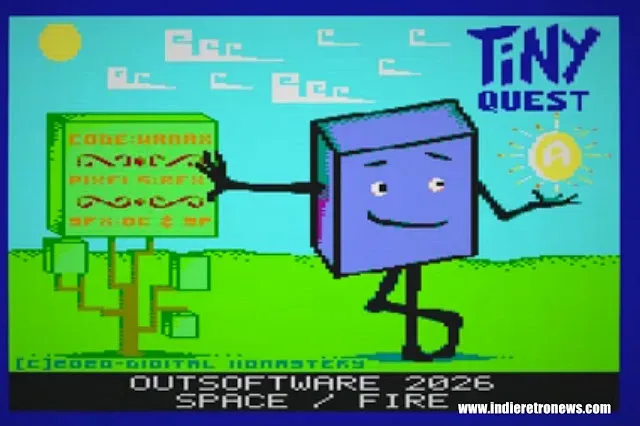
Tiny Quest, a challenging platformer originally created for the Commodore 64, has now arrived on the Amstrad CPC through a new port by Outsoftware. The conversion brings Mr. Cube's dangerous search for his true love to another classic machine, preserving a game built around fast reactions, precise movement, route planning, and the pressure of a continually depleting energy meter.
The Amstrad release follows an especially productive period for Outsoftware, which has spent the previous three weeks working through source-code conversions for a range of less frequently supported retro systems. That effort reportedly resulted in more than 30 ports across platforms including the Sam Coupé, Einstein 256, Timex 2068, and Sinclair QL. Tiny Quest is one of the projects to emerge from that burst of activity.
Crucially, the CPC version was made possible because original author Andrea Schincaglia shared the Commodore 64 source code. That access gave Outsoftware the opportunity to take the original game's foundations and bring them directly to the Amstrad CPC rather than attempting to reconstruct its behavior from scratch. The result is intended as a faithful adaptation of a game whose deceptively small-scale presentation conceals a highly demanding challenge.
A small hero facing unforgiving screens
Tiny Quest puts players in control of Mr. Cube, a compact protagonist sent through hazardous and quickly changing environments on a romantic mission. The objective is to find his true love before his energy supply is exhausted, but the journey is not presented as a relaxed, exploratory platforming adventure. It is a test of execution in which the player must repeatedly assess a screen, identify a safe route, and carry out the required sequence with careful timing.
For useful background on this topic, read Roland&Mej Build Brings a New Spy Platforming Mission to Amstrad CPC.
The game's danger comes from more than simply reaching a distant exit. Its environments are filled with traps, while the pace and layout demand quick responses. Some situations can initially appear impossible, particularly when hazards make the intended path difficult to read at a glance. Yet the developer stresses that every level can be completed. The apparent hopelessness of certain screens is therefore part of the game's challenge: success depends on learning what is happening, discovering the correct approach, and then performing it reliably.
That structure places Tiny Quest firmly in the tradition of exacting retro platform games where persistence is as important as reflexes. Players are encouraged to experiment, but careless experimentation comes at a cost. A missed move, mistimed action, or collision with a trap removes one of Mr. Cube's limited lives. With only five lives available, there is little room for repeated errors.
Energy, lives, and the need for control
The draining energy meter gives every moment in Tiny Quest an additional layer of urgency. A player cannot simply wait indefinitely for a comfortable opening or cautiously wander through a room at leisure. Decisions need to be made under pressure, and an efficient path matters alongside sheer survival. Fast reflexes may help in sudden situations, but they are only one part of the equation.
Advanced planning is equally important. Before committing to a jump or moving into a new danger zone, players may need to consider how the room is changing, where a trap is likely to strike, and whether a risky maneuver is truly necessary. Perfect timing then turns that plan into progress. The intended rhythm is one of observation, commitment, failure, adaptation, and eventually mastery.
Outsoftware's warning about self-control is particularly fitting for a game with this kind of design. In difficult platformers, frustration can make players rush into the same failed approach again and again. Tiny Quest appears designed to punish that impulse. A single mistake costs a life, and losing all five can bring the run to an abrupt end. Patience is therefore not merely an optional virtue; it is part of the skill set the game demands.
For players who enjoy the process of gradually turning an intimidating screen into a solved puzzle, this can be the central appeal. The game does not promise effortless progress. Instead, it offers the satisfaction of overcoming levels that once looked impossible through practice, familiarity, and disciplined control.
Part of a broader retro conversion effort
The Tiny Quest port is notable not only for bringing a Commodore 64 game to Amstrad CPC, but also for the pace of the work surrounding it. Outsoftware's recent conversion efforts have focused on machines that remain beloved among retro-computing enthusiasts despite receiving less regular software support than some of their contemporaries.
The Sam Coupé, Einstein 256, Timex 2068, and Sinclair QL were all named among the systems involved in the developer's recent work. Completing over 30 ports in three weeks suggests a broad technical push to make games accessible across a diverse group of vintage platforms. Each machine has its own hardware characteristics and community expectations, making source-code access especially useful when adapting a game while retaining its core identity.
In Tiny Quest's case, the availability of Andrea Schincaglia's original C64 code is a significant detail. Retro ports can take many forms, from loose reinterpretations to conversions designed to mirror the original closely. Here, the shared code gave the Amstrad version a direct path toward the latter approach. It also highlights the collaborative side of the retro scene, where creators and developers can extend the life of older games by making their work adaptable for other hardware.
Why the Amstrad CPC version matters
The Amstrad CPC has a long-standing place in European home-computer gaming history, and new releases or ports remain meaningful to its active enthusiast community. A conversion such as Tiny Quest offers CPC players a chance to experience a game that began life on a different classic format while also giving collectors and fans another reason to revisit original hardware or modern compatible setups.
There is also a preservation angle. Software for vintage computers can be restricted by the platforms for which it was originally developed, especially when code is unavailable or difficult to adapt. Sharing source material can help ensure that games continue to be played, studied, and enjoyed beyond their first machine. In this instance, the Commodore 64 original has found a new home without abandoning the demanding design that defines it.
That does not make Tiny Quest a game for everyone. Its emphasis on punishing hazards, limited lives, time pressure, and exact inputs means it will likely appeal most strongly to players who appreciate uncompromising old-school difficulty. The game's own premise makes that clear: screens may seem unwinnable at first, but they are built to yield to enough practice.
A quest for players who enjoy mastering the impossible
For Amstrad CPC fans, Tiny Quest presents another modern opportunity to test themselves on classic hardware. Mr. Cube's journey may be framed around finding true love, but the route is defined by danger at every turn. Rapidly shifting situations, hostile traps, a shrinking energy reserve, and a five-life limit ensure that progress must be earned rather than assumed.
The game's move from Commodore 64 to Amstrad CPC also stands as an example of what can happen when developers are willing to support older systems and original creators make their code available for adaptation. Outsoftware's wider run of conversions has brought attention to several underrepresented machines, while Tiny Quest gives that effort a particularly clear showcase: a compact-looking platformer with a large appetite for player skill.
Anyone approaching the CPC version should expect setbacks. The right response is not panic, but observation. Learn the trap patterns, work out the intended route, conserve lives where possible, and resist the urge to force a move before the moment is right. Tiny Quest may look charming, but its quest is built to be conquered one hard-won screen at a time.
Community
Discussion
Start the conversation.
No comments have been posted yet.