

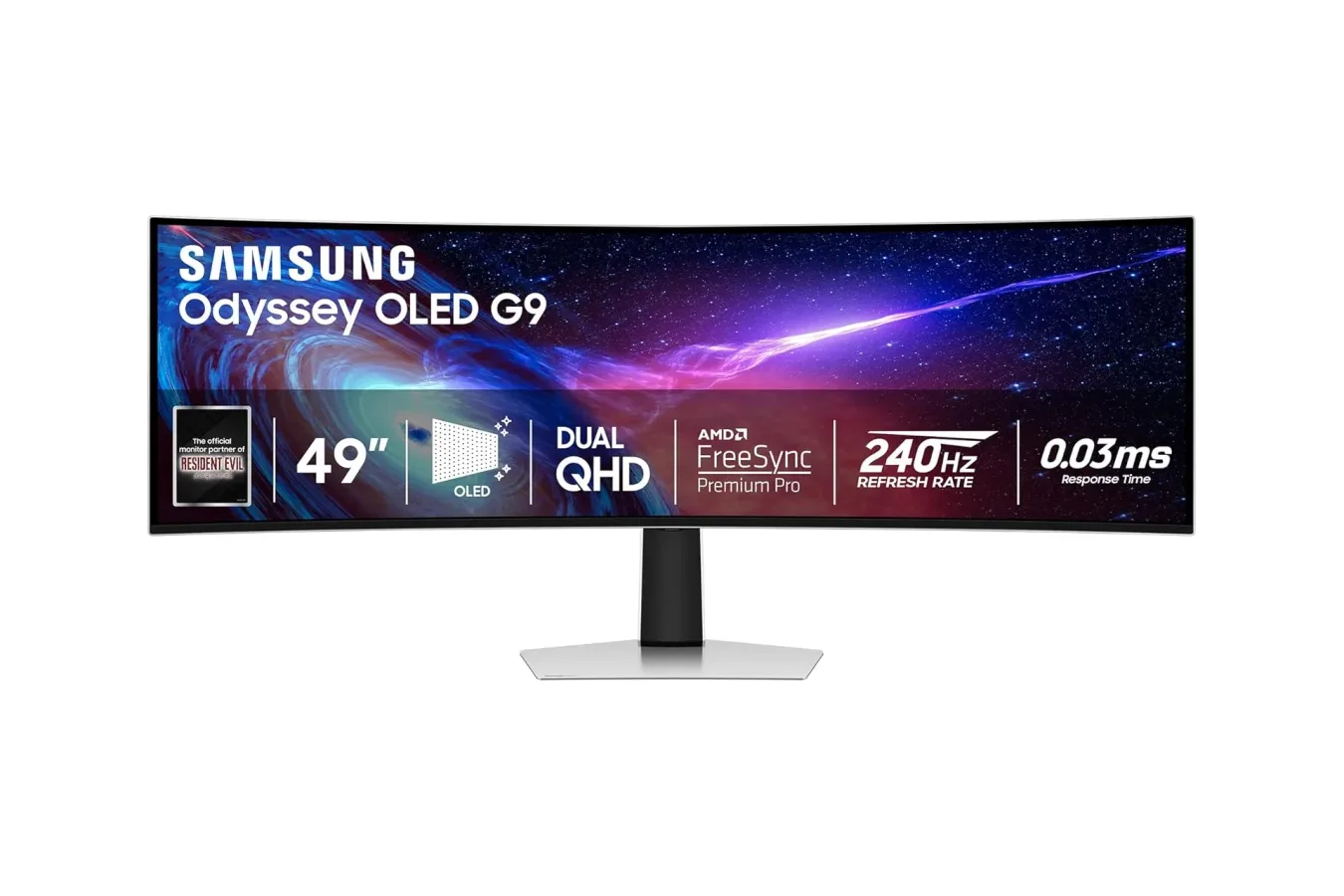
Samsung's 57-inch Odyssey Neo G9 is one of the most extreme gaming monitors available for PC players, and it is receiving a substantial Black Friday discount. The massive curved display has dropped from $2,099 to $1,349 at Amazon, a reduction of 36%. That remains a premium purchase, but the price change significantly alters the value proposition for players who have been considering a high-end ultrawide setup, particularly for sim racing, flight games, multitasking, and cinematic single-player releases.
The Odyssey Neo G9's appeal is not simply that it is physically huge. Its 7680 x 2160 resolution gives it the exact horizontal pixel count of two 4K monitors placed next to one another. Samsung refers to the configuration as Dual UHD. In practical terms, it offers an enormous desktop without a bezel slicing through the middle of the player's field of view. For anyone who has spent time with multi-monitor arrangements, that missing center seam may be the monitor's defining advantage.
A single display built to replace a multi-monitor desk
Triple-monitor setups have long been popular in sim racing because they can extend the image far into a player's peripheral vision. They also come with familiar complications: multiple panels to calibrate, bezels between screens, extra cables, GPU configuration, and often a large stand or mounting solution. A 57-inch Dual UHD display does not perfectly replicate every triple-screen configuration, but it presents a cleaner alternative for players who want an expansive wraparound view from one panel.
The Neo G9 uses a 1000R curve, a pronounced bend intended to keep the monitor's outer edges closer to the viewer's natural viewing distance. On a screen this wide, that design matters. A flat 57-inch panel would require considerably more head movement to inspect the far left and right edges. The curve is meant to make the screen feel more surrounding without forcing the user to constantly turn away from the center.
For useful background on this topic, read Rockstar Explains GTA 6's Criminal Profile System and Its New Consequences.
That makes the display especially compelling for racing games, where side windows, mirrors, trackside detail, and cars approaching from adjacent lanes all benefit from extra horizontal space. Flight simulation players can similarly use the room for cockpit instruments and a broader exterior view. Strategy games, MMOs, management games, and open-world titles also stand to gain from the expanded canvas, though interface scaling and ultrawide support can vary considerably from game to game.
There is a productivity angle as well. Two conventional 4K monitors can provide comparable pixel width, but the Neo G9 puts that space into one uninterrupted screen. That can be useful for video timelines, spreadsheets, code editors, large creative applications, or simply keeping several windows visible without stacking them. Its sheer size means prospective buyers should carefully measure their desk before committing, especially if they currently use a smaller monitor arm or shallow desk surface.
240Hz performance comes with a major hardware requirement
The Odyssey Neo G9 is not just a resolution-focused desktop display. It supports a refresh rate of up to 240Hz and a 1ms gray-to-gray response time. Those specifications place it in territory usually associated with much smaller competitive gaming monitors. At lower resolutions, high refresh rates can be relatively easy to exploit in esports games. At 7680 x 2160, however, maintaining extremely high frame rates is a much larger technical demand.
The full Dual UHD image contains roughly the same number of pixels as two 4K screens operating side by side. Rendering modern games at that resolution, particularly with demanding visual settings enabled, requires a very powerful graphics card. Reaching anything close to 240 frames per second will be realistic mainly in less demanding games, older titles, or titles where users are willing to adjust settings and employ available performance technologies. Players shopping specifically for this monitor should view their existing PC hardware as part of the purchase decision.
DisplayPort 2.1 is a central feature here. The connection is designed to carry the monitor's full resolution and high refresh capability in a way that earlier DisplayPort generations can struggle to accommodate at this scale. The screen also supports variable refresh functionality through AMD FreeSync Premium Pro, which is intended to reduce visible tearing and improve smoothness when a game's frame rate fluctuates.
That combination makes the Neo G9 a forward-looking display, but not necessarily a simple plug-and-play path to maximum settings. A PC without a graphics card offering DisplayPort 2.1 will not be positioned to take full advantage of its headline specifications. Even with compatible hardware, the difference between running a game at native Dual UHD and pushing it toward 240Hz can involve compromises. For many buyers, the screen's broad workspace and immersive aspect ratio may be more consistently useful than the theoretical maximum refresh rate.
Mini-LED backlighting targets high-end HDR image quality
Samsung's Quantum Mini-LED backlight is another major part of the Neo G9's premium specification sheet. The display has 2,392 local dimming zones, allowing different portions of the screen to brighten or darken independently. Compared with basic edge-lit displays, that can create more convincing contrast in scenes that combine very bright objects with deep shadows.
In gaming, the benefit is easiest to picture in nighttime driving, dark science-fiction environments, explosions against black skies, or a sunlit horizon viewed from a dim cockpit. A monitor with effective local dimming can retain brighter highlights without lifting every dark region into gray. The Neo G9 is certified for VESA DisplayHDR 1000 and reaches a stated peak brightness of 1,000 nits, giving HDR content more room for intense highlights than many standard gaming displays.
HDR performance is not solely about maximum brightness, of course. Game implementation, Windows settings, calibration, and personal preference all affect the final image. Still, the Mini-LED approach and the large number of dimming zones make this monitor more ambitious than an ultrawide focused only on size and refresh rate. It is intended to deliver both a broad view and the contrast needed to make modern HDR games look dramatic.
Picture-by-Picture makes the display useful beyond gaming
The monitor's value is also tied to its multi-input tools. Picture-by-Picture support lets two sources appear side by side at their native resolutions. A desktop PC and work laptop, for example, can share the giant panel without requiring a second monitor. That feature could be useful for someone who alternates between work and gaming, or for users who need to monitor another device while retaining their main system at full scale.
Picture-in-Picture offers a different arrangement, placing a smaller secondary source in a corner of the primary image. A stream, video call, chat window, or another connected device can remain visible while the main screen stays dedicated to a game or application. These modes will not replace the flexibility of a full multi-monitor workstation for every user, but they reinforce the Neo G9's goal of consolidating an elaborate desk setup into one display.
Physical adjustment options include swivel, tilt, and height adjustment through the included stand. The display is also compatible with VESA monitor arms, although anyone planning to mount a panel of this size should ensure that their arm is rated appropriately. Connectivity includes DisplayPort 2.1, HDMI 2.1, and a USB hub. Samsung also includes CoreSync, which projects colors based on the on-screen image onto the rear of the display, along with Core Lighting+ for ambient lighting effects behind the desk.
Who should consider the Black Friday price?
At $1,349, the Odyssey Neo G9 remains a specialized piece of hardware rather than a casual monitor upgrade. Buyers will need enough desk space, a PC capable of driving very high resolutions, and a genuine use for the enormous horizontal canvas. It is not the most practical choice for players who only play competitive games at modest resolutions, nor is it automatically better than separate monitors for every professional workflow.
For the right audience, though, the discount is meaningful. Sim enthusiasts can reduce the clutter and visual interruptions of a multi-display rig. PC players building around a high-end graphics card can pair exceptional pixel count with a 240Hz ceiling. Creative users and heavy multitaskers can gain a seamless desktop equivalent to two side-by-side 4K panels. The Black Friday reduction does not turn the 57-inch Neo G9 into a budget monitor, but it makes one of the most ambitious single-screen gaming setups considerably easier to justify.
Community
Discussion
Start the conversation.
No comments have been posted yet.