

For all the advances horror games have made in visual fidelity, cinematic performance, and elaborate monster design, some of the medium's most lasting scares were built from limitations. Silent Hill, Konami's 1999 PlayStation original, is a landmark example. Its famously unnerving early alley sequence is technically simple by modern standards: a short route, restricted visibility, strange sound, unstable camera work, and a scripted enemy encounter. Yet for many players, it remains one of the most frightening introductions ever put into a game.
The power of that scene is not just nostalgia. Silent Hill's opening demonstrates a fundamental horror principle: uncertainty can be more upsetting than direct confrontation. Before it gives players a clear villain, a reliable explanation, or even a useful understanding of the rules, it places them in an unfamiliar town and makes every sensory detail feel wrong. The result is a sequence that can stay with someone for decades, particularly if it was their first true encounter with survival horror.
A Rental That Became a Horror Memory
One memorable account of the game's impact begins in 2000, when a nine-year-old rented the original Silent Hill for PlayStation from Blockbuster with family. The game was already not brand new, and the original PlayStation was nearing the end of its life, but a weekend rental still offered the chance to discover something unexpected. For a child who had been eager to try as many games as possible, the choice could have seemed no more consequential than picking up a platformer, a licensed action game, or a skating game.
That context matters. The player had experienced tense moments in games before, and had played titles rated T and M, but had not spent much time with dedicated horror series such as Resident Evil or Alone in the Dark. There was no established familiarity with survival-horror conventions: no expectation that ammunition would be limited, that vulnerability was intentional, or that a player character's defeat might be required to progress.
For useful background on this topic, read Ubisoft Pauses Assassin's Creed Remakes as Hexe Targets a 2027 Update.
Silent Hill begins by warning players that it contains violent and disturbing imagery. It is a direct message, but it offers no real preparation for the emotional texture to come. After the opening movie, players assume control of Harry Mason in the fog-covered town. Even at this point, the game is already working against the comfortable rhythms associated with many PlayStation adventures of the era.
The Town Is the First Monster
Harry does not begin Silent Hill equipped with confidence, a clear mission structure, or an obvious enemy to defeat. He begins in a place that feels abandoned but not empty. Thick fog limits what can be seen. The audio landscape is dominated by a persistent, oppressive drone. Footsteps echo with an uncomfortable clarity. The town's streets, obscured by the technical fog that helped the PlayStation handle its draw distance, become difficult to read as physical space.
In another kind of game, these elements might have been minor atmosphere. In Silent Hill, they are the experience. The fog does not merely hide geometry; it removes certainty. A player cannot easily tell whether the path ahead is safe, whether something is moving beyond sight, or whether the destination is close. The game's low visibility turns ordinary navigation into an act of apprehension.
Then comes the discovery of a mutilated body, followed by the distant sound of an air-raid siren. These are not simply plot points. They are escalations in an emotional argument. The town has already made the player uneasy. Now it establishes that the unease has a horrific explanation, while refusing to explain what that explanation is. The siren signals a transition without defining its meaning. It tells players that the rules have shifted again.
The Alleyway's Escalating Nightmare
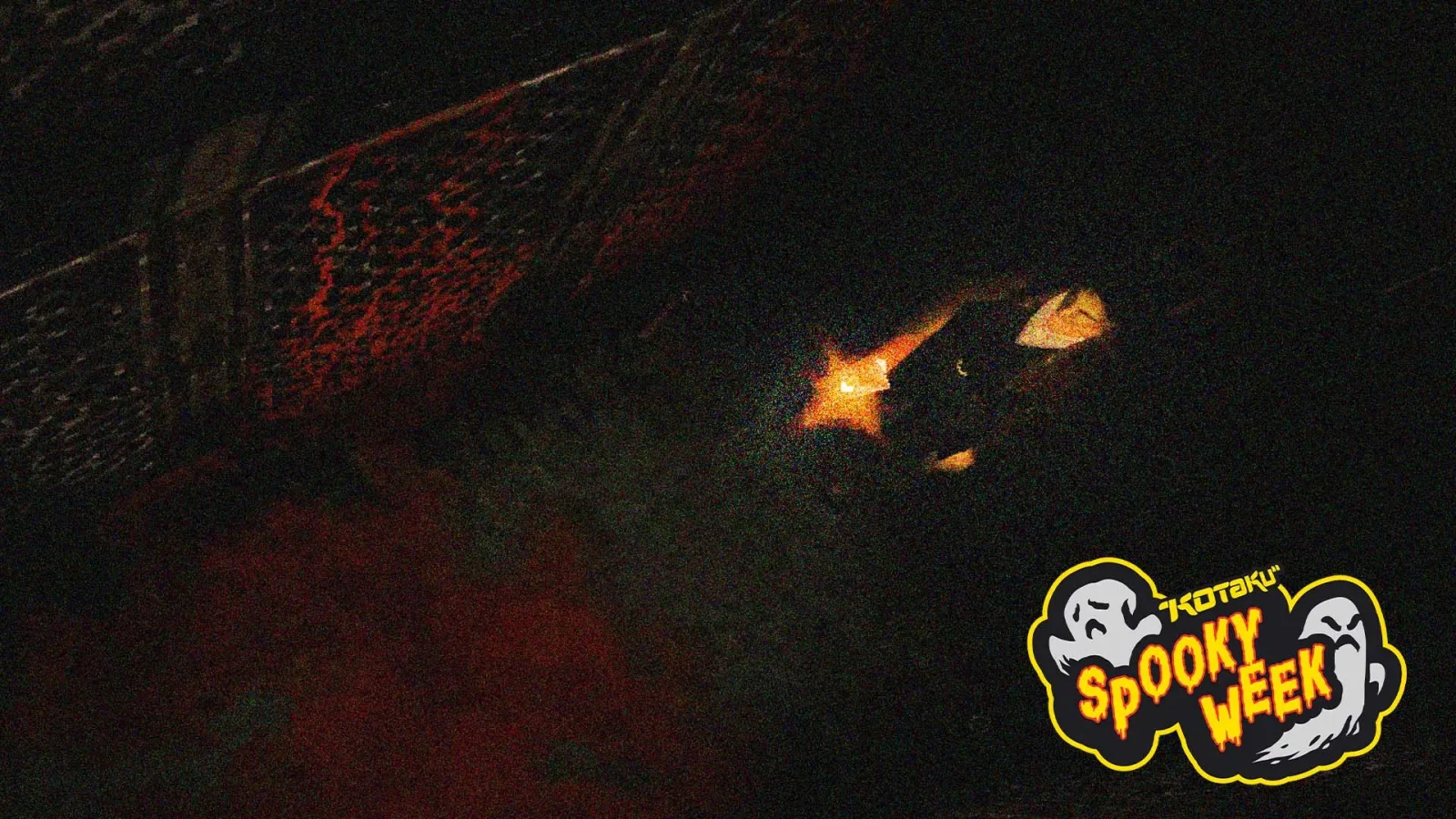
The opening alley is where Silent Hill turns that unease into panic. Initially, the path appears navigable. But as Harry advances, the environment becomes increasingly distorted, darker, more industrial, and more grotesque. Rusted surfaces and harsh shadows replace anything that resembles an ordinary neighborhood. The route narrows into an oppressive passage of fencing, concrete, and threatening shapes.
The game's fixed camera is especially important here. Silent Hill does not always present the world from a stable, player-friendly angle. In the alley, the camera jitters and shifts in ways that make movement feel less secure. The player may still control Harry, but does not fully control the act of seeing. That loss of visual authority is a major part of the fear.
Darkness compounds the problem. Harry takes out a small lighter, which gives the player only a weak, limited pool of illumination. A flashlight might suggest investigation and preparedness. The lighter suggests fragility. It is an inadequate answer to the darkness, and the player knows it. The sound design intensifies as the alley becomes more nightmarish, refusing the relief of silence and making it feel as though the game itself is tightening around the player.
At the end of the route, Silent Hill offers an image designed to overwhelm anyone who has reached that point expecting a conventional opening level: more bloodied bodies, including a corpse displayed in a deeply disturbing manner. The player is encouraged to turn back. That instinct is understandable. The path forward has become unbearable, and retreat feels like the only sensible decision.
It is then that small, childlike creatures emerge from the darkness carrying knives. The image is deliberately disorienting. Their size does not make them harmless; it makes the attack stranger and more upsetting. For an inexperienced player, the immediate response may be to run, fight wildly, and mash buttons in genuine alarm. The game provides little room to process what is happening.
A Scripted Defeat That Feels Like Failure
The alley encounter is scripted. Harry is meant to take damage and collapse, leading into the next scene at the diner. But that design decision can make the sequence even more effective, because first-time players do not necessarily know that losing is required. They may believe they have failed to react quickly enough or have made a catastrophic mistake.
That gap between what the game expects and what the player understands is key. Silent Hill transforms a familiar mechanic--taking damage--into a personal crisis. A player trying desperately to escape those creatures is not thinking about narrative structure. They are responding to an immediate threat. When the game takes control away through Harry's collapse, it reinforces a central message: survival is not entirely in the player's hands.
The diner scene that follows should bring relief. It gives Harry a new location, another person to speak with, and a moment of apparent normality. But after the alley, the player's sense of safety has already been compromised. Even a quieter room can feel temporary. When a large bat-like monster crashes through the diner window shortly afterward, that fragile calm disappears completely.
For one young player, that was the breaking point. The game was turned off, and the original Silent Hill was never revisited despite later experience with other entries in the series and horror games including Resident Evil. That is not a failure on the player's part. It is evidence of how fully the opening accomplished its aim. Silent Hill did not just present frightening content; it made the act of continuing feel unsafe.
Why Old Graphics Do Not Dilute the Fear
It is easy to look at a PlayStation-era game now and focus on its blocky models, low-resolution textures, and technical constraints. But horror does not depend on realism alone. In fact, the abstractions of Silent Hill can sharpen its effect. Faces and environments are less exact, leaving the imagination to complete the image. Fog obscures the world. Audio implies details that the screen cannot show. The game's rough edges become part of its dreamlike, unstable identity.
Modern horror games can portray blood, creatures, and environments with far greater precision. They can use motion capture, advanced lighting, surround audio, and seamless cinematic editing. Those are powerful tools, but they do not automatically create the intimate dread of being lost in a narrow corridor with poor visibility, an unreliable camera, and no certainty that escape is possible.
Silent Hill's alley is frightening because it is an authored descent. Each detail arrives in sequence: fog, body, siren, darkness, rust, noise, confinement, grotesque imagery, then attack. It does not need a long explanation or a complicated combat tutorial. It conditions the player to fear the next few steps.
The Future Remake Faces an Impossible Comparison
A remake of the original Silent Hill is planned for the future, creating the prospect of a new generation encountering Harry Mason's journey. A modern version may preserve the broad shape of the opening while rebuilding it with contemporary technology and design expectations. It could be darker, more detailed, more fluidly animated, and more visually explicit than the 1999 game ever could have been.
But recreating the exact fear of a first encounter may be impossible. That is not a criticism of a remake before players have seen it. It is simply an acknowledgment that the original scene's impact was tied to circumstance: playing at a young age, entering the genre without learned expectations, and discovering a game that seemed determined to reject the safety of familiar PlayStation entertainment.
The original Silent Hill's alleyway remains a lesson in restraint and escalation. It proves that the scariest moment does not always require the biggest creature, the loudest jump scare, or the most graphic visual. Sometimes it is a flickering lighter, a distant siren, a camera that will not sit still, and a path that grows worse with every step forward.
Community
Discussion
Start the conversation.
No comments have been posted yet.