

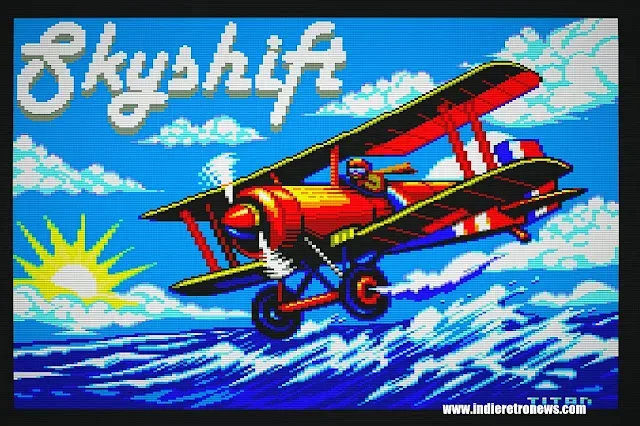
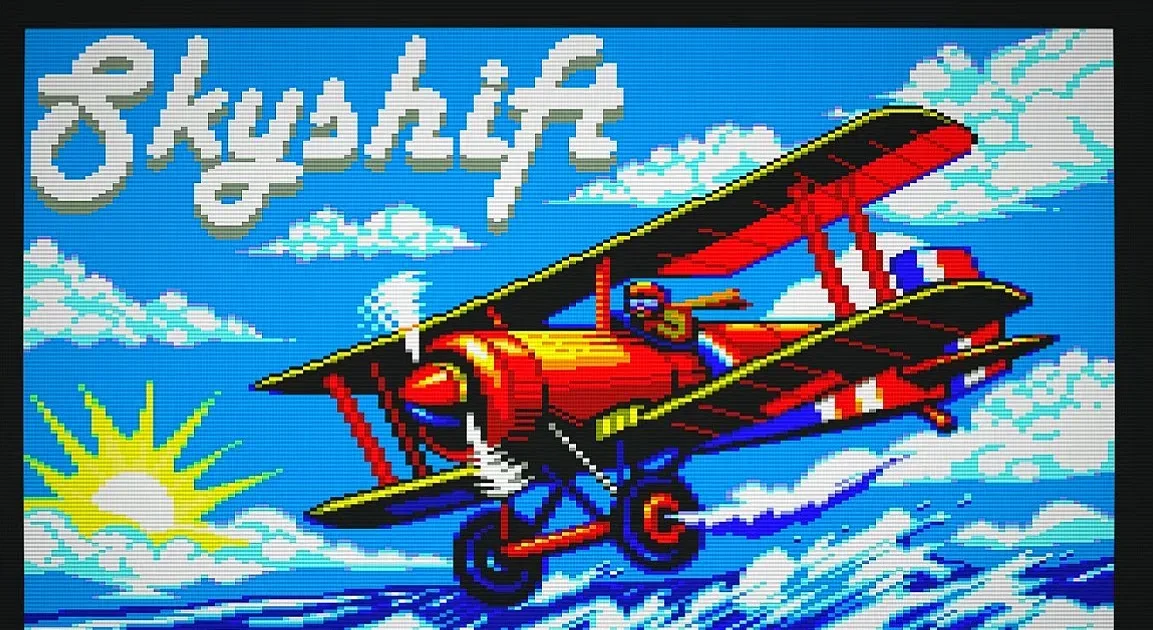
Skyshift is a newly released arcade-inspired shooter for the Amstrad CPC, created by TITAN. Built in the spirit of classic vertically scrolling aerial combat games, the project places a vulnerable First World War biplane against a steadily stranger array of futuristic opposition. Its premise begins with a familiar dogfight over the Western Front, but quickly turns into a science-fiction survival story involving time displacement, alternate realities and an alien-controlled version of Earth.
The game takes particular inspiration from shooters such as 1943, a fitting comparison for a production centered on aircraft, rapid action and a screen filled with incoming threats. Yet Skyshift's scenario deliberately moves well beyond conventional wartime action. Rather than simply escalating from enemy biplanes to stronger military hardware, it puts its hero on a path from 1918 battlefield skies into a dystopian dimension where both the rules of war and the nature of the enemy have changed completely.
A lone ace in an impossible sky
Skyshift follows an Allied flying ace fighting above the front lines during the spring of 1918. In the middle of an aerial engagement, the pilot is engulfed by an unusual luminous cloud. When he emerges, the world above and below him is no longer the one he knows. The immediate danger is obvious: enemy aircraft now fly without propellers and possess a level of technology far beyond the fragile machine he is piloting.
At first, the stranded aviator assumes he has crossed the barrier of time and arrived in 1945. That assumption gives the game's early conflict an effective tension. A pilot from the era of canvas, wire and piston engines is suddenly forced to confront jet propulsion and military equipment he cannot understand. He continues fighting because there is little alternative, facing an opposition that becomes increasingly unlikely with every encounter.
For useful background on this topic, read Kizuna Brings a Monochrome Ninja Escort Adventure to ZX Spectrum.
The truth is more unsettling than a jump into the future. As recognizable terrain transforms into something unfamiliar and eerie, the pilot realizes he has not merely travelled through time. The strange phenomenon has deposited him in another reality. This parallel Earth has fallen under the power of an oppressive alien empire, and humanity has effectively lost control of the sky.
That change gives Skyshift an unusually expansive backdrop for an Amstrad shooter. The central character is not a futuristic super-pilot equipped to match the setting's high-tech weapons. He is a survivor from another universe, flying an obsolete biplane in hostile airspace. The contrast between his era and the alien force's evolving arsenal is the heart of the game's identity: a lone flier attempting to outmaneuver enemies that should be impossible for him to defeat.
Arcade roots, science-fiction escalation
Vertical shooters have long been a natural fit for the arcade tradition. Their basic appeal is immediate: steer through danger, fire constantly, recognize attack patterns and survive long enough to meet greater challenges. Skyshift appears to embrace that accessible foundation while using its setting to give the usual escalation a narrative reason. The player is not only encountering tougher waves because the game needs to raise the difficulty; the opposition itself is described as a relentlessly evolving military force from an alien-dominated dimension.
The reference point of 1943 also helps establish expectations for the kind of action Skyshift is pursuing. That classic style emphasizes movement, aerial positioning and a constant stream of targets. In Skyshift, those familiar genre fundamentals are filtered through a premise where an early aviation hero is pitted against jets and extraterrestrial technologies. It is a setup with plenty of room for visual contrast, from conventional battlefield imagery to machinery and environments that no longer resemble the world of 1918.
The scenario further suggests that discovery is part of the journey. The pilot must uncover the secrets of the unfamiliar dimension while trying to endure its aerial defenses before time runs out. The available details do not outline specific stages, weapons, bosses or progression systems, so players should not assume features beyond what has been announced. Still, the narrative gives each advance a clear purpose: survival is tied to understanding where the hero has been sent and what happened to this alternate Earth.
A focused technical approach for the CPC
Skyshift has been designed around a specialized 128 by 256 pixel gameplay window, displayed in the Amstrad CPC's Mode 0. TITAN has described this choice as a way to maximize programming efficiency while maintaining crisp, readable visuals. That is an important consideration for a fast shooter, where clarity can matter as much as raw detail. Players need to distinguish their aircraft, enemy fire, opposing units and hazards quickly, especially when the action grows more intense.
On a machine such as the Amstrad CPC, design decisions around screen layout are closely connected to how a game feels in motion. A more constrained gameplay area can allow developers to concentrate resources where the action occurs, instead of spreading them across a larger display. For a vertical shooter, this can also create a strong arcade-like focus. Attention stays on the flight path ahead, the immediate threat field and the rapidly changing situations within the active play space.
Mode 0 is one of the CPC's distinctive display modes, and Skyshift's use of it is presented as part of a deliberate balance between implementation efficiency and visual legibility. The announcement does not provide performance figures or a full technical breakdown, so it would be premature to make claims about scrolling methods, frame rate or the number of colors used in particular scenes. What is clear is that the project's presentation has been planned around the strengths and constraints of the hardware rather than treating the CPC as an afterthought.
That approach is especially appropriate for an arcade-led game. Shooters live or die by readable action. Even an imaginative setting can be undermined if enemy silhouettes blend together or incoming fire is hard to follow. By prioritizing a crisp gameplay window, Skyshift aims to keep its increasingly outlandish conflict understandable at the moment players need to react.
TITAN and CLAUDE share development duties
The game's concept and scenario are credited to TITAN, identified as Eric Cubizolle. TITAN is also responsible for the graphics. Programming is credited jointly to TITAN and CLAUDE, while music is likewise a collaboration between TITAN and CLAUDE. The shared credits point to a compact development effort in which the project's creative direction, visual work, code and soundtrack are closely connected.
That kind of small-team production remains one of the most appealing aspects of the active retro-computing scene. New releases for systems such as the Amstrad CPC are not simply exercises in nostalgia; they are opportunities to make purpose-built games that engage directly with older machines' technical character. A project can take inspiration from arcade history while still pursuing a premise that would have felt unusual in its original commercial era.
Skyshift's concept does exactly that. Its action starts from the visual language of historical air combat, then breaks away into a collision of eras. The player's biplane is a symbol of early air warfare, while the enemy force represents an alien future--or, more precisely, a technologically advanced parallel world. This collision makes the protagonist's predicament immediately readable without requiring an elaborate introduction: his aircraft simply does not belong in the sky he now has to survive.
Why the premise suits a retro shooter
There is an enduring appeal to games that make an underpowered vehicle or character feel heroic through player skill. Skyshift's pilot is isolated, outclassed and far from home, which creates a natural underdog story. Every successful dodge or enemy defeat carries the implication that the player is overcoming a technological gulf through precision and persistence rather than matching force with force.
The alternate-reality framing also avoids being locked into strict historical recreation. While the game begins in 1918 and uses a First World War ace as its lead, the story can move into distorted landscapes, unfamiliar machines and alien threats without losing its internal logic. The luminous cloud provides the rupture, and the parallel Earth provides the canvas for the game's escalating aerial battles.
For Amstrad CPC enthusiasts, Skyshift is therefore notable on two fronts. It is a fresh action game designed for the platform, and it is a production with a specific technical presentation built around Mode 0 and a dedicated gameplay window. For shooter fans, its attraction lies in the combination of recognizable vertical-arcade influences and a more fantastical narrative hook than the genre's usual military settings.
Skyshift asks a simple but compelling question: what happens when a 1918 flying ace is forced to fight for survival in skies ruled by technology he cannot possibly understand? TITAN and CLAUDE's answer is an Amstrad CPC shooter where propellers meet jets, historical warfare gives way to alien occupation, and one lost pilot must battle through a world that is not his own.
Community
Discussion
Start the conversation.
No comments have been posted yet.