

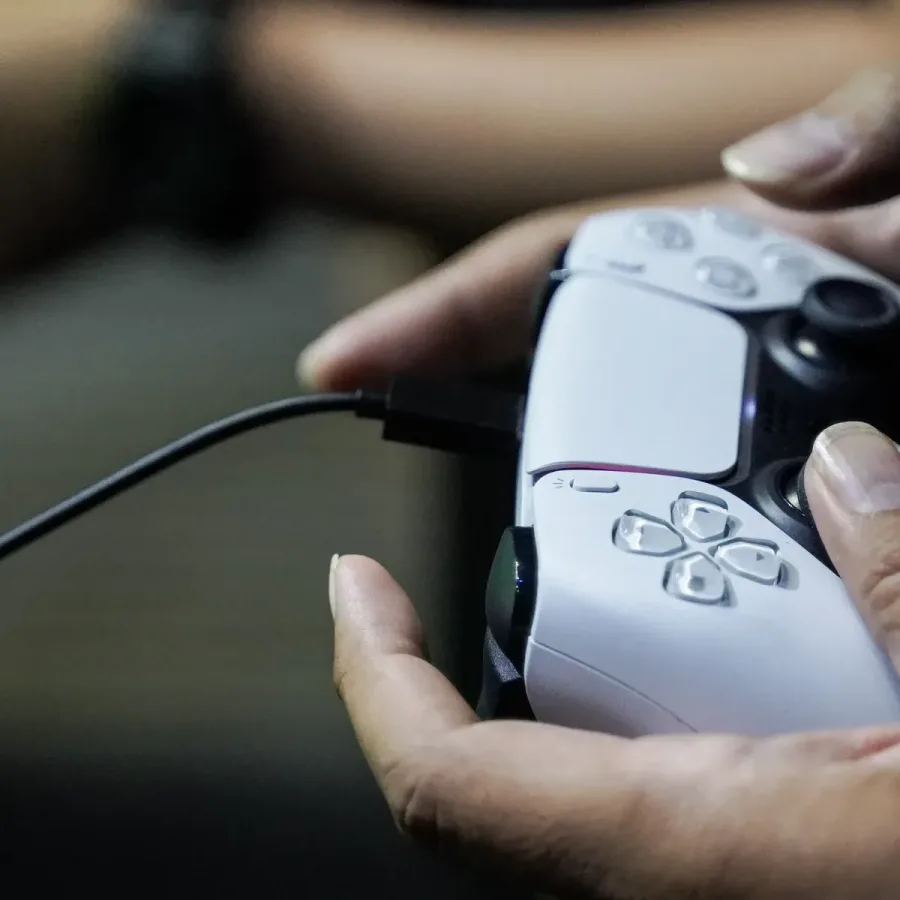
Sony has outlined a potentially convenient new use for the PlayStation controller: tapping a phone or payment card directly against it to send information to the console. A newly published patent, titled video game controller-driven information transfer, describes a controller equipped with near-field communication, or NFC, hardware. If such a feature ever reaches a commercial PlayStation product, it could simplify purchases, account setup, and certain other data-sharing tasks without requiring players to type as much information on a console interface.
The immediate idea is easy to understand. A player could place an NFC-capable credit or debit card near a compatible controller, with the controller relaying the necessary details to the PlayStation system. The same process could potentially work with a smartphone. Instead of entering payment information through an on-screen keyboard, or moving through several screens to connect a device, the console could receive approved information through a short-range tap.
That is the most obvious possible application, but the patent goes beyond checkout. Sony's documentation also discusses using the controller to help move PlayStation account information onto a new console. That could make initial setup less cumbersome for people replacing a system, adding another console to their household, or signing into a PlayStation device away from their usual hardware.
A controller as a setup tool
Modern console setup is generally straightforward, but it can still involve a surprising number of steps. Players may need to enter account credentials, verify a sign-in attempt, retrieve two-factor authentication codes, connect a phone, add a payment method, download cloud data, and adjust privacy settings. Each individual task is manageable, yet the overall process can feel slower when it moves between a television, controller, phone, and computer.
For useful background on this topic, read PlayStation Patent Explores NFC Controller Transfers for Payments and Sign-Ins.
The patent proposes putting a small but useful connection point in the device already in a player's hands. NFC has become a familiar part of daily consumer technology. It is used in contactless payments, transit cards, building access systems, wireless accessory pairing, and mobile wallet setup. Many smartphones can read NFC tags or communicate with cards and compatible devices simply by being held close to them.
On a PlayStation controller, that same kind of communication could offer a more direct route between a user's phone or card and their console. Rather than using a QR code and switching attention back and forth between displays, players could initiate a transfer with a tap. Likewise, a new system could theoretically identify an account-transfer request through the controller before asking the user to finish whatever verification Sony requires on the TV or phone.
The patent frames this as more than a matter of convenience. It raises concerns around conventional approaches that require multiple operational stages across several devices, suggesting that coordinating those steps can affect console performance or result in operations failing. Sony's proposed NFC approach appears intended to make certain handoffs more reliable by reducing the amount of back-and-forth involved.
Whether NFC would meaningfully reduce setup failures compared with existing sign-in and QR-based systems remains an open question. Typing passwords and scanning codes can be awkward, particularly with a controller, but they are also established methods with clear security flows. An NFC controller would need to demonstrate that it is not merely faster in ideal circumstances, but dependable when users have different phones, cards, account settings, and network conditions.
Payments would need strong safeguards
Any proposal involving payment data and account transfers immediately raises security questions. The ability to tap a card or phone against a controller sounds simple, but a simple interaction must not mean that another person can complete sensitive actions without authorization.
For purchases, a real implementation would likely need to follow the same broad principles used by contactless payment systems elsewhere: encryption, tokenization where applicable, transaction authorization, and limits on what data is exposed. A controller should not become a convenient way to retrieve raw card information. The console would also need to distinguish between adding a payment method, confirming a purchase, and transferring account details, since each carries a different level of risk.
Account migration deserves even more scrutiny. If tapping a phone could begin moving a user's PlayStation profile to another console, Sony would need a robust confirmation process. Physical access to a phone or controller alone cannot be enough to hand over an account containing games, subscriptions, saved data, friends lists, messages, and potentially stored payment options.
There are several familiar ways a company could add a second layer of protection. A player might be asked to approve the transfer on their phone, enter a temporary code displayed by a trusted device, confirm a notification, provide a password, or satisfy an existing two-factor authentication requirement. The patent itself does not guarantee which method would be chosen, and any retail product could differ substantially from the concept described in the filing.
That distinction is important. Patent documents are often broad explorations of ideas that companies may want to protect, investigate, or keep available for future hardware and software designs. They are not product announcements. Sony has not confirmed an NFC payment feature for a future PlayStation controller, nor has it announced a specific console that will use this concept.
Why the idea fits the PlayStation ecosystem
Even with that uncertainty, the proposed functionality makes sense within the direction of connected gaming platforms. Consoles increasingly function as stores, media hubs, social spaces, cloud-save clients, subscription devices, and remote-play endpoints in addition to game machines. The easier it is for a player to securely enter an ecosystem, recover their profile, or make an approved purchase, the more seamless the experience can become.
PlayStation already relies heavily on phone integration through its companion app and account infrastructure. Mobile devices can help with messaging, account verification, remote downloads, and other connected features. An NFC-enabled controller could make the physical act of linking a phone to a console feel more immediate, particularly during the first few minutes with new hardware.
Accessory pairing is another area where NFC could be useful beyond payments. Players are already accustomed to placing wireless earbuds close to a phone for quick pairing. A comparable interaction could, in theory, help a PlayStation system recognize compatible headsets, identify user profiles, or pass limited configuration information. Those possibilities are not confirmations of planned features, but they illustrate why Sony's patent is broader than a simple tap-to-buy mechanism.
There is also a practical design question: where would Sony place the NFC component? A controller must remain comfortable, durable, reasonably affordable, and free from accidental interactions. The touchpad area, central body, or another clearly marked portion could be a logical target, but the patent does not establish what a final retail design would look like. Designers would need to consider cases, controller grips, user habits, and the possibility of players unintentionally resting a phone or wallet near the reader during play.
Useful technology, if it ever ships
The most appealing version of this idea is not a controller that constantly asks players to pay for something. It is a controller that makes optional administrative tasks less irritating. Tapping a phone to start a secure account migration, pairing a supported device without digging through menus, or adding a payment method through an approved contactless flow could all remove friction from moments that are rarely fun.
At the same time, players would be right to expect clear controls. Any payment or account-transfer function should be optional, easy to disable, and accompanied by transparent confirmation screens. A physical tap is useful because it is intentional, but it should be only one part of a secure process rather than a replacement for safeguards.
Sony's controller-driven information-transfer patent offers a glimpse at how future PlayStation hardware could treat the gamepad as more than an input device. For now, however, it remains a patent concept rather than a promised feature. The proposal has practical potential, especially for setup and account management, but its ultimate value would depend on how carefully Sony handles privacy, authentication, compatibility, and player choice.
Until Sony reveals actual hardware and software plans, the filing is best viewed as an interesting indication of the kinds of interaction the company is considering. A quick tap on a controller could someday be a useful shortcut. It will need to be a shortcut players can trust.
Community
Discussion
Start the conversation.
No comments have been posted yet.