

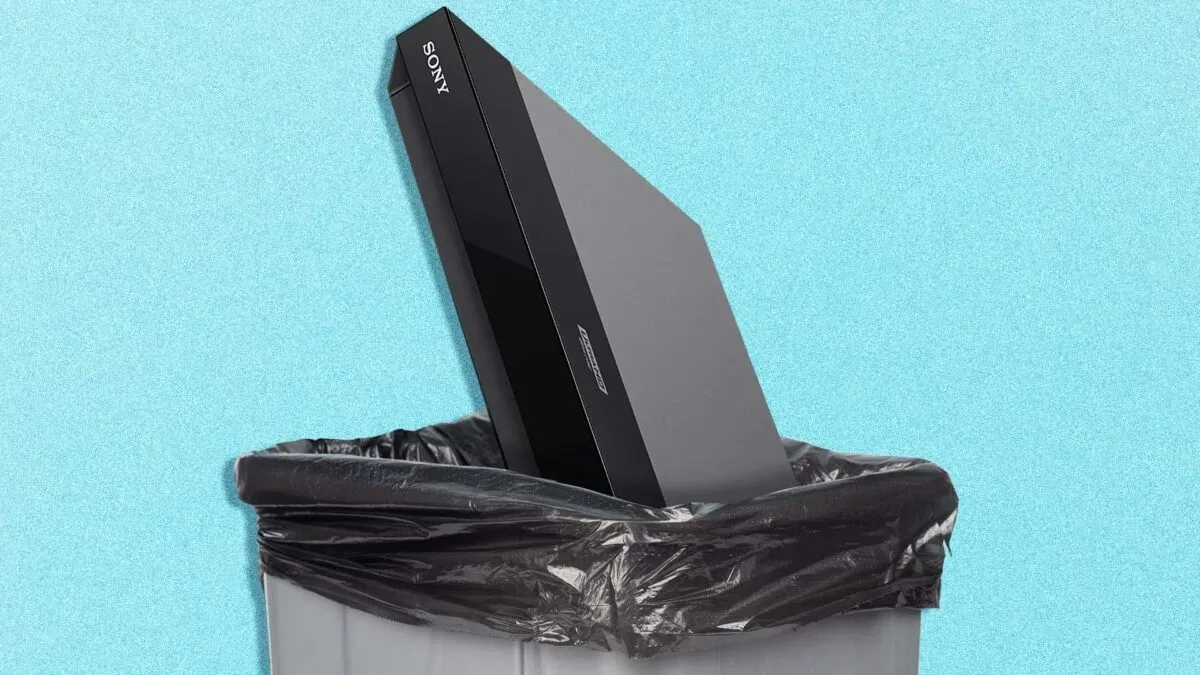
Sony's dedicated 4K UHD Blu-ray player business may be reaching its endpoint. The company has reportedly ended sales of the UBP-X700/K in Japan, a move that would remove the final Sony-made UHD disc player from the country's consumer electronics lineup. Sony Japan's own product listing identifies the player as out of stock and says it will not be restocked, providing a strong indication that the model's retail life is over locally.
The UBP-X700/K had a significant distinction: it was Sony's last remaining 4K UHD Blu-ray player sold in Japan. If the reported sales cutoff is final, people looking for a newly manufactured Sony device capable of playing 4K UHD Blu-ray movies in the region will effectively be left with one option from the company: a disc-equipped PlayStation 5.
That does not mean Sony has immediately abandoned every form of optical-disc hardware. It is still making one DVD player model and one standard Blu-ray player model for now. But ending its sole UHD player would be a notable symbolic step. 4K UHD Blu-ray remains the highest-quality consumer format for movie playback, offering high bitrates and avoiding many of the compression compromises that can affect streamed video. For collectors, home-cinema enthusiasts, and players who use a console as part of their media setup, a dedicated player disappearing from such a major brand's catalog is difficult to overlook.
Embedded X/Twitter post
A quiet end for Sony's dedicated UHD lineup
Reports of the UBP-X700/K reaching the end of sales emerged from Japan, where the model was identified as Sony's final active UHD deck. The company's Japanese storefront listing adds an unusually definitive message beyond a routine stock shortage: the unit is not expected to return. In practical terms, that means existing retail inventory may be all that remains for buyers who specifically want this Sony model.
For useful background on this topic, read Saber Says Hellraiser: Revival Is Performing 'Extremely Well' on PC and Consoles.
There is still uncertainty around the international picture. Sony has not publicly confirmed in the available information that production or sales will end in every market at the same time. A Japanese discontinuation does not automatically establish that every regional version of the player has already been removed. Still, Japan often provides an early indication of broader changes in Sony's consumer hardware strategy, so the possibility of a wider wind-down appears plausible.
The timing is important because the UBP-X700 family had long represented an accessible route into Sony's 4K disc ecosystem. Dedicated UHD players offer advantages that consoles do not always prioritize, including a more focused home-theater form factor and an identity built entirely around physical movie libraries. Once these devices leave the market, consumers have fewer choices not just in brands, but in the kinds of hardware they can buy.
Panasonic now stands as the last major electronics company still producing UHD players, based on the currently reported market situation. That concentration is a concern for physical-media fans. Fewer manufacturers mean less competition, fewer product tiers, and potentially fewer replacements when older players finally wear out. It also makes each corporate decision to scale back hardware feel more consequential.
For another perspective on this story, read Sony's UBP-X700/K Reportedly Reaches the End of Sales in Japan.
Why PlayStation 5 matters in this shift
The PlayStation 5 is an especially notable part of this story because it is both a current game console and, in its disc-capable configurations, a UHD Blu-ray player. In Japan, it may soon be Sony's only newly available UHD playback device. That gives the console an even more unusual role in the company's wider entertainment ecosystem.
For many players, a PlayStation has always been more than a machine for games. Sony's earlier consoles helped popularize disc formats in living rooms: PlayStation 2 included DVD playback, while PlayStation 3 played Blu-ray discs. The PlayStation 5 continues that legacy for 4K UHD Blu-ray, although its usefulness depends on owning the standard disc model or the appropriate disc-drive setup rather than the Digital Edition alone.
There is an important distinction, however, between having a console that supports UHD movies and supporting a dedicated player category. A PS5 is purchased principally for games, and its media features are part of a larger package. A standalone player is bought by customers who may not want a game system, may already own another platform, or may simply prefer dedicated audiovisual equipment. Removing the latter from a company's offerings can leave those audiences behind even if a console still technically plays the same discs.
It also underscores the divide inside the PlayStation family. Digital-only hardware provides no route to playing physical games, DVDs, Blu-rays, or UHD Blu-rays without an added drive where supported. As digital storefronts, subscriptions, patches, and cloud-connected services become increasingly central to console gaming, the disc-capable PS5 remains one of the more prominent pieces of mainstream hardware that bridges modern games with a physical movie collection.
A broader pullback from home electronics
The reported UBP-X700/K decision does not exist in isolation. Sony has been reducing its direct involvement in parts of its traditional electronics business. Earlier this year, the company sold much of its TV and hardware production factories and facilities to TCL through a wider arrangement that also gave TCL a controlling stake in Sony's Bravia television business.
That kind of restructuring suggests a business increasingly focused on areas other than maintaining a broad catalog of internally produced home-electronics devices. Sony still has enormous interests across gaming, music, film, cameras, imaging technology, and entertainment, but those strengths do not necessarily require the company to keep building every category of living-room hardware it once sold.
Dedicated disc players are a particularly tough category to sustain. Streaming is the default way many households watch films and television, while smart TVs and game consoles have absorbed functions that previously justified separate boxes under a television. Consumer demand for physical movies has narrowed, even though the audience that remains is often highly committed to collecting discs and preserving access to high-quality versions of films.
For that audience, streaming is not a complete replacement. Services rotate titles in and out of catalogs, versions can be edited or altered, and video quality depends on bandwidth and platform settings. A purchased disc offers a more stable form of access, even if it is not free from all compatibility or hardware concerns. That is precisely why the dwindling availability of players can be as troubling as the declining availability of discs themselves.
The physical-media concern extends to games
The same anxiety is not limited to movie collectors. Earlier this year, Sony announced a plan to end PlayStation disc production in 2028. That announcement, alongside the reported end of the UBP-X700/K in Japan, paints a stark picture for people who value physical ownership across both games and films.
Physical games provide benefits that are not always replicated by a digital library. They can be resold, lent to friends, collected, displayed, and played without requiring a purchase to remain tied to a specific storefront account. There are caveats in the modern era: many games still need downloads, patches, server access, or online features. Yet a disc can remain a valuable starting point for preservation and personal ownership, especially as digital stores can delist titles without much warning.
Movie discs face a similar challenge. A 4K UHD Blu-ray collection can be played years after a streaming license expires, but only as long as the owner has hardware capable of reading it. When manufacturers stop making new players, the burden gradually shifts toward preserving existing units, seeking used hardware, or relying on a shrinking set of brands that remain committed to the format.
- For movie collectors: the choice of new dedicated UHD players may become more limited.
- For PS5 owners: disc-capable systems gain added value as multipurpose 4K media hardware.
- For game collectors: Sony's previously announced 2028 disc-production plan raises larger questions about future physical releases.
- For preservation-minded buyers: maintaining working optical-disc hardware may become increasingly important.
What happens next remains unclear
At present, the firmest detail is regional: the UBP-X700/K appears to have reached the end of sales in Japan, and Sony Japan indicates that it will not be restocked. Whether the model will be formally discontinued worldwide, and whether Sony has any unannounced successor in mind, remains unknown. There is no confirmed replacement player in the information available.
That uncertainty leaves physical-media fans watching Sony's next moves closely. The company still has a stake in disc playback through PlayStation 5, and it continues to offer limited non-UHD disc hardware. Yet the overall direction appears to be toward fewer dedicated devices and a greater emphasis on digital entertainment services and broader entertainment businesses.
For anyone with a library of UHD Blu-rays, Blu-rays, DVDs, or disc-based games, the immediate lesson is simple: existing hardware has value. A reliable player or disc-capable console is no longer merely a convenience when the number of new alternatives continues to contract. Sony's reported withdrawal from the dedicated 4K UHD player market in Japan may be just one product-line change, but it is also another sign that physical media is entering a more fragile phase.
Community
Discussion
Start the conversation.
No comments have been posted yet.