

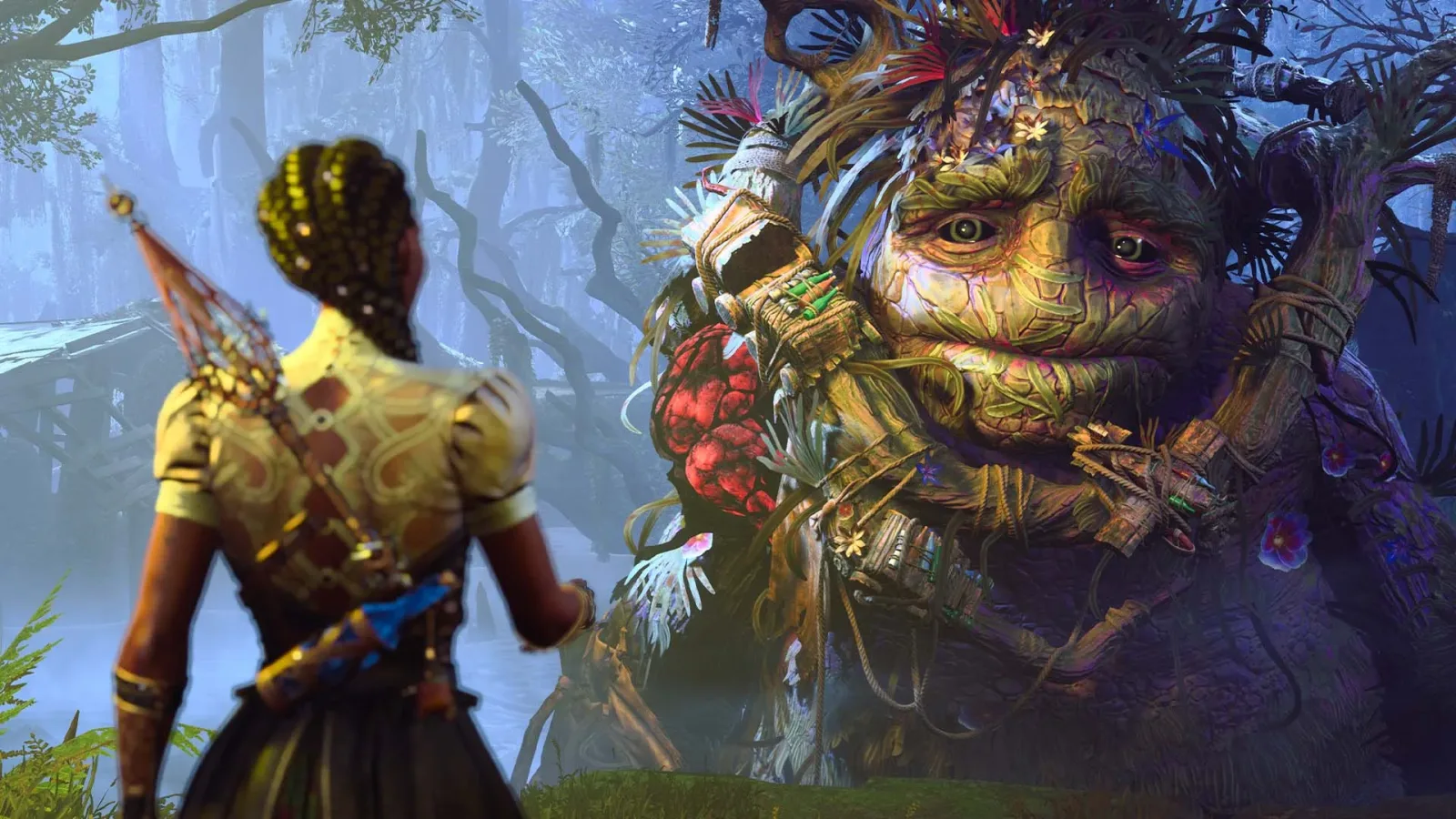
South of Midnight was one of the more distinctive games to emerge from Xbox's recent first-party slate: a stylized Southern Gothic adventure from Compulsion Games, built around folklore, music, and an identity far removed from the industry's usual blockbuster templates. But while the game earned major recognition after launching in 2025, including a BAFTA, Compulsion creative director David Sears has offered an unusually candid assessment of the financial conditions that allowed it to happen.
In a recent interview with Ben Hanson of MinnMax, Sears discussed the reasoning behind Xbox funding games that were not expected to become huge commercial successes. He said that projects such as South of Midnight and Double Fine's Keeper could contribute to Xbox's cultural standing and prestige even if they did not bring in the kind of revenue associated with the company's biggest releases.
Yet Sears also made clear that he had long doubted whether that spending model could last. When asked whether he was thankful Microsoft had strongly supported South of Midnight, while also acknowledging that he would not necessarily have personally chosen to fund it, Sears agreed: "Yeah, probably."
That answer does not sound like regret over making the game. Sears stressed that he absolutely wanted to create South of Midnight, and the finished project exists because Compulsion had access to funding that many independent studios could only dream of. His reflection instead concerns the sustainability of financing ambitious, creatively specific games without a clear expectation that they will generate an enormous return.
For useful background on this topic, read BioWare's Legacy Lives On in the Players, Creators, and Communities It Changed.
A game worth making, but a difficult model to sustain
Sears said he would have been willing to stop somebody else's spending before work began on South of Midnight, not because he lacked belief in the project, but because he viewed the larger situation as unsustainable. In retrospect, he said, a disruptive or "shocking" outcome felt inevitable.
"I wanted to make it. No doubt. Obviously. Because we made it," Sears said. "Would I have turned off someone else's money flow before South of Midnight? Yeah. Because I'm not completely selfless. It just seems like, in hindsight at least, it was unsustainable."
He described conversations with other game directors during development, when people wondered how studios had become so fortunate and whether the industry had entered a new golden era for games with unconventional ambitions. Sears' response was more guarded. He said he always felt that the favorable conditions could end, even if nobody could say precisely when that would happen.
That concern has become particularly resonant following Xbox's restructuring. Compulsion Games is now free to determine its own future outside Microsoft, and it has reportedly been seeking collaborative work with other partners. The studio took its intellectual property with it in the transition, as well as an unspecified amount of financial runway, though it remains unclear whether Compulsion has formally signed its next project.
The change puts Sears' comments in a sharper light. South of Midnight was not simply an isolated creative bet. It was made amid a period in which Xbox invested in a broad portfolio of studios and games, from major franchises intended to reach vast audiences to smaller, more authored works designed to diversify the platform's catalogue. That approach could give players games with markedly different voices. It could also create an expensive structure that became harder to support once corporate priorities shifted.
Xbox's prestige projects and the value of creative range
Games do not have to be runaway commercial hits to matter. That is at the heart of Sears' observations. A platform holder can benefit from having acclaimed releases that build goodwill, demonstrate creative breadth, win awards, and give subscribers or hardware buyers reasons to view an ecosystem as artistically valuable. For Xbox, funding games with unusual themes and styles could help counter the perception that big-budget game development only has room for familiar genres and established brands.
South of Midnight fit that role well. Its setting and visual character gave it a personality immediately distinguishable from more conventional action games. Compulsion had already developed a reputation for pursuing unusual concepts through 2018's We Happy Few, published by Gearbox Publishing. Microsoft acquired the studio shortly before that game's release, bringing it into Xbox Game Studios and eventually backing the development of South of Midnight.
For creative teams, the value of that support is obvious. A publisher with deep resources can offer a studio the time, staffing, technology, marketing, and risk tolerance needed to attempt something that might otherwise be impossible. Original games often struggle to secure enough investment because their commercial ceiling is more difficult to predict than that of a sequel, adaptation, or recognizable live-service product.
But the same arrangement can become precarious when a corporation decides its portfolio must become more efficient. A game can be well reviewed, celebrated by players, and honored by awards organizations without producing the financial outcome executives want. That disconnect is a recurring tension across the games business: artistic relevance and cultural impact do not always map neatly onto quarterly returns.
Sears' comments do not dismiss the worth of prestige-driven investment. If anything, they acknowledge that it enabled a game he cared deeply about making. The hard part is that appreciation for the opportunity can coexist with a realistic understanding that the underlying financial system may not hold forever.
Compulsion's next chapter is uncertain
The immediate question is what Compulsion Games does next. Now operating independently from Xbox, the team has room to chart its own direction, but it will also face the difficult realities of finding partners and financing in an industry where funding for mid-sized and experimental projects is often limited.
The studio's next game could be very different from South of Midnight. Sears' comments suggest that Compulsion may be evaluating future projects through a more cautious business lens, especially after experiencing both the advantages and instability of major corporate support. That does not necessarily mean the studio will abandon its identity or move away from distinctive storytelling. Rather, it may need to find a scope and production plan that better aligns creative aspirations with what partners are willing to finance.
There are several paths available to a studio in Compulsion's position. It could pursue a new publishing partnership, take on collaborative work for another company, develop a smaller original game, or combine those approaches while preserving enough independence to sustain its own long-term plans. None of those possibilities has been confirmed, and the studio has not announced a new project.
What is known is that Compulsion retained its IP as part of the separation from Microsoft. That matters because it gives the team more control over the worlds and concepts it has created, rather than leaving those assets behind as it moves forward. Financial runway is also important, though its duration has not been disclosed.
A frank view of an industry-wide problem
Sears also noted that the Microsoft of today is more humane than the company he knew in the 1990s. In his view, allowing studios to spin out rather than simply shutting them down represents a meaningful difference, particularly in an era when closures and layoffs have become painfully common throughout the industry.
That perspective does not erase the uncertainty facing the people affected by restructuring, but it helps explain why Sears can speak with both gratitude and criticism. Xbox gave Compulsion the means to make a game that likely could not have existed in the same form without substantial backing. At the same time, he believes the conditions supporting that investment were headed toward a breaking point.
For players, the story is a reminder that the games most praised for originality are often made within fragile business arrangements. The desire for companies to support bold, unusual work is entirely understandable. So is the concern that those investments may vanish when budgets tighten and strategies change.
South of Midnight remains an example of what can result when a large platform holder makes room for a game that does not fit the safest commercial mold. Sears' reflection is not that such work should never be funded. It is that making it possible requires a more durable answer than an open spending tap that everyone assumes will remain on indefinitely.
As Compulsion looks for its next opportunity, its experience may become increasingly relevant to other teams navigating the gap between creative ambition and financial survival. The studio has already shown it can make games with a singular voice. Its challenge now is finding a way to protect that voice while building a future that can last.
Community
Discussion
Start the conversation.
No comments have been posted yet.