

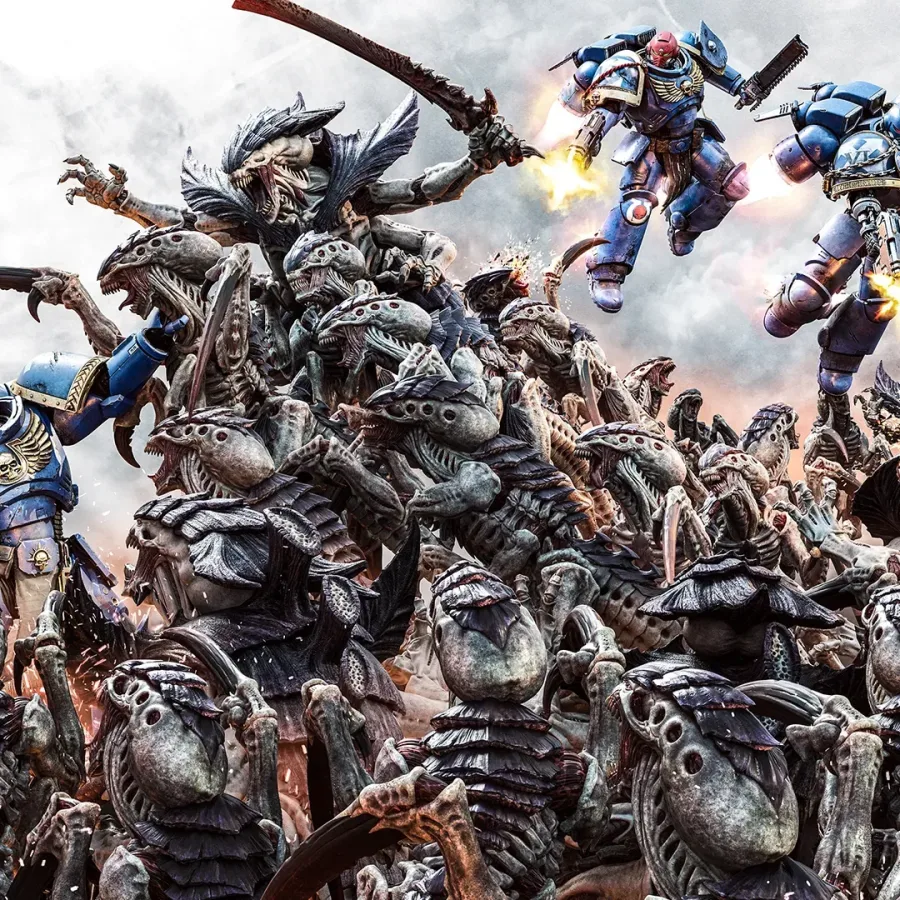
Warhammer 40,000: Space Marine 2 is set to receive a future balance pass aimed at the gap between its two major PvE enemy forces. Game director Dmitry Grigorenko has acknowledged that Chaos is more difficult to fight than the Tyranids, validating a complaint players have raised since the game launched in 2024.
The confirmation came during a Reddit AMA, where Grigorenko was asked about the considerably different experience offered by the factions in Operations. His response did not provide a timetable or specific list of adjustments, but it established that the development team understands the issue and intends to address it in a future update.
"We understand that Chaos is more difficult to fight against Tyranids, yes," Grigorenko said. "There will be some pass on this in the future. I don't think it will be about bots being good vs Chaos specifically, though."
That final clarification is important for solo players. The question behind it proposed tuning Chaos Operations around AI companions so those missions would be less punishing when tackled alone. Grigorenko's answer suggests that the planned work is not simply a targeted buff to bots in Chaos content. Instead, players should expect some kind of broader look at the faction's overall combat balance, though the exact form remains unknown.
For useful background on this topic, read Nvidia-Branded Trailers Stolen in California Were Carrying Sand, Not GPUs.
Why Chaos feels tougher in Space Marine 2
Space Marine 2 asks players to confront the Tyranids and the Thousand Sons in sharply different ways. The Tyranids deliver the fantasy of holding a line against an overwhelming alien swarm. Smaller creatures fill the battlefield while larger threats break through the mass, creating hectic fights built around crowd control, melee execution, ranged pressure, and quick reactions.
For many players, that rhythm is the game at its most immediately satisfying. A Space Marine can wade into a dense tide of enemies with a Power Sword, fire into advancing monsters with a bolter, parry an incoming strike, and keep pushing forward. The screen may be packed with hostile creatures, but the action frequently supports a forceful, aggressive style of play. The player is under pressure, yet they are also given the tools and space to feel like an armored super-soldier cutting through an invasion.
Chaos encounters, by comparison, are more deliberate and often more restrictive. The Thousand Sons are fellow Space Marines, supported by daemonic forces, and their identity naturally makes them more resilient and dangerous opponents than a large portion of the Tyranid roster. They bring ranged attacks, durable elite units, and battlefield threats that can force a squad out of comfortable positions.
Terminators are a frequent example of why Chaos missions can become so punishing. Their missile barrages create intense pressure that can be difficult to escape, especially when several enemies are active and a squad is already dealing with other threats. Rather than charging into a crowd and maintaining momentum, players can find themselves playing a more cautious game of positioning, survival, and target priority.
Neither approach is inherently wrong. Chaos should feel formidable in a Warhammer 40,000 game, particularly when players are facing corrupted Space Marines and their daemonic allies. But the difference in difficulty has become pronounced enough that many players view Tyranid Operations as both more manageable and more enjoyable. Grigorenko's comments indicate that the developers agree there is a real imbalance worth examining.
Higher difficulties make the divide clearer
The perceived gap is not necessarily as dramatic at lower difficulty settings. At the more accessible end of the scale, Tyranid and Chaos missions can present a broadly comparable challenge. Both require awareness of incoming attacks, effective use of class abilities, ammunition management, and cooperation between squad members.
The situation changes as players move into tougher difficulty tiers. Higher difficulties are a meaningful part of progression, so they are not simply optional tests for the most dedicated squads. At that point, Chaos can become especially oppressive, while Tyranid missions may retain more of their familiar flow. Players still need to manage swarms and dangerous larger enemies against the Tyranids, but the faction often feels more readable and more responsive to the game's core melee-and-firepower loop.
Chaos fights can instead punish mistakes more heavily. High-damage ranged pressure, durable enemies, disruptive abilities, and difficult combinations of foes can make a mission spiral quickly. The result is that a squad which feels capable against the Tyranids can encounter a significantly steeper wall when the mission rotates to Chaos.
This is also why the discussion is about more than raw difficulty. Some players enjoy a severe challenge, but they still want it to feel consistent, learnable, and rewarding. The complaint is not merely that Chaos can kill Space Marines. It is that the faction's missions can feel disproportionately harsh compared with the Tyranids, particularly in content where advancing through the game's progression systems calls for taking on greater difficulty.
What a future balance pass could change
Grigorenko did not identify individual enemy changes, so it is too early to assume a specific nerf or redesign. Still, a balance pass could involve many different elements without fundamentally changing Chaos into a Tyranid-style swarm faction.
- Enemy durability: The team could reassess how long certain Chaos units take to bring down, especially when several elite threats arrive together.
- Damage output: Ranged attacks and major area-of-effect tools, including missile pressure from Terminators, could be tuned to reduce extreme spikes in incoming damage.
- Spawn composition: Adjusting which enemy types appear together, how often they appear, or where they arrive could improve the feel of an encounter without weakening every Chaos unit individually.
- Encounter pacing: Changes to the intensity or frequency of difficult waves could give squads more opportunities to recover and re-establish control.
- Difficulty scaling: The largest adjustments may be reserved for the upper difficulty levels, where the disparity between Chaos and Tyranid missions is most apparent.
Those are possibilities rather than announced features. What is confirmed is narrower: Saber intends to make a future pass on the issue, and the work does not appear to be centered solely on making AI bots stronger against Chaos.
Tyranids may remain the more immediately satisfying enemy
Even if Chaos receives meaningful tuning, the two factions are designed around different combat fantasies. Tyranids are built to supply the spectacular sight of a Space Marine standing against impossible numbers. Their swarms create a powerful sense of scale, and cutting through them tends to produce the kind of relentless forward motion associated with the setting's power fantasy.
Chaos, meanwhile, is likely to remain more methodical. Thousand Sons warriors are not meant to evaporate like lesser swarm creatures, and their presence should demand more thought from a team. A successful balance pass does not need to erase that distinction. The goal can be to make Chaos difficult in a way that feels fairer and less exhausting, rather than to make every mission play the same.
That distinction matters for the long-term variety of Operations. If Tyranid missions are built around carnage and battlefield momentum, Chaos can provide a tactical counterpoint. The challenge for the developers is ensuring that the latter remains compelling rather than becoming the faction players dread seeing on a mission selection screen.
A continuing discussion as Space Marine 3 develops
The balance conversation also arrives while Space Marine 3 is in development. No enemy lineup for that game has been confirmed, but speculation has naturally turned toward which faction could serve as its large-scale opposing force. The Necrons have been widely considered due to hints present in Space Marine 2, while the Orks from the first Space Marine and forces such as the Death Guard and Plaguebearers are other possible fits within the wider Warhammer 40,000 universe.
For now, the immediate concern remains Space Marine 2 and its existing factions. Players do not yet know when the Chaos balance pass will arrive or exactly what it will adjust. But after years of feedback about the faction's higher difficulty curve, the acknowledgement itself is significant. Chaos is supposed to be dangerous. The upcoming work will be judged on whether it can stay dangerous without feeling disproportionately punishing beside the Tyranid swarm.
Community
Discussion
Start the conversation.
No comments have been posted yet.