

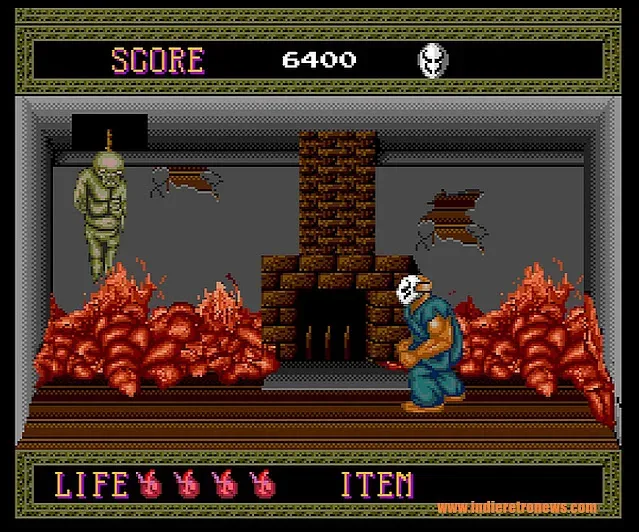
Splatterhouse, Namco's landmark 1988 horror action game, has received an unofficial new life on Commodore Amiga hardware. Built by Modern Vintage Gamer, whose previous Amiga work includes Gunsmoke AGA and Zippy Race A500, the new conversion reconstructs the creature-filled mansion adventure for AGA-equipped systems.
The project is designed to put players back in control of Rick, the masked protagonist attempting to fight through a nightmarish estate and save Jennifer. It includes the full seven-stage arcade-style journey and is aimed at the Amiga A1200 as well as other machines with AGA graphics hardware. It also has dedicated options for CD32 users and WHDLoad installations, making the release relevant to several corners of the still-active Amiga retro scene.
Although Splatterhouse has appeared in several forms over the decades, the Amiga has long been an especially interesting target for an ambitious home conversion. The game's combination of oversized enemies, violent set pieces, side-scrolling action, oppressive visuals and memorable audio makes it a demanding fit for a machine whose most celebrated games often achieved impressive results through careful engineering rather than brute-force power. This new release approaches that challenge through a reconstruction built specifically around the capabilities and limits of AGA hardware.
A full mansion escape for AGA Amigas
The port covers the complete seven-stage adventure, rather than functioning as a short technical demonstration or a partial recreation. Rick's route through the mansion remains focused on direct combat and survival, with players moving through hostile rooms and corridors packed with grotesque threats. The familiar premise is intact: wear the terror mask, push deeper into the house, and battle toward Jennifer's rescue.
For useful background on this topic, read Avenging Spirit, Mole Mania and Pinball: Revenge of the 'Gator Join Nintendo Switch Online.
Its release targets Amigas fitted with the AGA chipset, the enhanced graphics architecture most closely associated with the Amiga 1200 and Amiga 4000 range. The standard hard-drive edition requires an AGA system with a Motorola 68020 processor or better and 2 MB of Chip RAM. Fast RAM is optional for this version. After extracting the supplied LHA archive, players can launch the game through its Workbench icon or from the Shell.
That baseline matters because it positions the project around hardware that is attainable for many Amiga enthusiasts without requiring a heavily expanded configuration. At the same time, the separate WHDLoad package is intended for a more memory-equipped setup. That edition needs 2 MB of Chip RAM, 4 MB of Fast RAM, WHDLoad 17 or newer, plus the player's own A1200 Kickstart image and a matching RTB file. The WHDLoad build can be exited by pressing F10.
There is also a CD32 version intended for the stock console configuration, using its 2 MB of Chip RAM. Since the CD32 remains one of the most accessible ways to play Amiga software on original console hardware, a version tailored to that machine is an important part of the release rather than an afterthought.
Built around Amiga-specific techniques
Modern Vintage Gamer's port was reverse-engineered into portable C code, with speed and faithfulness both identified as priorities. Rather than simply trying to force the game's original presentation onto the system unchanged, the reconstruction uses techniques suited to the Amiga's graphical architecture.
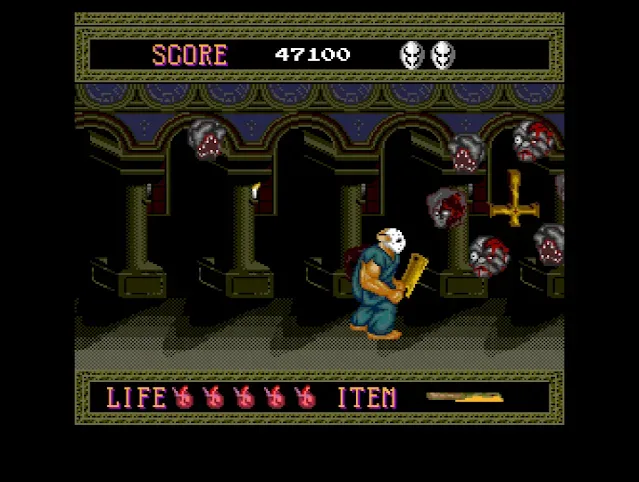
Among them is Dual Playfield mode, which can handle separate playfields and is well suited to building layered scenes. The port also makes use of copper lists, a classic Amiga technique that lets developers coordinate changes during display drawing, alongside double buffering intended to keep motion clean. These methods are paired with large hardware sprites, a useful asset for a game where prominent enemies and player animations need to stand out against scrolling environments.
The stated goal is to maintain smooth scrolling while also accommodating the dramatic sprite work that helps define Splatterhouse. That is a meaningful technical balancing act. Fast-moving side-scrollers can expose every weakness in timing and display handling, while horror-themed action games rely heavily on visual impact. If scrolling stutters or major enemies lose their presence, the tension and spectacle suffer alongside the basic responsiveness.
There are some colour approximations, reflecting the requirements of the Amiga's planar graphics format. Even so, the conversion aims to remain closely aligned with the PC Engine version in its overall visual identity. For a project of this kind, that distinction is useful: absolute pixel-for-pixel duplication is not the point when the destination system renders graphics differently, but preserving the game's composition, atmosphere and recognizable imagery remains central to the experience.
PAL and NTSC options target the right speed
One of the most practical features in the package is its handling of video timing. The release automatically detects PAL and NTSC operation, and it also provides a manual 50/60fps toggle. This is intended to ensure that the action runs at the correct speed across different display standards and hardware arrangements.
That attention is especially welcome for an action game. Game speed is not merely a cosmetic detail in Splatterhouse; enemy movement, attack timing, scrolling rhythm and the feel of Rick's progress through each section all depend on it. A conversion can have convincing graphics and sound yet still feel wrong if its timing does not match the intended pace. Automatic detection combined with a manual option gives users a way to account for their own setups.
Control support likewise covers more than one common Amiga input option. Players can use standard joysticks, while CD32 controllers are also supported. The latter is particularly important for the console version, but it also gives compatible users a controller layout suited to the game's direct arcade-style combat.
Three musical directions, from tracker playback to CD audio
The audio component is one of the conversion's most flexible areas. The core package includes a newly rearranged four-channel ProTracker soundtrack. ProTracker music is a natural fit for Amiga hardware, and the arrangement gives the project an audio identity shaped around one of the platform's most famous musical formats.
Sound effects are handled with priority over the available audio channels. In practical terms, the release is designed so effects can take precedence when needed without collapsing the game's musical mood. In a title built around impacts, attacks and sudden monster encounters, preserving audible feedback while keeping the soundtrack present is an important consideration.
Players using WHDLoad or the CD32 version can additionally access CDDA music. These editions allow users to switch among three soundtrack choices: the original arcade CD audio, the PC Engine music, and the new ProTracker arrangements. PC Engine CD audio is selected by default on the CD32 package.
This selection is more than a novelty. Different regional and platform releases of older games can carry distinct musical associations, and soundtrack preference is often deeply personal among retro players. Offering the arcade CD audio, PC Engine material and Amiga-native tracker interpretation in one project gives users room to choose the atmosphere they want without changing the underlying game.
A technical showcase with room for preference
The conversion supports both the Western version and the original Japanese presentation, allowing players to choose between the forms of the game rather than limiting the release to one regional interpretation. That approach complements the broad audio options and helps make the project feel designed for enthusiasts who know the game's history as well as those simply looking for a striking Amiga action release.
Its importance is also rooted in the nature of fan-driven preservation and reconstruction. Splatterhouse is a major horror game with an unmistakable identity, but it arrived from an era when home versions were frequently shaped by the strengths and compromises of each machine. An Amiga AGA reconstruction arriving decades later can revisit that old question with different tools, more technical knowledge and an audience that still actively uses original hardware, FPGA solutions, and hard-drive-based Amiga configurations.
The project credits Modern Vintage Gamer for the port, reconstruction and Amiga code, with some AI-assisted development noted. It uses PTPlayer 6.4 by Frank Wille, which is public domain, and the Shrinkler executable cruncher by Blueberry. Development was carried out with Bartman/Abyss's amiga-debug toolchain.
For Amiga fans, the result is a substantial new way to experience a genre-defining horror brawler on period-appropriate hardware. It is not presented as an official Namco release, but as an ambitious community-made conversion that seeks to make strong use of the AGA platform's display, sprite and audio capabilities. With the full seven stages, controller support, regional presentation choices, PAL and NTSC timing controls, and several soundtrack paths, this is a notably complete package for anyone ready to enter the mansion once more.
Community
Discussion
Start the conversation.
No comments have been posted yet.