

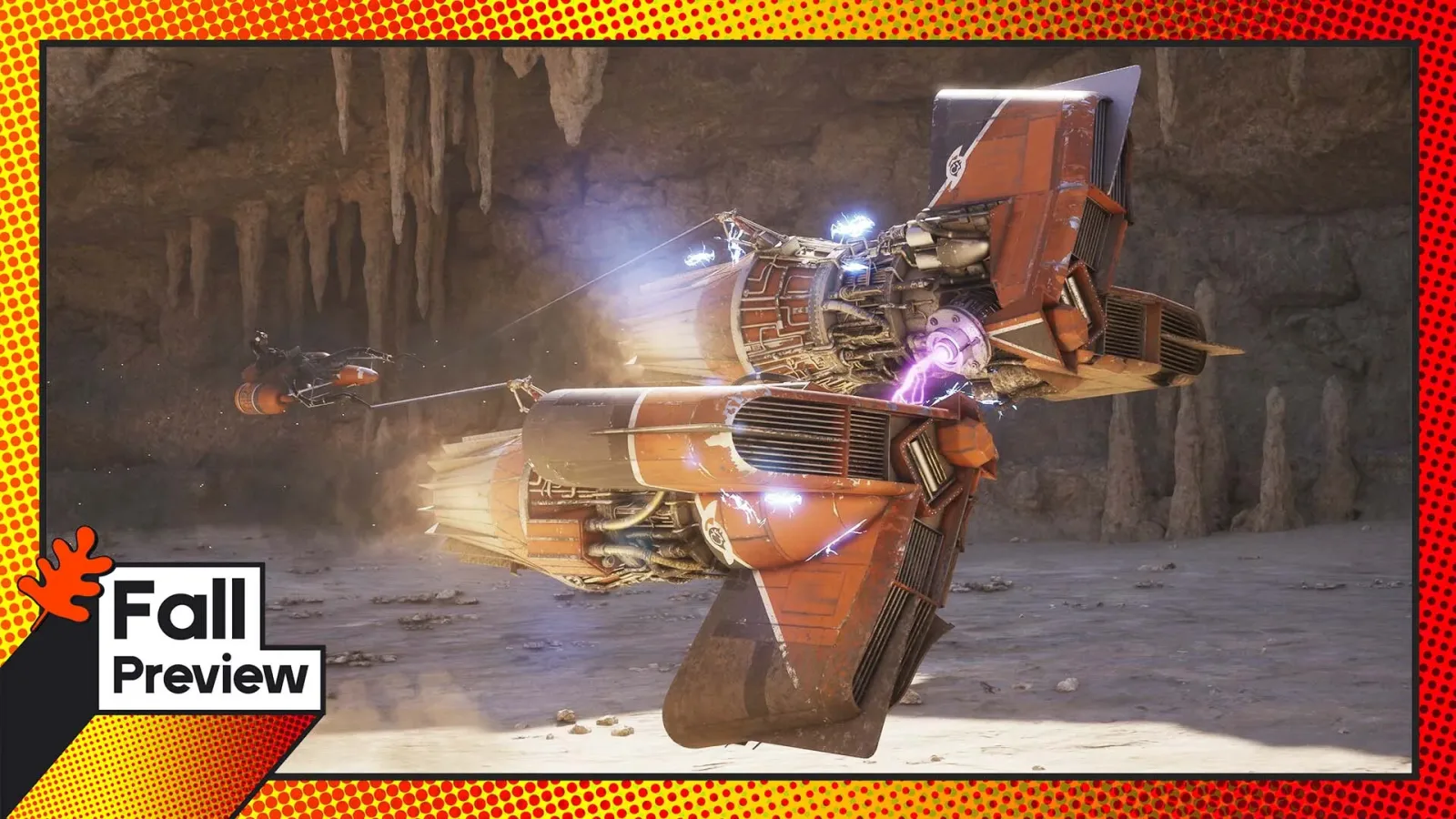
Star Wars: Galactic Racer is heading toward the finish line on October 6 for PlayStation 5, Xbox consoles, and PC. On its own, a new Star Wars racing game would be notable. The series has spent much of its modern gaming life in the worlds of blasters, lightsabers, cinematic third-person action, and multiplayer combat. But Galactic Racer's timing, its developer pedigree, and its apparent embrace of podracing make it feel like more than a nostalgic revival of one specific corner of the franchise.
It could be another important sign that Star Wars games are again willing to explore genres beyond the safest and most familiar choices.
Developed by Fuse Games, Galactic Racer is described as a fast arcade racer with roguelike elements woven into its central progression. The studio is led by veterans with key experience on the famously high-speed Burnout series, an association that immediately raises expectations for aggressive racing, spectacular collisions, and a strong sense of momentum. Putting that expertise to work in a galaxy filled with dangerous canyons, crowded alien cities, and ramshackle spacecraft is a naturally compelling idea.
More importantly, it is an idea that makes the Star Wars universe feel bigger. A franchise with this many planets, vehicles, species, occupations, and cultures should not be restricted to a narrow list of game formats. Galactic Racer has an opportunity to show why.
For useful background on this topic, read Chris Metzen's BlizzCon Absence Does Not Signal Trouble for World of Warcraft.
A Long-Awaited Return to Star Wars Racing
The wait for a major Star Wars racer has been remarkably long. The previous big entry in that space was 2002's Star Wars Racer Revenge, meaning Galactic Racer arrives roughly 24 years after that game. In the years since, podracing has remained one of the most obvious videogame-ready concepts in the entire series: extremely fast machines, high-stakes competition, unusual courses, mechanical upgrades, colorful rivals, and almost no limit on the kinds of environments a race can visit.
It is difficult to look at Tatooine's dusty podracing circuits and not see a videogame premise. The sequence's appeal has always rested on speed and danger rather than complicated lore. That simplicity can be a strength. Players do not need a lengthy explanation to understand the thrill of guiding an unstable racer through tight turns while massive engines strain to remain connected.
Galactic Racer will return players to podracing and include recognizable locations such as Tatooine. That combination suggests a game interested in honoring the fantasy people remember while using modern arcade-racing design to make it feel immediate again. Fuse Games' Burnout background is especially meaningful here. Podracing should be loud, unpredictable, and just slightly out of control; a team accustomed to building games around velocity and vehicular mayhem seems well suited to that task.
For another perspective on this story, read Star Wars: Galactic Racer Could Put Podracing Back on the Front Line.
The concept is not entirely new to Star Wars, of course. Earlier generations saw multiple racing-focused games, while the broader catalog also experimented with vehicle combat. Yet the genre largely faded away as licensed games increasingly clustered around action-adventure and shooter formulas. Galactic Racer is asking a straightforward question: why should a setting this expansive go so long without a proper racing game?
Fuse Games Found an Enthusiastic Partner
Fuse Games CEO and founder Matt Webster has said that the studio's planning repeatedly returned to that same gap. As the team considered what its debut game should be, the absence of a major Star Wars racing title stood out. Creative director Kieran Crimmins explained in an interview with IGN that the developers believed a Star Wars racer was simply the strongest first game they could make.
Crimmins also said the idea was presented to Lucasfilm, a company Fuse had worked with previously. Rather than needing to convince a reluctant rights holder, the team found a partner that shared its excitement for the project. That mutual enthusiasm matters. Licensed games can feel constrained when the property and the developer do not appear aligned on what makes the project special. In this case, the premise seems to have been supported because it fit both the team's abilities and an overlooked part of the Star Wars fantasy.
"It was fairly obvious that [a Star Wars racing game was] probably going to be the best game we could make for our first game," Crimmins told IGN.
That is a promising philosophy for any licensed release. The best use of a major franchise is not necessarily to attach its characters and iconography to whichever genre happens to be popular. It is to find a genre where a developer's individual strengths and the setting's natural possibilities reinforce each other. Galactic Racer appears to be built around precisely that overlap.
Racing Meets Roguelike Campaign Decisions
Galactic Racer is not positioned as a purely traditional series of isolated races. Its main campaign includes roguelike-style elements, asking players to make decisions as they move through races, improve their vehicles, and attempt to reach a grand championship. The full shape of those systems remains to be seen, but the approach could give the game a valuable layer of replayability.
Racing games have long used upgrades, championships, vehicle selection, and time trials to create progression. Roguelike structure could make each campaign push more tense and less predictable. Instead of merely winning events to unlock the next one, players may need to weigh risk against reward, select upgrades that suit a specific run, and decide when an aggressive maneuver is worth the possible cost.
That design direction has an especially good thematic fit for podracing. These machines have always seemed unreliable, custom-built, and prone to failure. The fantasy is not that of a polished professional sport with flawless engineering. It is a dangerous competition where a racer's choices, parts, nerve, and ability to survive chaos all matter. A campaign built around hard decisions could capture that tone better than a conventional ladder of increasingly difficult tracks.
Early hands-on impressions have pointed to a track-focused racer that understands the appeal of speed and spectacle. The roguelike component may prove to be the feature that separates it from a simple nostalgia exercise. If it creates meaningful variety without interrupting the arcade flow, Galactic Racer could remain engaging well beyond the first rush of returning to a podracer cockpit.
Zero Company Shows the Value of Genre Variety
Galactic Racer's arrival follows only a few weeks after Star Wars Zero Company, which took the franchise in a very different direction. Zero Company offered tactical strategy gameplay in the mold of XCOM, combining turn-based planning with familiar Star Wars ingredients including clones, droids, and Jedi. Its technical shortcomings did not prevent it from standing out as a welcome change of pace.
Together, Zero Company and Galactic Racer make a persuasive case for a more diverse Star Wars slate. One gives players careful tactical decisions across strategic missions; the other is set to emphasize split-second driving, machine upgrades, and arcade action. Neither needs to replace the larger action games that continue to have an audience. The point is that they can exist alongside them.
For years, Star Wars games have often been treated as though their most dependable form must involve a lone hero, direct combat, and cinematic set pieces. Those ingredients can certainly work. But the setting has always supported far more. It contains criminal syndicates, pilots, scavengers, smugglers, bounty hunters, mechanics, politicians, rebels, soldiers, musicians, shopkeepers, farmers, and countless people simply trying to live on worlds affected by galactic conflict.
That breadth should encourage different kinds of play. A tactical game can explore squad leadership and battlefield positioning. A racer can lean into speed, gambling, and mechanical improvisation. A story-driven adventure could focus on personal relationships in a remote corner of the galaxy. A management game could put players in charge of a trade route, a settlement, or even a cantina.
The Galaxy Has Room for More Than Blasters and Lightsabers
The most encouraging thing about Galactic Racer is not merely that it brings back podracing. It is that the game recognizes Star Wars as a setting rather than a single gameplay template. The franchise is full of strange worlds and unusual professions, which means its future should have room for more experiments.
There is obvious potential for a narrative-focused game that prioritizes character drama over combat. Sports are common throughout the galaxy and could sustain a competitive game with a distinctly alien twist. Survival horror could make a derelict station, abandoned Imperial installation, or creature-infested moon genuinely frightening. A city builder could explore the logistical challenge of establishing a frontier settlement amid piracy, resource shortages, and political pressure.
Even lighter ideas have merit. A comedy game built around the galaxy's oddballs could be a welcome counterpoint to stories of planetary war. A restaurant-management game starring Dexter Jettster might sound absurd, but that kind of focused, playful premise is exactly what a rich fictional universe can support. Not every project needs to carry the fate of the galaxy on its shoulders.
That does not mean every genre experiment will succeed. A recognizable license cannot guarantee that a racing, strategy, horror, or management game will be good. Each still needs strong mechanics, a coherent identity, and a reason to exist beyond branding. But games such as Zero Company and Galactic Racer are valuable because they begin from a healthier question: what kind of experience would be exciting in this universe?
October 6 Is an Important Test
Galactic Racer still has to prove itself when it launches on October 6 for PS5, Xbox, and PC. It will need satisfying handling, smart track design, memorable courses, and progression systems that enhance rather than distract from the thrill of racing. It will also carry the expectations that come with both the Star Wars name and the involvement of developers associated with Burnout.
But its existence is already meaningful. After more than two decades without a major Star Wars racing release, podracing is returning in a game built by people with extensive arcade-racing experience. Coming soon after a tactical strategy entry, it reinforces the possibility that the franchise's gaming future may become less predictable and much more interesting.
Star Wars does not need to abandon shooters or third-person action games. It simply needs to remember that its galaxy is large enough for racers, tacticians, traders, builders, comedians, and every other kind of player fantasy. Star Wars: Galactic Racer may be one more step toward that broader horizon.
Community
Discussion
Start the conversation.
No comments have been posted yet.