


Healing is one of the most important parts of surviving the demanding battles in Phantom Blade Zero, but the game does not hand over its medicine-upgrade feature immediately. Players will need to make meaningful progress through the story before they can improve their restorative items, which can make the first stretch of the adventure feel especially punishing if medicine supplies are running thin.
The good news is that the upgrade system becomes available during the journey through Pangzhen. Once it has been unlocked, it offers a lasting way to increase the effectiveness of the healing items in a chosen loadout and, where applicable, improve their available uses. There is one major catch, however: medicine upgrades are permanent. Unlike weapon improvements, they cannot simply be undone and reassigned later.
That makes knowing where to unlock the feature, what it costs, and when to spend rare materials especially valuable. Here is a full breakdown of how medicine upgrading works, where to find the NPC who opens it, and how to avoid wasting Healer's Memories on items that may soon leave your inventory rotation.
Where to unlock medicine upgrades
Medicine upgrades become available at roughly the midpoint of the game while exploring Pangzhen. The key destination is the Green Serpent House, located in the Backstreets section of the town.
For useful background on this topic, read Cameraman Tower Defense codes for November 2026: Free Coins and Redemption Steps.
Inside the Green Serpent House, speak to Xie Xiaorong at the counter. This conversation unlocks the ability to improve medicine. If a player has already reached Pangzhen but cannot access the relevant building yet, the solution is generally to keep following the main quest path through the town. Pangzhen is a desolate, progression-driven area, and reaching the house may take additional story advancement rather than a simple detour from the earliest arrival point.
In practical terms, there is no need to worry about repeatedly traveling back to the Green Serpent House after the first visit. Meeting Xie Xiaorong is the step that opens the system; it is not a requirement for every individual improvement.
How to upgrade medicine after meeting Xie Xiaorong
Once medicine upgrading has been unlocked, it is incorporated into the broader Upgrade Equipment interface available at any Bell. Bells are therefore the convenient long-term hub for managing both gear-related improvements and medicine investment.
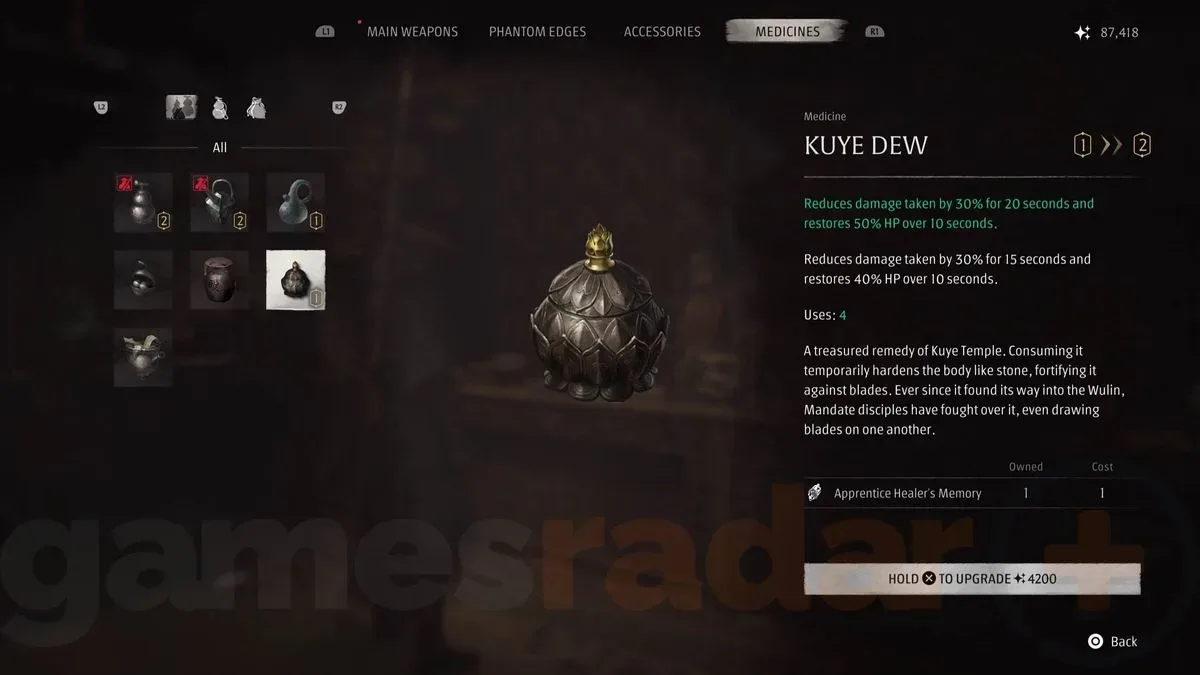
To improve a medicine item, interact with a Bell and open the Upgrade Equipment menu. From there, navigate to the medicine options and select the healing item that is currently part of the preferred setup. The menu will show the required resources and the benefits tied to the next level before the player confirms the upgrade.
This arrangement matters because it removes the need for tedious backtracking. Pangzhen and the Green Serpent House serve as the narrative gateway to the feature, but future upgrade decisions can be made while progressing through other regions. As soon as the necessary materials are available, a Bell can be used to strengthen a favored medicine item before a difficult encounter or a new stretch of exploration.
Medicine upgrade costs explained
Every medicine level requires two kinds of resources: Remnant Dust and a Healer's Memory. The dust cost is measured in the thousands and increases as a medicine reaches higher levels. Healer's Memories also rise in rarity over time, so later upgrades demand more valuable versions rather than merely larger stacks of an early-game item.
The first two upgrade levels, for example, use one Apprentice Healer's Memory apiece. The third and fourth levels instead require a Skilled Healer's Memory. This establishes the broader pattern: higher upgrade tiers call for more advanced Healer's Memories, making it unwise to treat the material as an endlessly replaceable currency.
- Early levels: Consume Remnant Dust and Apprentice Healer's Memories.
- Later levels: Continue to require greater amounts of Remnant Dust while shifting toward rarer Healer's Memory types.
- Upgrade effect: Enhances the healing potential of medicine and can increase uses for relevant restorative items.
Players can find Healer's Memories of different qualities while exploring the world. Limited quantities can also be purchased from the Bell shop. The limited nature of that shop stock is worth remembering. Buying a Memory may solve an immediate problem, but it does not necessarily mean there will be an unlimited supply for every medicine in the inventory.
Why permanent upgrades require careful planning
The defining rule of medicine upgrades is that they are permanent. Weapon upgrades can be reverted, allowing a player to recover an investment and redirect resources to another weapon. Medicine does not work that way. Once a Healer's Memory and the associated Remnant Dust have been spent on a particular medicine item, that commitment remains in place.
For that reason, the safest strategy is to focus only on medicine currently being used in combat. There may be several restorative tools to experiment with, but spreading upgrades across every item can leave a character with a collection of modestly improved supplies rather than one or two highly dependable recovery options.
A focused approach also preserves flexibility. If a stronger or more suitable medicine is found later, holding onto spare Healer's Memories makes it possible to upgrade the new choice quickly. This is particularly helpful for players who are still learning which healing style suits their build, combat habits, and preferred weapons.
In other words, medicine upgrading should follow actual usage rather than curiosity alone. Test a newly acquired medicine before committing rare materials. If it earns a lasting place in the active loadout, then investing in it makes sense. If it is only being carried for experimentation, it is usually better left at its base level until its long-term value is clear.
Best medicine upgrade priorities
There is no universally mandatory medicine item identified by the system itself, since the best choice depends on the player's available inventory and how they handle combat. Still, a few broad priorities can help guide spending.
- Upgrade the primary healing item first. The medicine used most often is the one most likely to affect survival across ordinary enemies, elite fights, and bosses.
- Prioritize consistency over variety. A reliable restorative option with stronger healing or improved usage capacity is generally more useful than minor upgrades scattered over several situational items.
- Keep rare Memories in reserve. Do not spend every advanced Healer's Memory as soon as it is acquired. A later medicine may better complement the current combat approach.
- Check resources at Bells. Since the upgrade menu is accessible there, use Bells as decision points before heading into a challenging new objective.
- Account for Remnant Dust needs. Even when the correct Memory is available, the necessary dust can be substantial. Avoid draining reserves without considering upcoming equipment plans.
This advice is less about delaying every upgrade and more about making each permanent upgrade meaningful. Early improvements to a trusted medicine can have an immediate impact, while indiscriminate spending is the real danger.
Progression around Pangzhen and the Serpent Houses
Unlocking medicine upgrades is only one part of the larger Pangzhen progression path. As the story continues in the area, players will eventually obtain the Flaming Mane weapon. This weapon is important because it finally permits entry into other Serpent Houses found around the world, locations that are essential to the main quest.
Before setting out toward the Pangzhen Backstreets, it can be useful to finish the Four Fierce Axes quest. From there, progression in the Backstreets includes tracking down the Mandate Encampment Key and continuing the Flesh Lily quest. These objectives help frame the route through Pangzhen while moving the player closer to the Green Serpent House and the medicine system.
Because the town's paths and quest steps are tied closely to story progression, players who do not immediately see the house should resist assuming that they missed a hidden requirement. Continue through the main objectives, complete the relevant local tasks, and the route will open naturally.
A lasting boost for difficult fights
Medicine upgrades are a major quality-of-life and survival milestone in Phantom Blade Zero. They arrive later than some players may expect, but the system becomes conveniently accessible once Xie Xiaorong has been met at the Green Serpent House. From that point forward, Bells provide a practical place to improve healing items without repeated trips to Pangzhen.
The central lesson is simple: spend Remnant Dust and Healer's Memories with intent. Upgrade the medicine that is already proving useful, avoid investing heavily in items that may soon be replaced, and save some rare Memories for future discoveries. With permanent upgrades supporting a carefully chosen healing setup, the road beyond Pangzhen should become considerably more manageable.

Community
Discussion
Start the conversation.
No comments have been posted yet.