

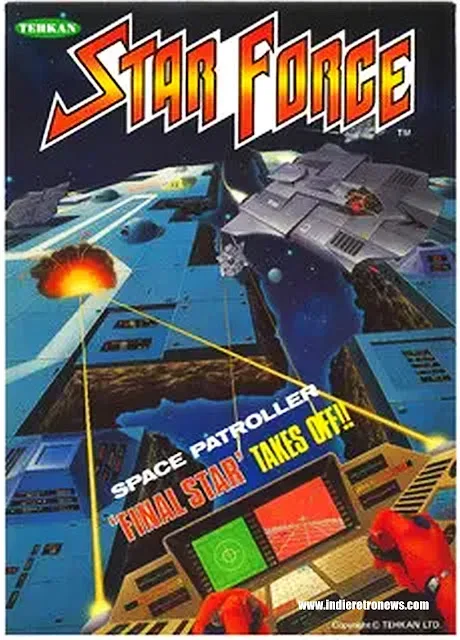
Starforce, the fast-paced 1980s vertical arcade shooter that arrived in North America under the name Mega Force, is being developed for the Amiga AGA. The project comes from Acidbottle, who has also been working on Amiga versions of other classic arcade games, including Defender and a beta version of Centipede.
The new adaptation is still a work in progress, but development footage has confirmed that the arcade game's core action is taking shape on Commodore's enhanced Amiga hardware. For fans of score-driven shoot 'em ups, the significance lies not just in seeing another coin-op favorite return, but in the specific type of challenge Starforce represents: a relentless forward-scrolling game built around positioning, timing, route knowledge, and a surprisingly unforgiving power system.
Rather than being a modern reimagining loaded with new systems, the Amiga AGA version is positioned around preserving the recognizable mechanics and escalating structure of the original. Players take control of the Final Star spacecraft, push through stages themed around the Greek alphabet, and attempt to survive an arcade loop that can continue far beyond a conventional final encounter.
A classic vertical shooter built for endurance
Originally released in arcades in the mid-1980s, Starforce is remembered as an early and influential vertical-scrolling shooter. Its design is straightforward on the surface: pilot a lone ship upward through hostile territory, destroy formations and ground targets, collect helpful items, and prepare for increasingly severe enemy patterns. But that simplicity is part of why the game has remained memorable among arcade enthusiasts.
For useful background on this topic, read Freestyle - Tales of Itch Launches a 50-Level Comic-Book Platforming Adventure for Amiga.
The player's ship, Final Star, travels through a succession of areas named after Greek letters. These stage names provide an easy sense of progression, beginning with familiar entries such as Alpha and continuing toward later objectives. Each section mixes airborne attackers with destructible installations and targets placed across the playfield, demanding attention to both immediate threats and potential scoring opportunities.
Starforce does not rely on the safety nets common in many later shooters. Its identity is rooted in momentum and pressure. Enemies rapidly enter from multiple directions, the screen keeps moving, and a player who loses control of the ship's placement can quickly be boxed into danger. The planned Amiga AGA edition is intended to retain that demanding arcade character rather than soften it with an extensive new arsenal or an easier progression structure.
Two weapon levels, no bombs, and little room for error
One of the most notable details of the conversion is its adherence to Starforce's strict weapon design. The original system has only two weapon power levels. That may sound modest compared with shooters that pile on spread shots, lasers, shields, homing weapons, bombs, missiles, and screen-clearing special attacks, but it is central to the game's balance.
The player must make the most of a comparatively limited offensive upgrade path while dealing with a mounting volume of enemies. There are no bombs or missiles available to erase trouble in an emergency. That absence changes the feel of every encounter: survival rests on movement, recognition of incoming patterns, accurate fire, and the ability to decide when chasing a target is too risky.
For an Amiga adaptation, retaining this structure matters. It preserves the original game's tension and stops the project from becoming merely an arcade-inspired shooter wearing a familiar name. A faithful weapon model means that the Final Star should feel vulnerable even when upgraded, while successful runs should reflect player mastery rather than dependence on a large inventory of recovery tools.
It also suits the score-chasing nature of the game. In this kind of arcade design, efficiency has value. Learning where targets appear, knowing which formations are worth engaging, and staying alive long enough to carry a weapon state into later areas are all parts of improving a run.
From Scorpion Engine prototypes to modern development tools
Acidbottle's route to the current build has not been a simple one. The project began with early prototypes made using the Scorpion Engine, a toolset associated with creating games for classic systems. Development later moved toward the use of modern AI tools to help accelerate and complete the work.
That production path reflects an increasingly common reality for new games on retro platforms. Developers often combine period-appropriate hardware targets with contemporary workflows, using newer tools where they can reduce technical friction or speed up asset and implementation work. The end goal remains software that runs on the intended legacy machine, but the creation process does not need to be limited to the methods available during that machine's commercial lifespan.
In Starforce's case, the important point is that the project remains focused on Amiga AGA. The AGA chipset represents the enhanced graphics architecture used by later Amiga models, and it gives a conversion such as this a more suitable technical base than the earliest Amiga configurations. The current footage is not presented as a finished showcase, however. Its capture quality is poor and heavy video compression makes it difficult to judge every visual and performance detail with confidence.
Even with those limitations, the video serves a useful purpose: it demonstrates that the recognizable shooter is in motion and heading toward the Amiga rather than existing only as an announced concept. For retro fans, evidence of active gameplay is particularly meaningful on projects that may depend on the time and persistence of a small development effort.
IM76 is set to provide the music
Music is another key part of the planned package. The soundtrack is set to be handled by IM76, adding a dedicated musical contribution to the conversion's arcade atmosphere. Starforce's action depends heavily on pace, and a pulsing soundtrack is a natural fit for a game where players are constantly advancing into enemy fire and new formations.
The current musical arrangement does not include a dedicated high-score track. That omission has been noted as part of the work still to be addressed, rather than as an indication that the game's score-focused identity has been abandoned. In an arcade shooter, the high-score table is more than a leftover menu screen; it is the record of repeated attempts, incremental improvement, and competition between players who learn the game's systems in depth.
With IM76's score still planned, the audio side of the Amiga AGA release has room to develop further. It will be interesting to see how the eventual music supports the game's distinct pace without overwhelming the effects and visual cues players need during dense encounters.
The long road beyond Omega
Starforce is not simply a game about reaching a single ending and walking away. Its arcade structure is built for repetition. After players reach the Omega target, the action can continue through an endless loop, inviting increasingly practiced pilots to keep pushing their reflexes and consistency.
That looping quality is essential to its reputation. A first clear is an achievement, but it is also only another step in learning how long a player can remain composed as the game cycles onward. Repeated stages take on a different character once the player is no longer merely discovering them. Familiar enemy entries become tests of execution, and small errors that were survivable earlier can become run-ending mistakes.
There is also the possibility of the legendary Infinity stage being part of the experience, a challenge associated with players who continue far beyond the Omega objective. Its inclusion has not been confirmed as a finalized feature, so it remains something for dedicated fans to watch rather than a guaranteed part of the release. Still, even the prospect fits the spirit of a game designed to reward endurance at the edge of what most players will ever see.
A promising addition to the Amiga arcade library
The Amiga has a long association with arcade conversions, original shooters, and home interpretations of coin-op hits. A Starforce adaptation for AGA machines has the potential to appeal to several overlapping audiences: Amiga collectors, players with memories of Mega Force cabinets, vertical-shooter specialists, and retro enthusiasts interested in newly developed software for older hardware.
Acidbottle's continued work on several arcade-inspired Amiga projects also makes this conversion part of a broader effort to bring familiar classics to the platform. With Defender and Centipede already among the developer's recent projects, Starforce adds another very different style of arcade action to that lineup. Where some arcade games are defined by a single screen or a horizontal battlefield, Starforce is all about upward momentum and controlled aggression.
No release date, price, or distribution details have been announced for the Amiga AGA version. For now, the project is best viewed as an active development effort with visible progress, a planned soundtrack by IM76, and a clear commitment to the original game's two-tier weapon system, Greek-letter stages, and endurance-focused looping design.
For players eager to see how the Final Star's old-school challenge translates to Amiga AGA, the next major milestone will be a cleaner look at the build and further confirmation of its remaining features. Until then, this is a conversion worth keeping on the radar--especially for anyone who believes a shooter does not need bombs, missiles, or a dozen upgrade paths to create a formidable arcade test.
Community
Discussion
Start the conversation.
No comments have been posted yet.