


Steam Next Fest is built for discovery, and one new collection of demos offers a particularly wide-ranging tour of what smaller teams are bringing to PC. The five games in the lineup have little in common on the surface: there is a deliberately punishing fantasy role-playing adventure, a relaxing beach construction sandbox, an unnerving aviation-focused horror experience, a frantic roguelike escape scenario, and a grisly thriller about identity theft in its most literal form.
What connects Queen's Domain, Sandcastle, The Hollowing, 500 Finger Fillet, and SKINFACE is that each has a Steam demo attached to the event or arriving around it. For players who use Next Fest to sample projects before committing to wishlists or future purchases, it is a compellingly strange set of games. The group ranges from contemplative building to intense body horror, with each developer using the demo format to introduce a very distinct central hook.
Queen's Domain heads to a troubled island
Queen's Domain is an action RPG from the two-person team at Freshly Baked Games, a developer connected with creator Iron Pineapple. It draws stated inspiration from FromSoftware-style games, setting expectations for a dangerous world, demanding combat, and an atmosphere built around mysteries that need to be uncovered rather than plainly explained.
The demo sends players toward the Isle of Neasied, where the protagonist is searching for their missing father. That personal objective unfolds against a wider and increasingly ominous situation: hostile forces are gathering across the island, while its sleeping queen has begun to stir. It is a setup that gives the game a familiar dark-fantasy foundation while leaving substantial room for the demo to establish the island's characters, threats, and overall tone.
For useful background on this topic, read Pokémon Battle Advanced Reimagines FireRed With 3D Exploration and Real-Time Gym Fights.
Freshly Baked Games has reported that Queen's Domain has surpassed 200,000 wishlists, an early sign that the project has attracted a significant audience ahead of launch. The game is scheduled to arrive on PC through Steam and consoles on October 30, 2026. Specific console platforms have not been detailed here, but the Steam demo gives PC players an immediate chance to see how the game's exploration and combat feel before that release.
For fans of somber RPGs, the key appeal is likely the promise of a focused adventure made by a small team with an evident affection for the genre's mood and difficulty. The search for a father and the awakening queen offer two possible narrative threads, while the island setting provides a natural framework for a demo that can introduce a compact slice of a larger quest.
Sandcastle makes beach building into a physics toybox
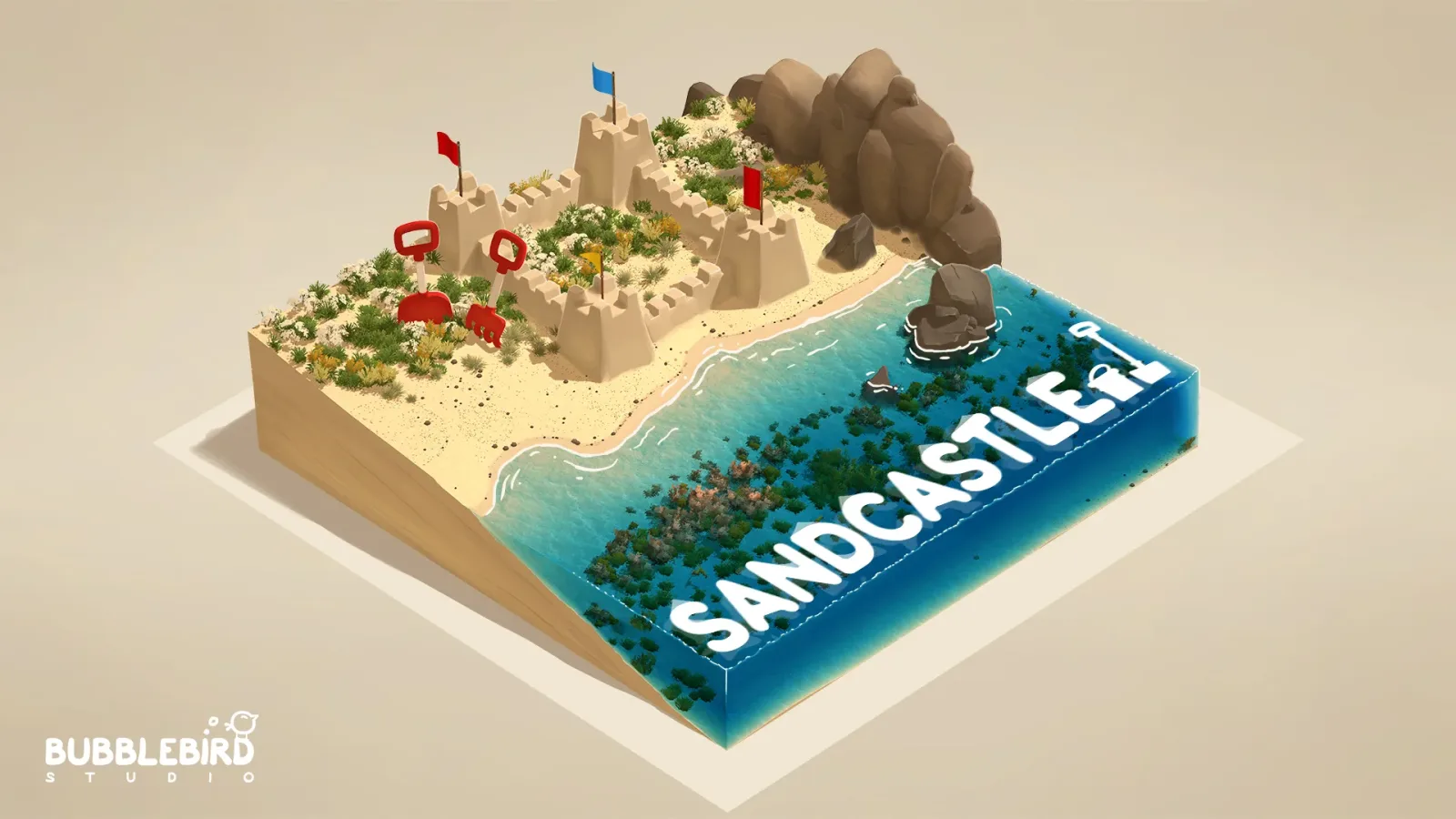
At the opposite end of the emotional spectrum sits Sandcastle, a sandbox builder from Bubblebird Studio. Rather than confronting players with ancient curses or hostile machinery, it asks them to create at the beach. The concept is uncomplicated in the best sense: build sandcastles, experiment with a physics-driven construction system, and see what kinds of seaside structures can be shaped from the available tools and materials.
A physics-based approach could be the difference between a standard decorative builder and something more playful. Sand does not behave like conventional blocks, and the pleasure in a game like Sandcastle may come from adapting to instability, experimenting with form, and turning imperfect constructions into part of the creative process. Towers, walls, sculpted features, and more ambitious layouts all seem well suited to a format where the beach itself is the building space.
Bubblebird Studio has listed Sandcastle for 2026, though a precise release date has not been provided. The game has also been described as a social-media hit, with 4.5 million views noted for its viral presence. That interest makes sense for a project with an immediately readable visual premise: watching elaborate sand structures take shape, or collapse under the consequences of physics, is easy to understand even before someone has played it.
The Steam demo is therefore an opportunity to find out whether the tactile appeal translates from short clips into a satisfying creative loop. Sandbox games often live or die on responsiveness, tool variety, and the way systems invite experimentation. Sandcastle's demo should help answer those questions while offering a calmer alternative to the event's more threatening games.
The Hollowing turns flight into isolated horror
The Hollowing takes the collection back into darker territory, combining first-person horror with the structure of a flight simulator. Developer Rubeki describes the broad idea as a meeting point between Iron Lung and Flight Simulator, an unusual comparison that points to both confined dread and the technical focus of piloting a craft.
Players are tasked with repairing communications towers positioned between settlements across a huge Megastructure. That mission suggests a practical, workmanlike rhythm--travel to an objective, maintain or repair vital infrastructure, then continue onward--but it is framed inside an atmospheric horror world. The tension is likely to come from being alone in an immense constructed environment, where distance and silence can be as unnerving as any direct threat.
Rubeki previously created Lorn's Lure, which has sold more than 60,000 copies. That history may interest players who appreciate first-person games built around strong environmental mood and disorienting architecture. The Hollowing appears to pursue a different mechanical focus, but the Megastructure premise again creates an opportunity for spaces that feel vast, alien, and difficult to fully comprehend.
Its demo is available on Steam during Next Fest. For horror fans, it may be among the most intriguing entries because it does not rely solely on walking through corridors or hiding from a pursuer. Flying between far-flung towers introduces navigation, vehicle operation, and the vulnerability of crossing open expanses, all within a setting designed to make isolation feel oppressive.
500 Finger Fillet puts 20 minutes on the clock
500 Finger Fillet has perhaps the most instantly alarming premise of the group. The horror roguelike comes from Heather Flowers, creator of Unfair Flips, a project reported to have amassed more than 10 million views. Here, the player is handcuffed to a machine that stabs hands, and must escape before a 20-minute limit runs out.
That setup is blunt, stressful, and intentionally difficult to shake. The title invokes a familiar real-world game of nerve and precision, then magnifies it into a horror scenario centered on entrapment. As a roguelike, 500 Finger Fillet also implies repeat attempts, meaning that failure may not simply end the experience but instead become part of learning how to survive the next run.
The combination of a fixed time limit and a violent mechanical threat should give the demo a sharply defined pace. Horror games can build fear slowly, but this one appears designed to create immediate pressure. Players will need to assess whatever escape options are available while the countdown continues and the machine remains a constant danger. The challenge will likely appeal to audiences who enjoy replayable horror concepts as much as traditional narrative scares.
500 Finger Fillet is currently listed for release on November 12, with no year specified in the available details. Its Steam Next Fest demo lets players test their nerves ahead of that planned launch and determine whether its high-intensity loop is the kind of horror they want to revisit.
SKINFACE brings a literal twist to disguise
The final game, SKINFACE, is a gruesome horror-thriller developed by Adam Pype and Ties Groen. Its protagonist is a faceless hitman with an especially disturbing ability: he can steal other people's faces. That concept immediately changes the usual meaning of disguise. Instead of simply putting on a mask or changing clothes, the game's assassin appears to use stolen identities as a core part of his violent work.
There is still a great deal left to learn about how SKINFACE will play, but its premise points toward stealth, infiltration, and horror-inflected transformation. A face-stealing mechanic could create questions about whom players can impersonate, what access those identities provide, and how the game treats the consequences of using such a power. Even without those answers, the pitch has a clear identity: this is not subtle horror, and its thriller framing seems likely to embrace that discomfort.
SKINFACE is slated for late 2026. A new Steam demo is set to arrive on October 19, giving curious players another opportunity to see how the game's brutal concept operates in motion. Of the five projects, it may be the one most likely to appeal to players looking for an aggressively stylized horror experience with a memorable central mechanic.
A useful cross-section of upcoming PC games
Taken together, these demos demonstrate why Steam Next Fest remains valuable for players willing to try games outside their usual habits. Queen's Domain offers dark fantasy RPG adventure; Sandcastle supplies hands-on creative construction; The Hollowing aims for lonely mechanical terror; 500 Finger Fillet delivers compressed roguelike panic; and SKINFACE leans into grotesque thriller ideas.
Not every demo needs to prove an entire game in a single session. Sometimes its role is to establish feel: the weight of a weapon, the give of virtual sand, the rhythm of a flight system, or the anxiety generated by a ticking clock. These five games all have sharply different ways of making that first impression, and their demos give PC players a low-risk way to decide which worlds are worth returning to when their full releases arrive.
Community
Discussion
Start the conversation.
No comments have been posted yet.