

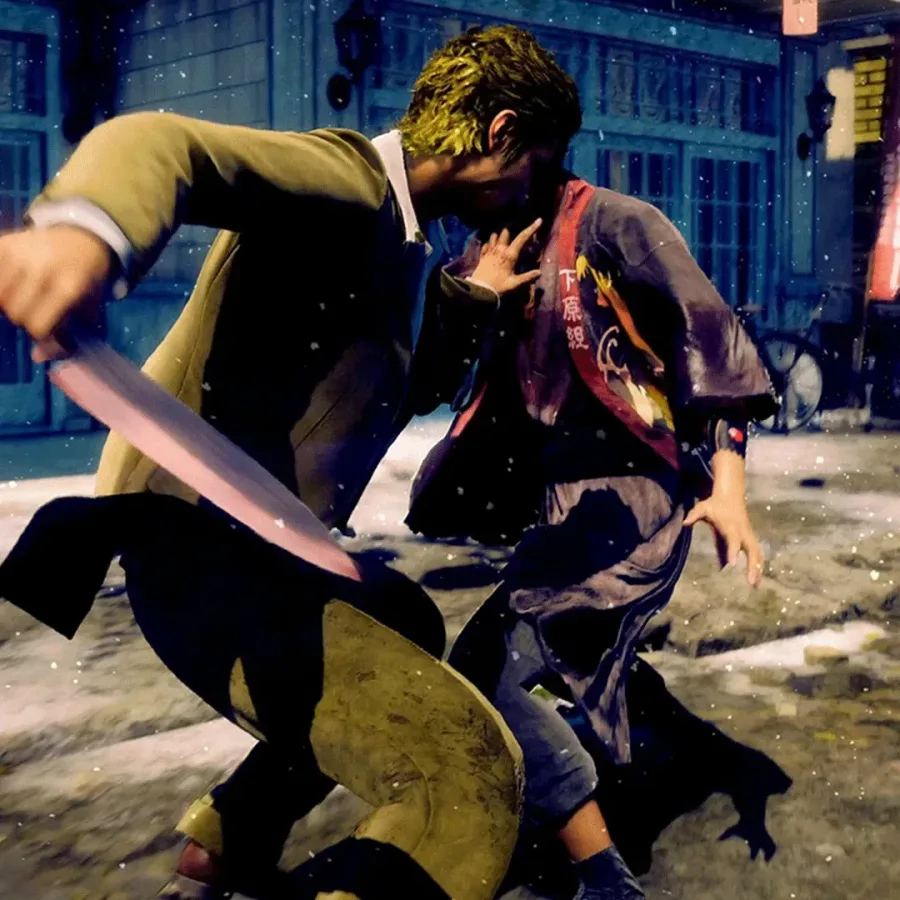
Stranger Than Heaven is asking players to engage with a more demanding style of action combat than they may expect from RGG Studio, but the developer is also building in ways to lower the barrier to entry. The upcoming street brawler will feature difficulty settings and optional support equipment intended to help newcomers survive battles without fully mastering its parry-driven systems.
The support features include what producer Hiroyuki Sakamoto calls "cheat items," though they are not hidden codes or post-game unlocks. Players can acquire them from the very beginning of the game. Their purpose is straightforward: make the protagonist substantially tougher, with effects such as automatic health recovery and other combat benefits.
There is a playful condition attached to using them, however. These accessibility-focused items are worn as clothing or garments, meaning they visibly mark the player character. Anyone watching a stream or looking at the gameplay screen will be able to tell that the assists are equipped. It is an intentionally cheeky trade-off that fits the studio's history of mixing serious drama with self-aware humor.
A more technical direction for RGG Studio action
Stranger Than Heaven comes from the team behind Yakuza and Like a Dragon, franchises known for dramatic crime stories, exuberant side activities, and brawling systems that have varied widely over the years. Some recent RGG Studio action games have allowed players to get through many encounters through relatively freeform combos and aggressive button presses. Stranger Than Heaven appears to be taking a more deliberate approach.
For useful background on this topic, read Chronicles: Medieval Studio Warns It Could Close Before Early Access Launch.
Hands-on impressions have characterized the game's combat as demanding, especially because successful defense is not simply a matter of pressing parry at the right instant. Players must also read enemy animation cues and identify the direction of incoming attacks before making the proper response. That requirement could make fights more rewarding for players who enjoy learning enemy patterns, but it also presents a steeper learning curve than an uncomplicated combo-focused brawler.
Sakamoto said the team understood that mechanics such as parrying could prove difficult. Feedback from players who tried public demonstrations at game events, including Gamescom Asia x Thailand Game Show 2026, has informed adjustments to the game's difficulty balance and control responsiveness. Those refinements suggest RGG Studio is not merely adding assists after identifying a harsh combat system; it is also continuing to tune the fundamentals based on hands-on feedback.
The developer's objective is to let a broad audience experience the complete game, rather than reserve its story and activities for people who can consistently execute advanced defensive maneuvers. That is especially notable for a studio whose games often attract players for their characters, elaborate narratives, eccentric minigames, and densely realized settings as much as for their fighting mechanics.
Support gear aims to keep players moving forward
The assist equipment in Stranger Than Heaven seems designed to cover multiple skill levels. Some items will automatically restore health, making players more resilient when they take repeated hits. That alone can make a substantial difference in a game where timing errors may quickly turn a fight against the player.
More strikingly, Sakamoto described assistance gear for beginners who continue to have trouble with blocking. With those items equipped, encounters can be cleared using basic left and right punches alone. The wording does not necessarily mean every battle becomes entirely automatic, but it indicates that the game can dramatically reduce the need for players to engage with its more complicated defensive inputs.
That approach offers a useful middle ground between two common extremes. Some action games reduce difficulty only through broad sliders that affect enemy health and damage, while others insist that every player must learn the same core mechanics regardless of their reason for playing. Stranger Than Heaven appears set to offer conventional difficulty choices alongside tangible equipment that changes how much mechanical execution is required.
Players who want the intended pressure of reading attacks, blocking, and parrying can leave those items unequipped. Others can use the gear temporarily for a difficult sequence, or keep it on throughout the campaign if their priority is seeing the story through. The availability of the items at the start removes the possibility of players becoming stuck early in the experience before they have access to meaningful assistance.
The visible cost of using a "handicap"
RGG Studio has attached a cosmetic joke to what is otherwise a practical accessibility feature. Since the support items function as handicaps and are worn by the character, their use is visually apparent. A player may be able to withstand more punishment or simplify a battle down to basic punches, but they cannot easily present the resulting playthrough as an unassisted display of elite combat skill.
It is a small detail, but one that speaks to the game's apparent personality. Rather than treating easier settings as something shameful or locking them behind a menu with an ominous warning, the game frames the equipment as a conspicuous piece of in-world gear. The system acknowledges that players may want help while having a little fun with the idea of publicly wearing that help.
For streamers and players sharing clips, the visual indicator may also give viewers context for what they are seeing. In an era where combat difficulty discussions often become tangled in assumptions about how footage was recorded, Stranger Than Heaven's clothing-based solution is unusually direct. The character's outfit itself will communicate that support effects are active.
Importantly, Sakamoto's comments do not frame the gear as a replacement for teaching players the system. Stranger Than Heaven will include an extended tutorial segment early in the game, giving players time to understand its new combat rhythms. He expressed hope that persistence, combined with that onboarding process, will eventually lead many players to appreciate the mechanics.
The assist items instead provide a safety net for those who do not get comfortable with the system, or who simply do not want to spend their time perfecting it. That distinction matters. A player might enjoy learning parries but still turn on health regeneration during a difficult boss encounter. Another might be primarily interested in the game's story across multiple decades and choose the simplest available route through every fight. Both approaches are being accommodated.
Story, showbiz, and brawling on different terms
Stranger Than Heaven's appeal will not rest solely on its fights. The game is positioned around a narrative that spans multiple decades, while its side content includes activities connected to show business. RGG Studio's work has long balanced main-story intensity against distractions that can be comedic, theatrical, or unexpectedly detailed, and the new game looks set to continue that broad design philosophy.
Making combat more flexible could be particularly important in a project with those ambitions. Players drawn in by the historical scope of the story or the promise of entertainment-industry side pursuits may not necessarily be seeking a precision action challenge. By allowing them to tailor the experience, RGG Studio can preserve a higher skill ceiling for committed brawler fans without making progression inaccessible to everyone else.
There is also room for players to change their minds as they play. Since the support gear is available immediately, a newcomer can begin with help, learn at a comfortable pace, and later remove the items if the combat starts to click. Conversely, someone who begins on a standard setting can put on the regenerative equipment after reaching a frustrating wall. That kind of flexibility often matters more than a single up-front difficulty selection.
At the same time, the studio's focus on responsiveness and balancing suggests it wants its parry system to feel fair when players do choose to engage with it. A demanding action game can be satisfying when visual cues, directional inputs, and defensive timing all work reliably. The public demo feedback process gives the team an opportunity to address problems before launch, especially if players find that a missed parry feels caused by unclear animation or sluggish controls rather than their own decision-making.
Launch details
Stranger Than Heaven launches on January 15, 2027, for PlayStation 5, Xbox Series X|S, and PC. With its combination of a fresh, more technical combat model and broad optional assistance, it is shaping up as a game that wants to challenge players without demanding that every player meet the challenge in exactly the same way.
For veterans eager to test their reactions, the core parry system will remain central. For action-game beginners, story-focused players, and anyone more interested in showbiz distractions than perfect defense, the visible support garments promise a route through the experience that is considerably more forgiving. The only catch is that the outfit may give away the secret.
Community
Discussion
Start the conversation.
No comments have been posted yet.