

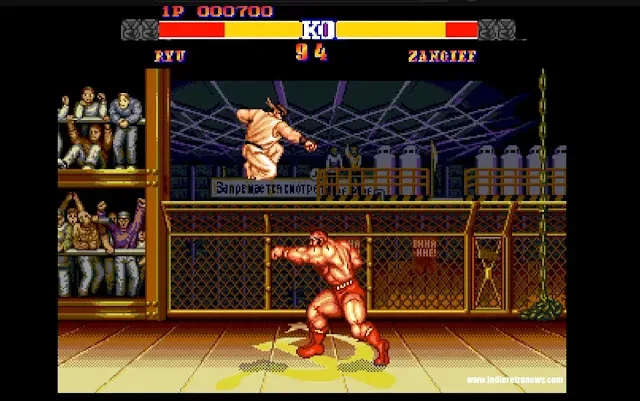
Street Fighter II may be one of the most widely remembered fighting games of its era, but its journey through home formats was never identical from one machine to the next. A new Commodore Amiga project from developer Str1der, created with AI assistance, is aiming to revisit that history with an enhanced version designed to sit closer to the arcade experience than the Amiga conversion released during the 1990s.
The work remains a development project rather than a fully detailed commercial announcement, and there is no release date, price, distribution method, or final feature list currently attached to it. What has been shared, however, gives retro hardware fans a clear idea of the ambition: improve the game's feel and presentation on original Amiga-class hardware while pursuing substantially smoother action than the machine's older official release.
Street Fighter II first became a phenomenon in arcades before arriving on a huge range of home systems. Its competitive one-on-one structure, recognizable cast, special moves, and demanding timing helped establish the language of the modern fighting game. That enormous popularity also meant that virtually every port carried high expectations, including versions for systems such as the Amiga, Atari ST, and ZX Spectrum. Hardware differences inevitably affected animation, sound, loading, controls, sprite handling, and overall speed.
An effort to move beyond the older Amiga conversion
The new project explicitly sets its sights on doing better than the US Gold-published Amiga port that players knew in the 1990s. That version was an important way for Amiga owners to experience Capcom's landmark fighter at home, but it also reflected the compromises common to conversions of a technically demanding arcade title. Reproducing large characters, animated stages, responsive combat, and recognizable audiovisual detail was a major challenge on home computers of the period.
For useful background on this topic, read Dragon Ball Rights Reportedly Forced Toei to Let Yu-Gi-Oh! Duel Monsters Move Forward.
Str1der's stated goal is not merely to run Street Fighter II on the platform again. The objective is to make it feel more in line with the arcade game, particularly in the areas that matter most in a fighting game: motion, speed, character scale, and immediate responsiveness. A fighting game can have familiar characters and stages, but if action appears sluggish or the game struggles to keep pace with player inputs, the experience changes significantly.
One of the most notable technical claims attached to the project is a target of 50 frames per second for an Amiga 68000 configuration using ECS graphics hardware, 1 MB of chip RAM, and 2 MB of fast RAM. That is an ambitious figure for a game whose appeal depends heavily on fluid visual updates and quick decisions. Whether the final build consistently achieves that target across all content, modes, and compatible configurations will be one of the key points to watch as development continues.
Hardware targets include ECS and AGA Amigas
The early specifications distinguish between several possible Amiga setups. For ECS machines, the listed baseline is an Amiga with a 68000 processor, ECS chipset, 1 MB chip RAM, and 2 MB fast RAM. The project is also described as running at full speed on an ECS-equipped 68020 system, or on a faster 68000 configuration such as one using an ACA500 expansion card.
That distinction matters because the Amiga family was not one fixed target. Different processors, chipset generations, memory arrangements, and accelerator hardware can change what a game is capable of doing. A program that works on a basic 68000 machine may benefit greatly from more processor speed and additional memory, while AGA systems can offer their own advantages over earlier ECS hardware.
For Amiga AGA hardware, the stated target is a 68020 processor, 2 MB chip RAM, and some amount of fast RAM. No exact fast-RAM requirement has been specified in the available information. Likewise, it is not yet clear whether ECS and AGA editions will differ in presentation, performance, content, or feature set beyond their respective hardware demands. Retro players considering the project should therefore treat the listed specifications as development targets rather than a final compatibility chart.
Wide sprites and a different visual approach
The project is also said to use wide sprites, with an approach intended to mimic the PC Engine television stretch. That is a particularly interesting design choice for a game like Street Fighter II, where the scale of the combatants contributes strongly to the arcade impression. Large, readable fighters are central to the visual identity of the series, yet they are expensive to move around a screen on older hardware.
Using a wider visual treatment may help the game present its characters with more of the presence associated with arcade fighting games. It also demonstrates that this is not simply a preservation-oriented effort to duplicate an existing Amiga release exactly. The developer appears to be exploring how the platform's display behavior and hardware capabilities can be used to make a more convincing interpretation.
There are still important unanswered questions around the exact implementation. No footage breakdown, detailed resolution list, palette explanation, control support overview, audio specification, or roster confirmation has been provided in the available details. As a result, it is too early to make precise comparisons between this version, the original Amiga conversion, and the arcade releases. The central promise is improved fidelity and speed, not a confirmed one-to-one reconstruction.
Why performance is the heart of the project
Street Fighter II is an unusually revealing game for hardware and programming choices. It is not enough for the background to resemble a familiar stage or for a fighter to have the right costume colors. Players notice timing immediately: the start-up of an attack, the moment a jump changes direction, the recovery after a missed move, and the response between a button press and a character action.
That makes a 50 fps target especially meaningful. Smoother updates can improve the visual impression, but the larger benefit is the potential for more coherent combat flow. The original arcade game's reputation was built around readable movement and fast tactical exchanges. Bringing an older home computer closer to that sensation requires balancing processor time, memory use, graphical complexity, collision checks, music or effects, and controller input without letting any one element undermine the rest.
The mention of full-speed play on a 68020 ECS system or a faster 68000 setup suggests that the project is conscious of the wide range of real hardware still used by the Amiga community. Some enthusiasts retain stock machines, while others use accelerators, memory expansions, and modern accessories. Supporting more than one performance level can make an ambitious retro release accessible to a broader audience, though final requirements and actual results will need to be demonstrated as the work progresses.
AI assistance is part of the development story
Str1der is developing the project with help from AI. The available information does not identify which tools are involved or explain precisely how AI is being used in the workflow. It would therefore be premature to assume whether that assistance relates to coding, conversion work, analysis, asset preparation, testing, documentation, or another aspect of development.
What is clear is that the project places AI assistance alongside traditional retro-development goals: working within strict memory budgets, understanding era-specific chipsets, and optimizing for processors that are decades removed from modern development environments. This combination is increasingly notable in the retro scene. Contemporary tools can potentially support experimentation and iteration, but producing convincing software for original hardware still depends on the practical limitations of the machine itself.
For players, the result will matter more than the workflow. The questions likely to define the project are straightforward: how close does it come to the desired arcade-style pace, which Amiga configurations can run it well, how broad is its content, and how polished does it feel in actual matches?
A promising project, with details still to come
The Amiga has long remained fertile ground for homebrew developers and hardware enthusiasts, and Street Fighter II is a natural candidate for re-examination. The game has historical importance, an instantly recognizable structure, and a prior Amiga version that gives this project a clear benchmark to surpass.
At this stage, the strongest takeaway is the scope of Str1der's technical ambition. An enhanced Street Fighter II designed for ECS and AGA Amigas, targeting 50 fps on a specified ECS configuration and full-speed play with stronger hardware, could become a compelling demonstration of what continued optimization and modern development assistance can bring to classic machines.
Until playable builds, more extensive demonstrations, and final specifications emerge, fans should keep expectations measured. But for Amiga owners who have always wanted a faster, more arcade-minded take on the famous fighter, this is a project worth watching closely.
Community
Discussion
Start the conversation.
No comments have been posted yet.