

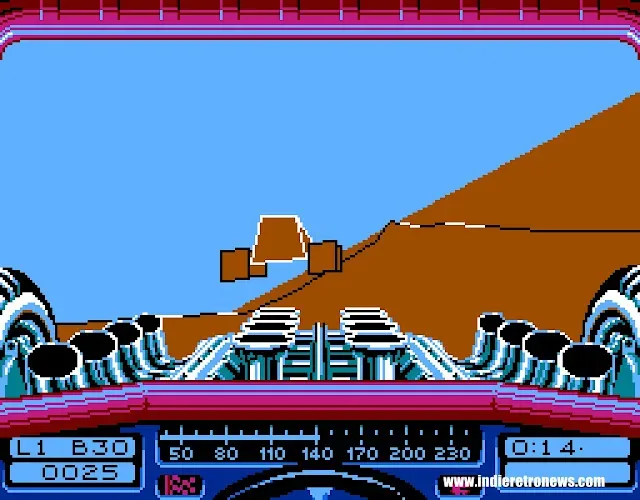
Stunt Car Racer, Geoff Crammond's celebrated and punishing stunt-racing game, has been brought to the Nintendo Entertainment System in an unofficial new port by developer cobbpg. The project is an especially striking technical undertaking because it attempts to preserve the game's fast, dangerous 3D racing identity on hardware better known for side-scrollers, platform games, and tile-based action.
The NES version combines elements from two classic editions of the game. It draws upon the code of the Commodore 64 release while adopting a visual presentation inspired by the more refined Amiga art style. Rather than being a simple conversion, the game has been substantially reworked by hand for Nintendo's machine. The result is an adaptation designed around the peculiar limitations and strengths of the NES, while still aiming to make the original's towering tracks, severe drops, and career-focused racing structure recognizable.
For retro players, that combination is the headline. Stunt Car Racer is not merely a game about finishing a lap quickly. It is a racing game built around nerve, precision, and learning how to survive elevated courses that can punish a single poorly judged crest or landing. Porting that sensation to the NES means confronting the challenge of presenting a filled-vector 3D world on an 8-bit console with limited graphics resources.
A 3D racer built to push NES hardware
The port uses an MMC3 mapper configuration with 256K of PRG-ROM, 16K of CHR-RAM, and 8K of WRAM. For those less concerned with cartridge specifications, that hardware arrangement is important because it gives the game room to handle its program data, actively managed graphical data, and saved progress. It is also part of the reason this project can attempt a version of Stunt Car Racer that retains such an unusually large driving view.
For useful background on this topic, read Tom the Postgirl Delivers Creepy-Cute Chaos on Switch and PC.
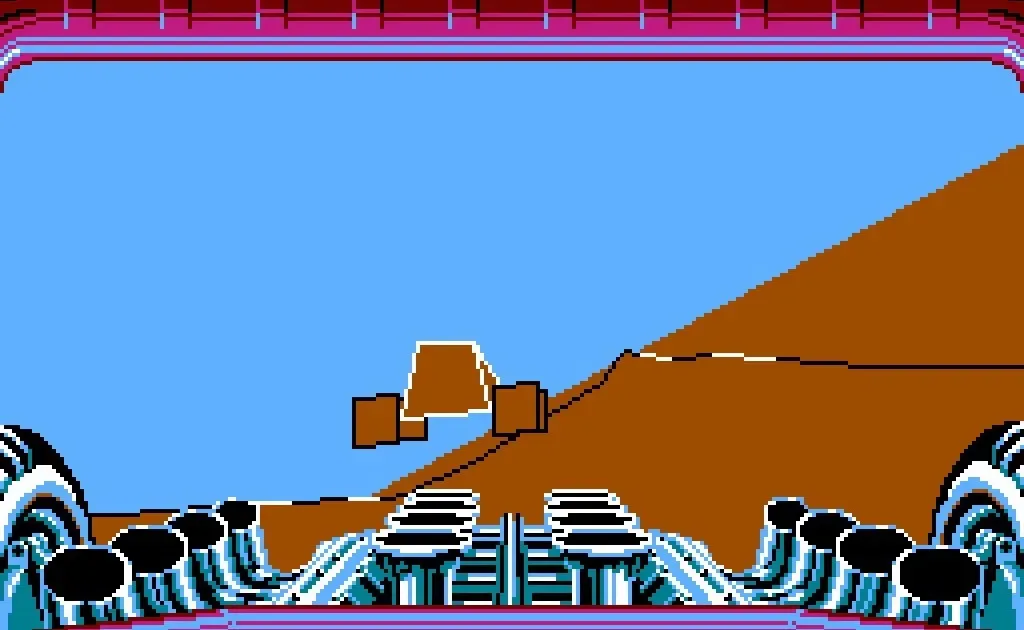
Its viewport measures 256 by 128 pixels and stretches across the full width of the screen. That choice was made to help preserve the look associated with the Amiga-styled artwork, creating a broad view of the track and the hazards ahead. In a game where drivers must read ramps, curves, gaps, and dramatic changes in elevation at speed, a wide view has obvious value. It gives players more visual context before committing to a jump or attempting to hold a line around a precarious section of roadway.
There is a trade-off, however. The full-width display can mean that the car's wheels are clipped on older CRT televisions because of overscan. This is a familiar issue with games that use more of the displayed image than some television sets reveal. Players using original display hardware may therefore see a slightly different image from those playing through emulation or on screens that expose the complete frame.
The game also dynamically allocates graphical tiles as they are needed. This approach is necessary to make a true 3D filled-vector presentation feasible on the platform, but it can be stressed by especially complicated scenes. When a frame contains many long, complex vectors, the game may temporarily exhaust the tiles available for that moment. When that happens, blocky artifacts can appear around the horizon.
Crucially, those visual imperfections are described as temporary rather than a gameplay failure. The game continues to run smoothly even when the horizon briefly becomes more abstract. In a project trying to render a large 3D course on NES hardware, that is a revealing compromise: cobbpg has prioritized keeping the race responsive and in motion instead of allowing a visually demanding frame to halt the action.
Separate versions for major regional standards
The release includes individually tuned versions for NTSC, PAL, and Dendy hardware configurations. That detail matters for a racing game, particularly one with elaborate timing-sensitive visual techniques and distinct regional video standards. Separate versions can account for the differences in timing and display behavior between those environments rather than expecting one build to serve every system identically.
Dendy support is a notable inclusion in its own right. Dendy-compatible environments have their own combination of regional characteristics, and accommodating them reflects the careful hardware-minded approach behind the port. This is not framed as a generic NES-inspired remake running on modern systems; it is a release built around the realities of the original console ecosystem and its variants.
The visual methods employed are cycle-exact, meaning their behavior depends on extremely precise timing. They have been extensively tested using the Mesen emulator, and the software is designed to support MMC3 chips made by Sharp or NEC. Those details offer useful reassurance to players planning to examine the game in emulation or with compatible cartridge hardware.
At the same time, there remains an important unanswered question for enthusiasts who play on vintage consoles. The port has not yet been benchmarked on original NES hardware. In other words, its real-world performance on an actual console has not been fully established. Collectors and hardware users who test it on an original NES may be able to provide valuable feedback on how the ambitious graphical work behaves outside the emulator environment.
The project embraces the challenge of large-scale 3D visuals on NES hardware while acknowledging the rare moments where the machine's available graphics tiles can be pushed beyond their limit.
The familiar climb through a brutal racing league
While the technical achievement is a major part of this release, the underlying game remains focused on its distinctive league progression. Drivers begin in a competitive racing ladder and must battle through four divisions in the standard league. Only after clearing that structure do they earn access to the much more severe Super League.
The career is organized around short four-race mini-seasons. Every compact season carries real pressure because the outcome can move a player upward into the next division or send them back down through demotion. That structure gives each race consequences beyond a single position on the results screen. A bad run is not just an isolated disappointment; it can affect the wider campaign and delay access to tougher competition.
That progression suits Stunt Car Racer particularly well. Its courses are hazardous, and success relies on becoming familiar with their shapes and traps. A player can know the basic controls and still lose a race by approaching a jump at the wrong speed, landing badly, or misunderstanding where a sharp change in elevation begins. The tracks demand more than raw reflexes. They reward repeated observation, disciplined driving, and the willingness to treat every crest as a possible disaster.
Among the memorable circuit concepts is the legendary Ski Jump, the kind of name that communicates exactly why caution is necessary. These are not conventional flat circuits. They are elevated raceways where the road itself can seem hostile, and where the visual drama of the landscape is inseparable from the driving challenge.
Practice before risking a promotion battle
To make that learning process more manageable, cobbpg's NES version includes a practice-run option between competitive seasons. The feature is presented as an essential preparation tool, not an afterthought. Before risking career placement in a four-race season, players can familiarize themselves with the upcoming courses and develop a better sense of braking points, ramp behavior, and the safest way to approach difficult sections.
That is especially welcome in a game defined by narrow margins. Practice allows a racer to make mistakes without immediately turning them into a demotion threat. It also keeps the game's central appeal intact: conquering a track should come from understanding it, rather than merely hoping that a dangerous jump works out during a crucial league race.
Progress saving designed for a long campaign
The port also supports persistence through WRAM, retaining both individual track-record times and overall career progress when the game boots. That is a meaningful addition for a mode built around multiple divisions and repeated attempts to improve. Players can return to their standing in the league rather than beginning the climb again every time they play.
WRAM write protection is used outside gameplay to help safeguard those hard-earned results. In practical terms, the design is intended to protect saved career advancement and time records when the game is not actively being played. For a high-score and progression-driven racing game, preserving that data is a key part of making the NES adaptation feel like a complete campaign rather than a brief technical demo.
As of October 29, 2026, cobbpg's Stunt Car Racer port stands as both a new way to experience a classic and an intriguing showcase for the NES homebrew scene. It does not hide the constraints involved in drawing a large, filled-vector 3D game on an 8-bit console. Instead, it works around them with mapper support, dynamically managed graphics, carefully targeted regional builds, and a willingness to let the occasional horizon artifact appear rather than compromise smooth play.
For fans of classic racing games, the appeal is easy to understand. The league ladder, practice sessions, record chasing, and intimidating elevated tracks are all central to what made Stunt Car Racer memorable. Bringing those elements to NES hardware is an ambitious proposition, and this version gives retro enthusiasts a new reason to revisit the perilous road to the Super League.
Community
Discussion
Start the conversation.
No comments have been posted yet.