

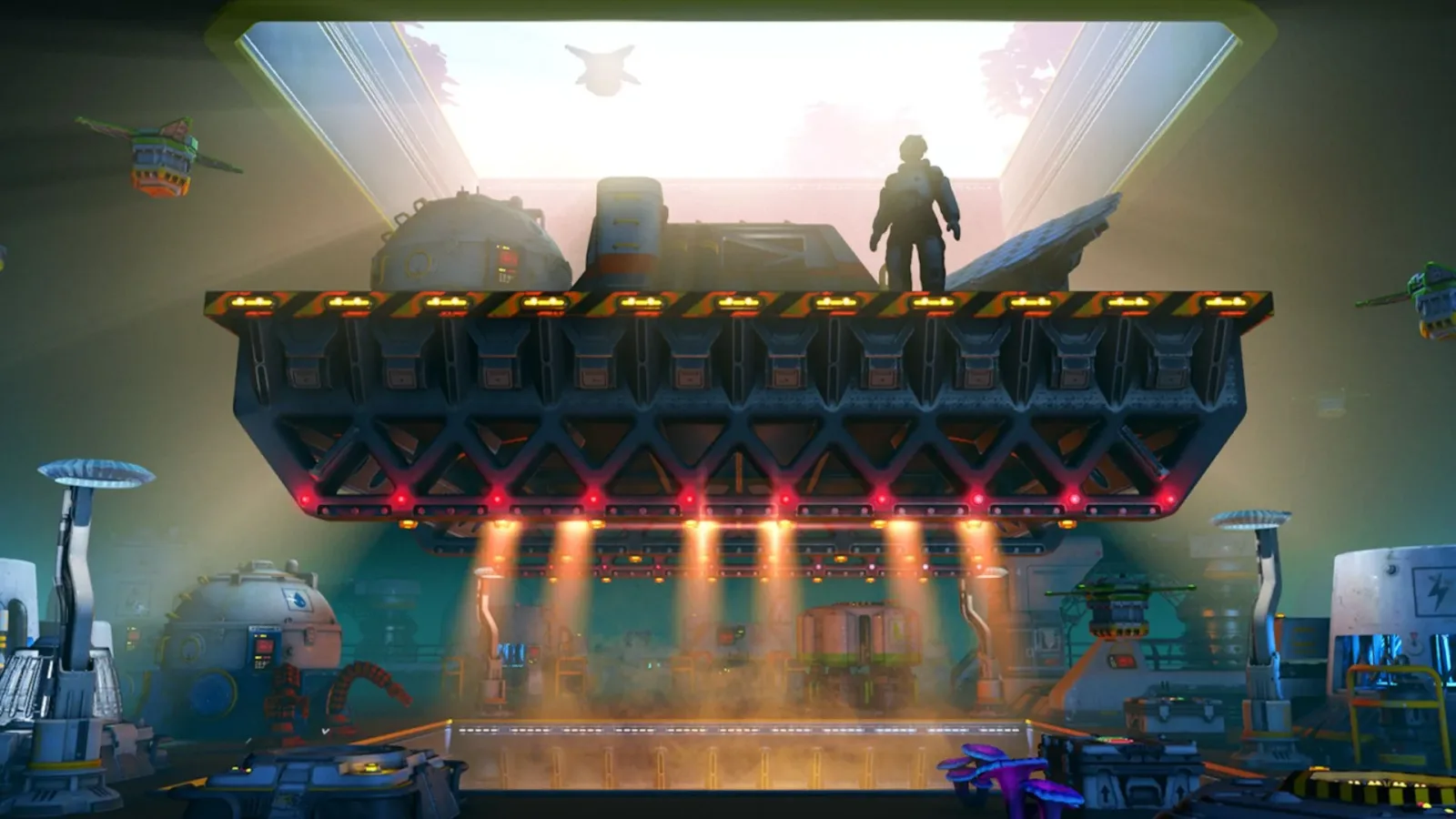
Substructure is setting out to make factory-game players think vertically. Developed by Dubious Design and published by Hooded Horse, the upcoming PC simulation game takes inspiration from an especially demanding corner of the automation genre: Factorio's celebrated Ultracube mod. But rather than simply reproducing that mod's defining production limitations, Substructure builds an entire planet-wide progression system around logistical pressure, environmental differences, and the need to move materials between increasingly hostile underground layers.
GamesRadar+'s Ali Jones reported on the game after seeing its opening hours, describing a production sandbox that begins with familiar gathering-and-automation foundations before rapidly becoming a far more involved exercise in planning. Substructure does not yet have a release date beyond TBC, but its central idea is already clear: every gain in scale creates fresh complications, and efficiency is not just about putting more machines on a belt.
From a rogue planet's surface to its unexplored core
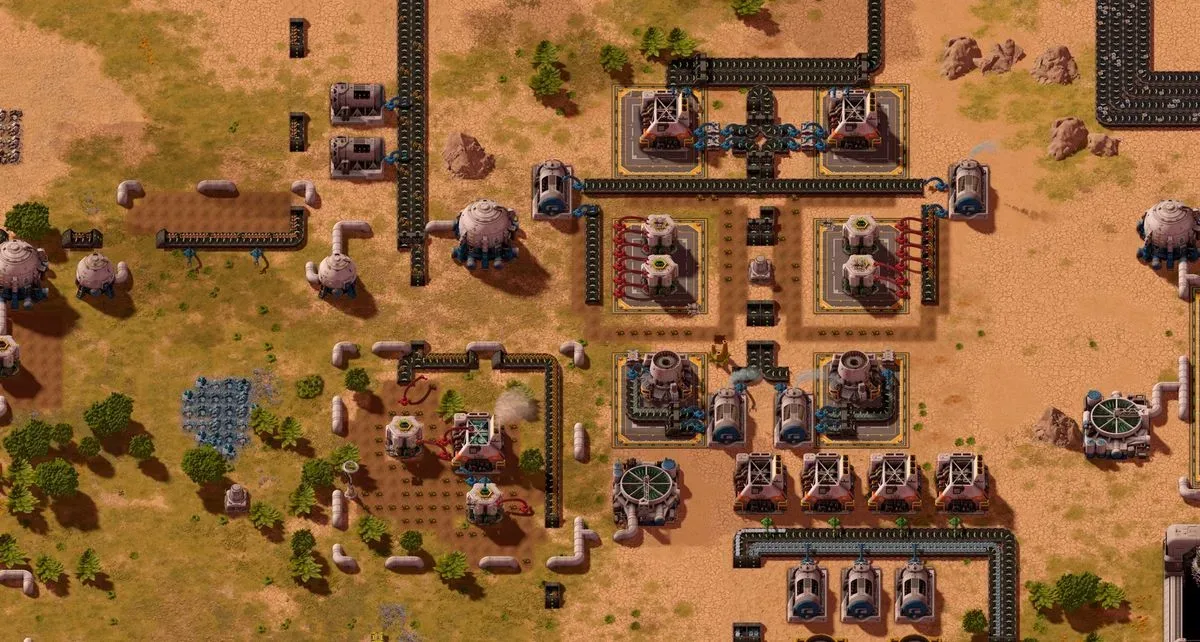
Substructure begins after a rogue planet enters the solar system. The player is sent to investigate it, landing on its surface and making use of the resources available around the initial site. Silica is among the first important materials, acting as a basic construction resource. It supports the machinery needed to exploit local fauna, which can then be turned into biofuel for more advanced structures.
That early loop has recognizable factory-sim DNA. Players expand extraction, establish processing chains, and steadily replace manual work with automation. Conveyors and robotic arms handle the movement and sorting of raw materials, fuel, and seeds, while replanting supports the growth of a wider industrial footprint. The goal is not simply collecting materials, but constructing systems capable of sustaining themselves while feeding the next stage of expansion.
However, the planet quickly introduces complications that make clear this will not be a straightforward surface-building game. One early material can only be mined at night and will disappear if it is not processed in time. That limitation immediately asks players to account for more than supply and demand. Timing becomes part of the factory layout, and a resource chain may fail not because the player lacks machines, but because the whole system is not ready when the material is available.
The deeper mystery is revealed when drilling opens the way beneath the surface. Rather than treating underground excavation as a minor extension of the starting map, Substructure makes it the backbone of its wider structure. Each descent exposes a new planetary stratum with its own atmosphere, materials, and industrial considerations.
A factory game built around layers
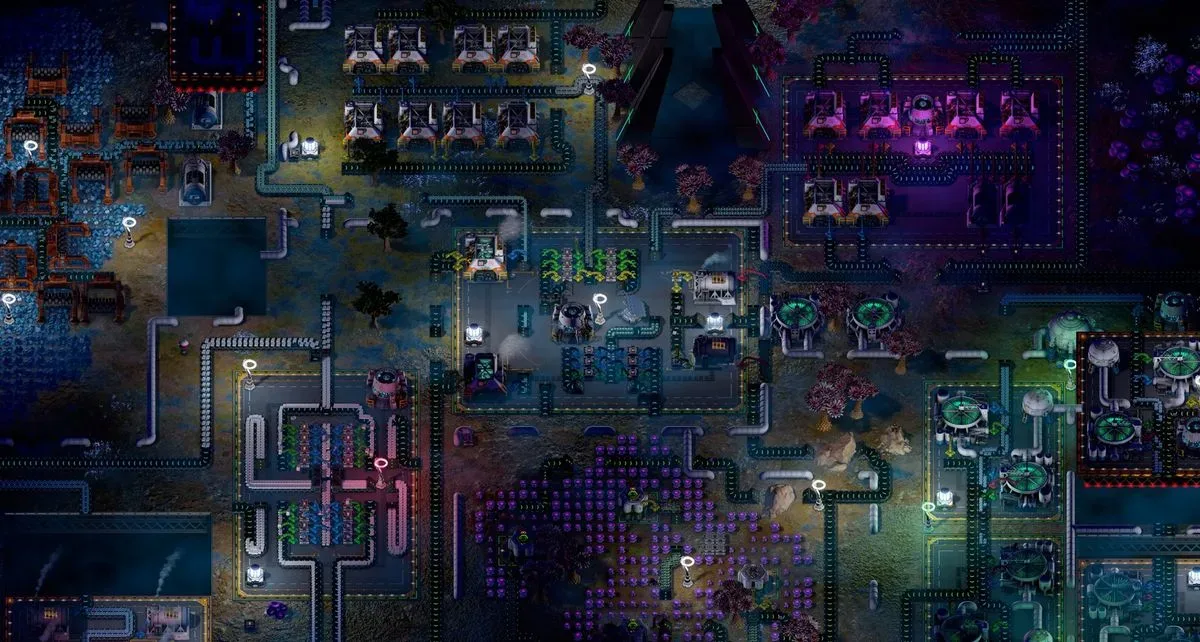
The first underground region is described as a dark, humid cavern filled with bioluminescent fungi. Further down, the conditions change again. Glowing crystals appear alongside increasing toxicity, creating a harsher environment than the layers above. Dubious Design has also indicated that the journey will continue toward the planet's core, where players may uncover more evidence that the world was not always as deserted as it appears on arrival.
That sense of discovery gives Substructure an exploration component, but the game's deeper layers are not merely destinations. They are active parts of a single sprawling production network. Resources found far below may be essential for surface expansion, while materials processed in sunlight may need to travel down again for another manufacturing step. The player is therefore constantly managing a factory that crosses several different climates and heights rather than operating on one flat map.
Drills are central to this arrangement. They do more than punch passages into the ground; they enable the construction of large elevator shafts. Those elevators are the critical connective tissue between regions, carrying supplies and outputs across the depths of the planet. An operation at one level is only as effective as the infrastructure that allows it to exchange goods with every other level that depends on it.
In practice, that makes vertical transport a production puzzle in its own right. An elevator can become a moving industrial platform, traveling between layers to exploit the qualities of each environment. Rather than always assigning a machine to a fixed location, players may need to consider what happens when production itself changes elevation.
Catalysts make location and timing matter
Substructure's environmental catalysts are a major reason those elevators matter. The game uses conditions such as sunlight and darkness to affect production speed. Plants in fields, for instance, can grow faster in sunlight and slower without it. That means a player cannot necessarily judge a production chain only by its recipe ratios or the speed of a conveyor line. They also need to think about where a process occurs, when it occurs, and whether a moving elevator should pause at a specific threshold before it continues its journey.
As systems expand, these interactions could turn a simple transport route into a carefully controlled timing mechanism. A player might need to decide which goods should be produced at the surface, what can be processed below, how much material an elevator should hold, and where output should be directed once the lift reaches another level. The result is a type of factory optimization that is as concerned with environmental context as it is with throughput.
This is where the comparison to Ultracube is particularly useful. The Factorio mod is known for making a single core constraint reshape the usual logic of automation. It asks players to navigate bottlenecks and plan around restrictive production conditions. Substructure takes that spirit and spreads it across a much bigger setting, with a multi-level planet creating natural separation between resources, machines, and useful environmental effects.
The game's intended challenge is not hidden. Jones noted that even after seeing only three of the planet's levels, the quantity of linked systems was enough to feel mentally overwhelming. That response is understandable given the number of concerns involved: surface agriculture, power, time-dependent mining, subterranean materials, elevator scheduling, different climates, and the need to route everything to the correct destination.
Dubious Design wants complexity, but not needless complication
Despite Substructure's dense web of ideas, Dubious Design's co-founders Mike Donoghue and Stu Taylor told GamesRadar+ that the team actively resists adding systems simply because they are complicated. The aim is to introduce concepts progressively, allowing players to understand the game through use rather than stopping the experience for lengthy interruptions or direct instruction.
The studio's internal approach is described as "all game." In other words, the path to understanding should happen inside the act of playing. Players are expected to encounter problems, experiment with solutions, and eventually recognize how the game's rules fit together. That philosophy aligns naturally with automation games, where one of the central pleasures is identifying the source of a bottleneck and redesigning a system until it works.
"You need friction for it to be interesting," Taylor told GamesRadar+, while Donoghue emphasized the satisfaction people get from solving challenges and feeling they have genuinely achieved something.
That perspective is important because Substructure's systems appear deliberately capable of frustrating players. Time-sensitive resources can expire. A useful catalyst may exist on a different layer from the material that needs it. An elevator's route may be the difference between smooth production and a stalled chain. The developers do not appear to view these obstacles as flaws to be removed, but as the source of the eventual reward when a difficult arrangement finally clicks into place.
Donoghue's description of the team's approach suggests that the game wants players to earn mastery through indirect guidance. There may be no single moment where Substructure declares that the player has learned an advanced concept. Instead, they may realize it after solving a problem that initially seemed impossible: restructuring an elevator network, moving an assembly process to a better climate, or finally stabilizing a resource chain that has been collapsing every night.
A promising new direction for factory-sim fans
Factory games have long been built on escalation. What starts as a handful of manually supplied machines grows into an enormous system of belts, pipes, arms, trains, power lines, and specialized processing. Substructure seems ready to preserve that appeal while changing the geometry of the problem. Its factories are not just spreading outward across a landscape; they are descending through a world with multiple distinct zones, each contributing its own restrictions and opportunities.
That vertical design could give the game a particularly strong sense of scale. A successful network is not merely a base, but a connected industrial organism reaching from a sunlit surface into fungal caverns, toxic crystal regions, and eventually the planet's core. At the same time, the rogue planet's history gives the progression a narrative undercurrent. Players are not only chasing better materials, but investigating a place that seems to hold secrets beneath its empty exterior.
Substructure is currently confirmed for PC, with Hooded Horse publishing and a release date still listed as TBC. Based on the details shared with GamesRadar+, it is shaping up as a factory sim for players who enjoy not just expanding production, but untangling the difficult consequences of that expansion. Its belts and robotic arms may be familiar, but its real ambition lies in making every layer of a planet part of the same intricate machine.
Community
Discussion
Start the conversation.
No comments have been posted yet.