

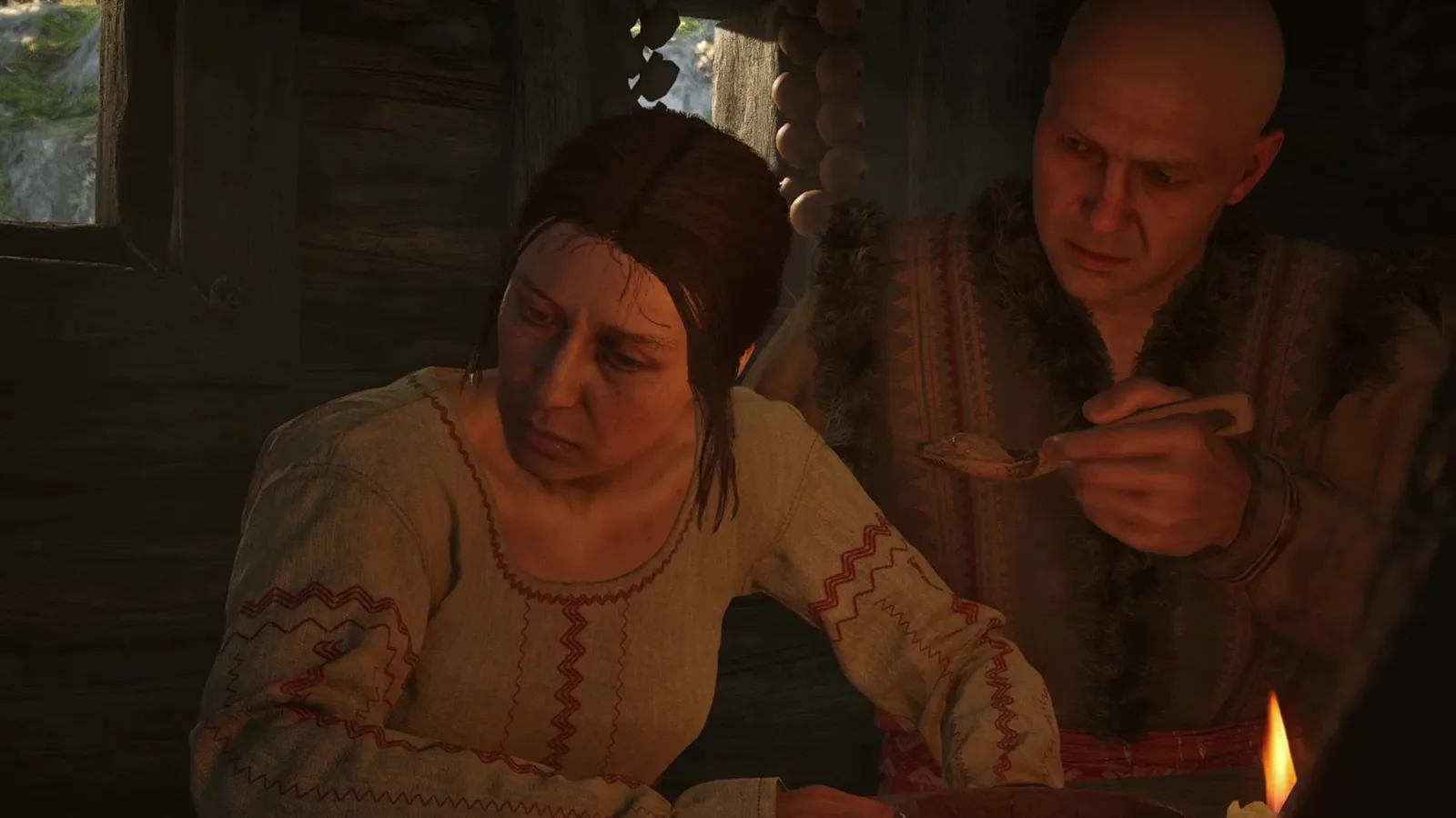
One of the first major dialogue decisions in The Blood of Dawnwalker puts players in an especially uncomfortable position. Coen's mother, Esme, has stopped eating, and his father Pieter believes that keeping her strength up is essential. The family is under enormous pressure: Brencis, the vampire overlord, reportedly takes a harsh view of perceived weakness. Pieter therefore moves toward trying to make Esme eat, leaving Coen to decide whether to participate or refuse.
According to GamesRadar+ writers Joel Franey and Oscar Taylor-Kent, players should generally choose not to force feed Esme. The recommendation is not based on a hidden reward, different quest branch, or a clearly better long-term mechanical result. Rather, the source reports that both major responses reach the same practical destination. Esme does not successfully eat if Coen attempts to force the issue, and Coen is sent to seek medicine for her regardless.
That makes this a choice driven more by role-playing and emotional tone than by progression efficiency. If players want to avoid putting Coen through an upsetting scene without losing access to the next part of the story, refusing to feed Esme against her will appears to be the straightforward answer.
The choice: force Esme to eat or respect her refusal
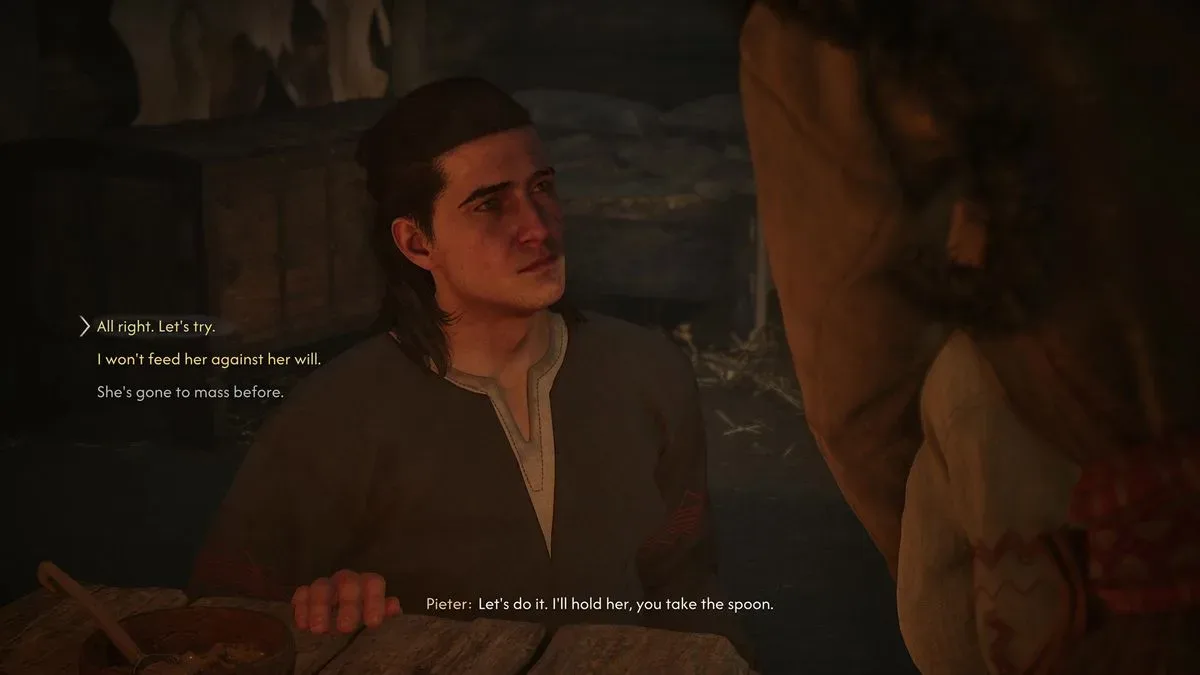
When Pieter resolves to intervene, Coen is presented with three dialogue responses:
- "All right. Let's try."
- "I won't feed her against her will."
- "She's gone to mass before." This is optional.
The third answer may initially sound like a way to redirect the conversation toward Esme's past behavior or condition. However, GamesRadar+ says it does not create a separate route through this scene. Selecting it simply returns the player to the central decision between helping Pieter try to feed Esme and refusing to do so.
In other words, the optional Mass response is useful only as extra dialogue context. It should not be treated as a hidden compromise or a way to bypass the moral choice. Players eventually need to select either the first response, agreeing to try, or the second response, declining to feed Esme against her wishes.
What happens if you choose to force feed Esme?
Selecting "All right. Let's try" leads into the difficult version of the sequence. Coen and Pieter attempt to get food into Esme despite her refusal. But the attempt does not resolve the crisis: Esme struggles and knocks the food away.
The immediate result is important for anyone worried that choosing compassion will somehow leave Esme in worse condition. The reported outcome indicates that agreeing to force feed her does not result in Esme being nourished, stabilized, or otherwise saved by that decision. The coercive approach fails in the moment, even though it may be motivated by Pieter's fear of what will happen if she remains visibly weak.
It is also the more distressing scene of the two. The game's premise has already placed Coen's family in a grim situation, with the threat of Brencis hanging over their lives. Choosing to take part in forcing Esme to eat intensifies that conflict, but it does not appear to unlock a different immediate practical solution.
What happens if you refuse to force feed her?
Choosing "I won't feed her against her will" avoids the attempted feeding sequence. Coen refuses to participate in making Esme eat when she does not consent to it.
Based on GamesRadar+'s comparison of both choices, this response does not impose a meaningful gameplay penalty. The story still moves toward the same need: Esme requires medicine, and Coen must go obtain it. There is no reported loss of a vital quest, alternate failure state, or different long-term consequence tied to refusing Pieter's plan.
That is why refusing is the recommended response. It reaches the same stated next objective while sparing players--and Coen--the unsuccessful attempt to compel Esme to eat. For players making decisions based on Coen's character, it also provides the clearest way to prioritize Esme's agency during a frightening family crisis.
Does this decision have long-term consequences?
GamesRadar+ reports no real difference in consequences between the two main options, based on playing through both outcomes. In each version of the scene, Esme ends up not being fed, and Coen is sent to obtain medicine. The short-term narrative beats and the subsequent objective therefore converge.
That does not necessarily mean every line of dialogue is identical or that the scene has no emotional significance. Dialogue choices can still shape how players interpret Coen, Pieter, and the wider situation in The Blood of Dawnwalker. Pieter's determination comes from concern for Esme's survival and fear of Brencis, while Coen's refusal can read as a moral boundary in a situation where every available answer is painful.
But for players primarily looking for a gameplay answer, the source's conclusion is clear: there is no apparent practical benefit to agreeing to force feed Esme. Since the food is rejected either way and the medicine objective follows either way, the refusal option is the less upsetting path without a reported downside.
Best answer: "I won't feed her against her will"
If you want the direct recommendation, choose "I won't feed her against her will."
This response avoids an unsuccessful and upsetting attempt to force Esme to eat. It also does not, according to the reported comparison, stop the story or deny Coen the next step in helping his mother. The quest continues with the need to find medicine.
Players who select "All right. Let's try" should not worry that they have ruined their playthrough. The reported outcomes converge, so there is no indication that this early choice locks the player into a worse quest route or prevents the medicine-related progression. It is chiefly a role-playing decision, and players can choose the answer that best suits their interpretation of Coen under pressure.
Why Pieter wants to do it
The context makes the choice more complicated than a simple disagreement between family members. Esme is refusing food, and Pieter fears that her weakness will draw Brencis's anger. Brencis is described as a vampire overlord who does not look kindly on weakness, turning Esme's health into a matter of danger as well as care.
Pieter's decision to try force feeding Esme is therefore framed as desperation. He is not merely impatient with her; he is trying to preserve her strength in an environment where the family appears to believe that vulnerability can have severe consequences. Even so, the scene asks whether fear of an outside threat can justify overriding Esme's wishes.
The fact that the attempt fails regardless reinforces the tragedy of the moment. Pieter's urgency does not produce a solution, while Coen's refusal does not immediately cure Esme's condition. The actual path forward is medicine, which is why both dialogue choices ultimately point the player toward the same task.
What to do next after the Esme scene
Once this decision is complete, Coen's focus shifts to securing medicine for Esme. Players still in the opening hours may also encounter other early objectives and decisions referenced by GamesRadar+, including what to do before Mass, locating a banner for Gremla, and brewing medicine using a recipe taught by Anca.
There is also a separate decision involving Anca when she suggests waiting out a storm. Those situations are distinct from the Esme feeding scene, so the outcome described here should not be assumed to apply to every early dialogue choice. The important takeaway for this particular moment is that the apparent moral fork does not seem to become a progression fork.
Final verdict
Do not force feed Esme in The Blood of Dawnwalker if you want to avoid the harshest version of the scene. Choosing to refuse does not, based on GamesRadar+'s playthrough of both paths, create a worse result. Esme rejects the food if you try to force the issue, and Coen is sent to find medicine whichever major answer you select.
The optional line about Esme having gone to Mass before does not offer a third outcome, as it loops the conversation back to the two main responses. So, for the cleanest and least distressing resolution, tell Pieter: "I won't feed her against her will."
Community
Discussion
Start the conversation.
No comments have been posted yet.