

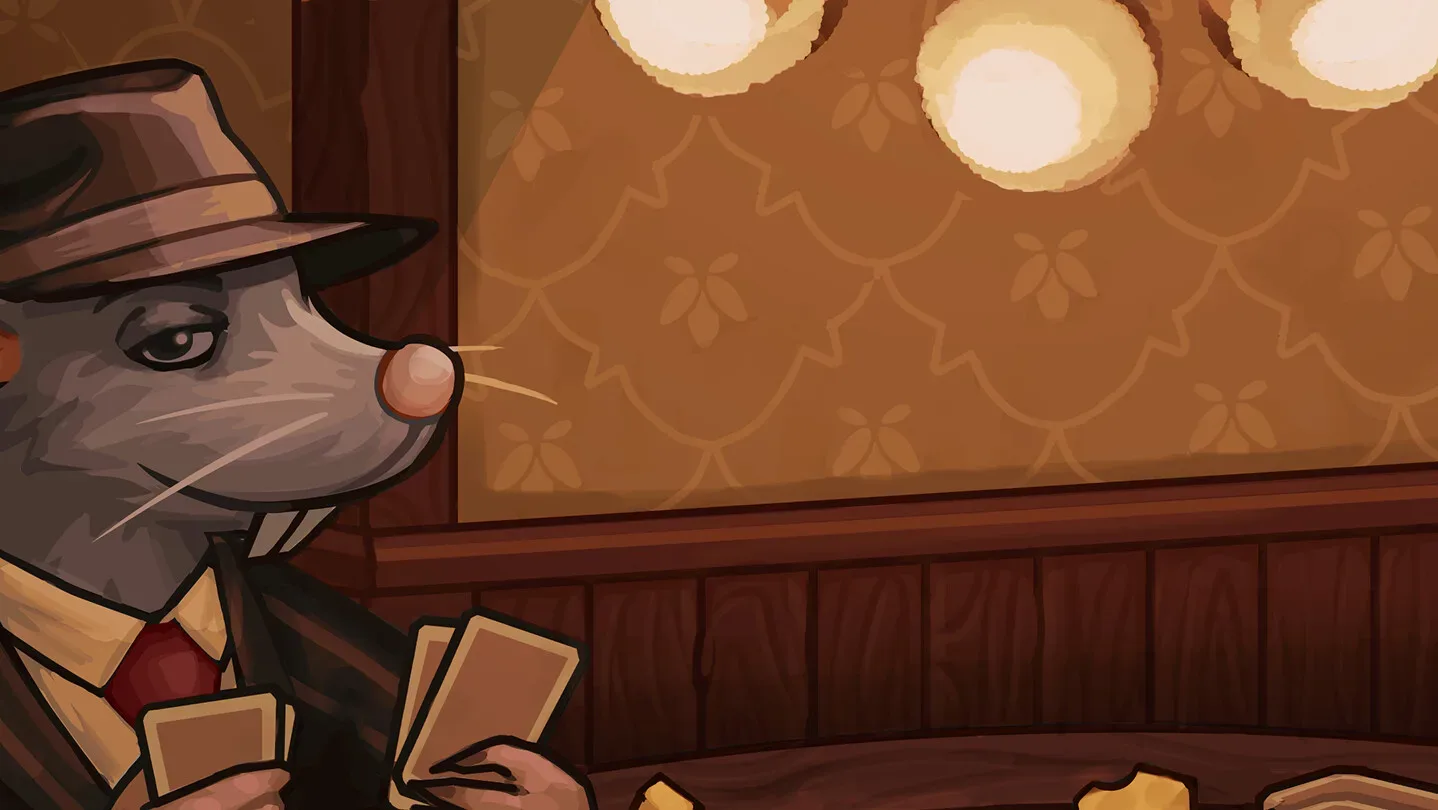
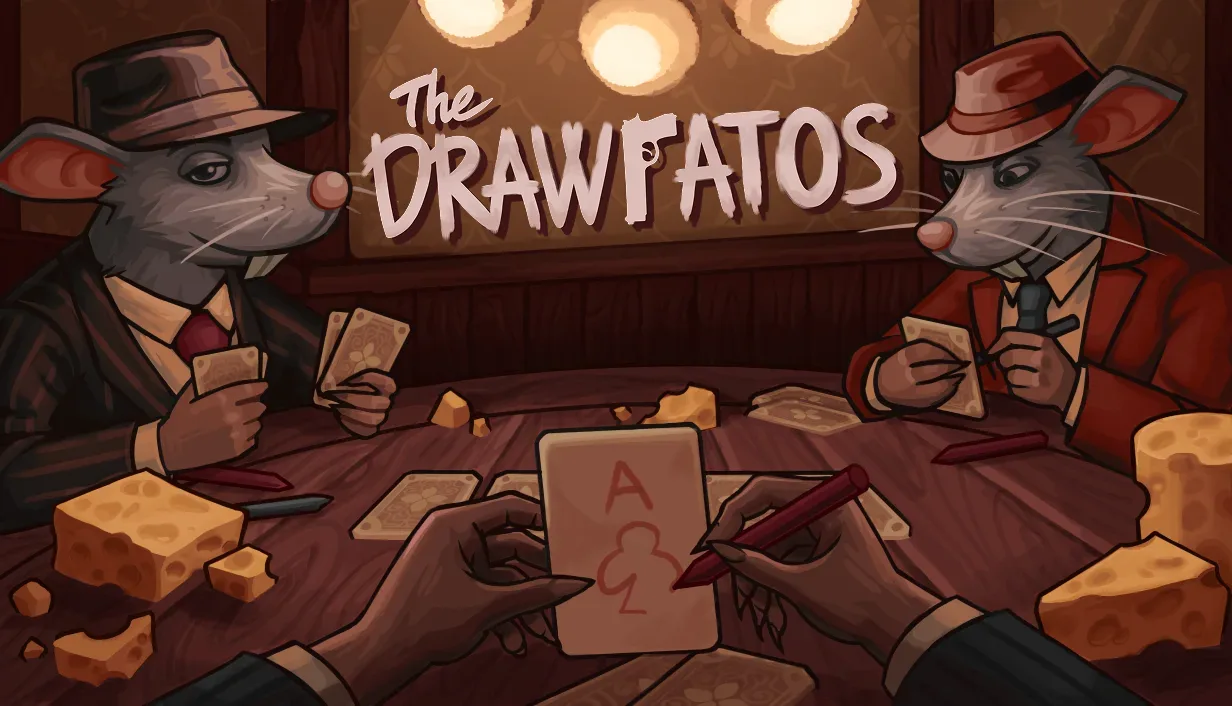
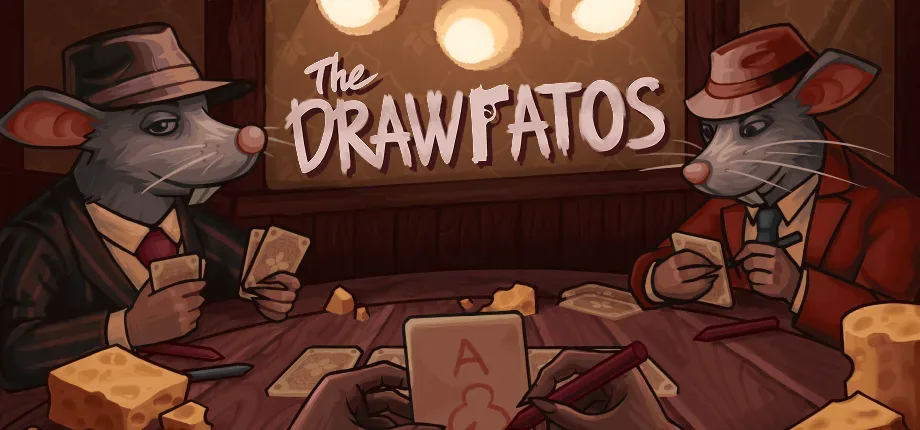
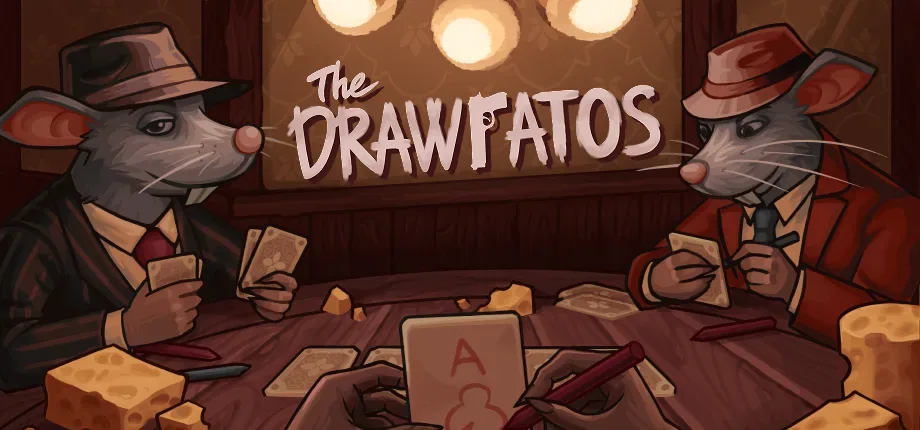
The Drawratos is bringing a deliberately unruly twist to the familiar language of poker. Announced by indie publisher Targem Games and developer Sliva Group, the upcoming game supports up to four players and makes the cards themselves central to its trickery. Rather than treating a dealt hand as fixed, players can draw directly onto cards to alter suits or ranks, create different combinations and complicate every assumption at the table.
The game is planned for Steam, and its core pitch is less about playing a pristine game of cards than bending one into something unstable. A hand may begin with the usual logic of poker, but that logic can change when someone modifies a card at the right moment. The result is a multiplayer card game where bluffing is not simply about concealing information: it can also involve visibly and strategically changing the pieces everyone is trying to read.
That premise gives The Drawratos a strong identity. Poker games are generally built around limited information, probability, betting and the ability to judge other players. The Drawratos retains the importance of hands and stakes, but adds a creative layer that lets players interfere with the underlying deck. Players can use drawings to strengthen their own position, throw rivals off balance or set up a scam intended to take their cheese.
Cards are meant to be altered mid-hand
The defining mechanic in The Drawratos is the ability to draw on cards during play. Drawing is not presented as a cosmetic feature. It can change a card's suit or rank, which means it can potentially transform the value of a hand and open routes to combinations that were not available from the original deal.
For useful background on this topic, read Demidoff Corp Announced as a Folklore-Fuelled 2D Soulslike Metroidvania.
This creates a very different tension from conventional poker. In a normal match, players have to work within the cards they receive and the choices made through betting, folding or raising. Here, a player may be able to reshape the hand itself. That means opponents need to pay attention not only to the visible cards, betting behavior and possible combinations, but also to how the board state could be edited before the hand is resolved.
Sliva Group describes cards as the main tools for deception. Players will be able to change them mid-hand, bluff, confuse opponents and improve their own prospects. The game also frames those changes as opportunities for trickery rather than as straightforward upgrades. A drawn alteration could make a powerful hand obvious, but it could also be used to create uncertainty, lure another player into a bad decision or disguise a more elaborate plan.
The announcement does not detail every limitation governing card changes. It remains unclear, for example, how often players can draw, what resources may be required, whether every alteration can be challenged, or how the game determines the final state of a heavily modified card. Those details will likely matter greatly to the game's balance, since the appeal of editable cards depends on players having room for clever plays without turning every hand into pure chaos.
For another perspective on this story, read The Drawratos Announces Four-Player Poker Built Around Drawing on Cards.
Cheese is the currency at the table
The Drawratos uses cheese as its betting currency. Players are not merely trying to assemble the best cards; they are putting cheese at risk and trying to leave the table with more than they brought in. The announcement emphasizes that the stakes can swing sharply, with a player able to lose everything in a single hand.
That all-or-nothing possibility fits the game's emphasis on scams, confidence plays and sudden reversals. A carefully altered card may become the centerpiece of a successful bluff. On the other hand, a player who commits too much cheese based on an assumption about another hand could discover that the apparent rules of the round were never as stable as they seemed.
Cheese also gives the game a playful character that separates it from a straight poker simulation. The Drawratos is clearly using the framework of betting-card games, but it is not positioning itself as a strictly traditional recreation. Its central fantasy is a social contest of improvised manipulation: players are encouraged to test each other's trust, exploit confusion and pursue risky opportunities when a hand can be rewritten.
Cooperation, competition and shifting alliances
The Drawratos is described as a cooperative poker game for as many as four players, yet its stated gameplay is packed with competitive pressure. Players can outwit opponents, take rivals' cheese and attempt to make off with the table's rewards. The apparent contradiction is part of the intrigue. The game's cooperative element seems to be tied to the social and tactical dynamics of a shared match rather than a promise that every participant will always have identical goals.
Alliances can shift during games, suggesting that temporary partnerships will be an important part of play. One player may benefit from helping another frustrate a third rival, only for that partnership to dissolve once the cheese becomes the focus. This sort of unstable cooperation can make multiplayer card games memorable because table talk, perceived loyalties and opportunistic decisions become just as important as the technical value of a hand.
With a maximum of four participants, The Drawratos is aimed at a compact group rather than a large online lobby. That scale should keep every player involved in the same evolving round, where each mark on a card and each wager can affect the social balance. For groups that enjoy party-game mischief alongside card-game strategy, the promise is not simply to win through calculation. It is to make other players doubt what they are seeing and whether a deal remains trustworthy.
The announcement does not specify whether The Drawratos will include solo options, bots, matchmaking formats, private rooms or additional multiplayer modes. It also does not outline how rounds are structured beyond the use of cheese as a stake. For now, the confirmed focus is a four-player experience built around editable cards, bluffing and the possibility of a dramatic loss.
A playtest is on the way
Targem Games is inviting interested players to join an upcoming playtest through The Drawratos Steam page. The playtest is set to begin shortly, though a specific start date has not yet been announced. Players who sign up will receive a notification when the test becomes available.
Participants are also encouraged to bring friends, which is especially relevant given that the game supports up to four players. A card game based on shifting alliances and deceptive edits is likely to show its intended personality most clearly when a full group is experimenting with its systems together. Early players may have an opportunity to discover which approaches work best when everybody at the table can alter the expected outcome of a hand.
There is no content embargo attached to the playtest. Players who gain access are free to stream their sessions, record gameplay videos and publish reviews. That open approach should make it easier for curious players to see how the drawing mechanic works in practice before the game's broader release plans are detailed.
What makes The Drawratos worth watching
The Drawratos has a simple hook that could produce complicated matches: poker cards are no longer sacred objects with unchangeable values. They can be drawn on, manipulated and used as instruments of misdirection. That idea directly attacks one of poker's most fundamental assumptions, creating space for a game in which rule-bending is not a cheat or an exception, but the entire point.
Its success will depend on the exact boundaries around that freedom. The best multiplayer deception games give players enough tools to surprise each other while still making those surprises understandable in hindsight. If The Drawratos can make card alterations feel mischievous, readable and strategically meaningful, it could offer a distinctive alternative for groups looking for a social card game with more volatility than a normal poker night.
For now, the confirmed details are focused on Steam, four-player matches, editable cards, cheese betting and a forthcoming public playtest. Players interested in seeing how the game handles its unusual mix of cooperation, rivalry and drawn-on card manipulation can register through its Steam page and wait for the playtest notification.
Community
Discussion
Start the conversation.
No comments have been posted yet.